
RITA DI SANTO contemplates two films about journalism that opened this year’s festival


‘When America was having a nervous breakdown’
SETH SANDRONSKY recommends a production that looks back at the political Tinseltown in the mid-1970s when US cinema ‘didn’t pander to trends’
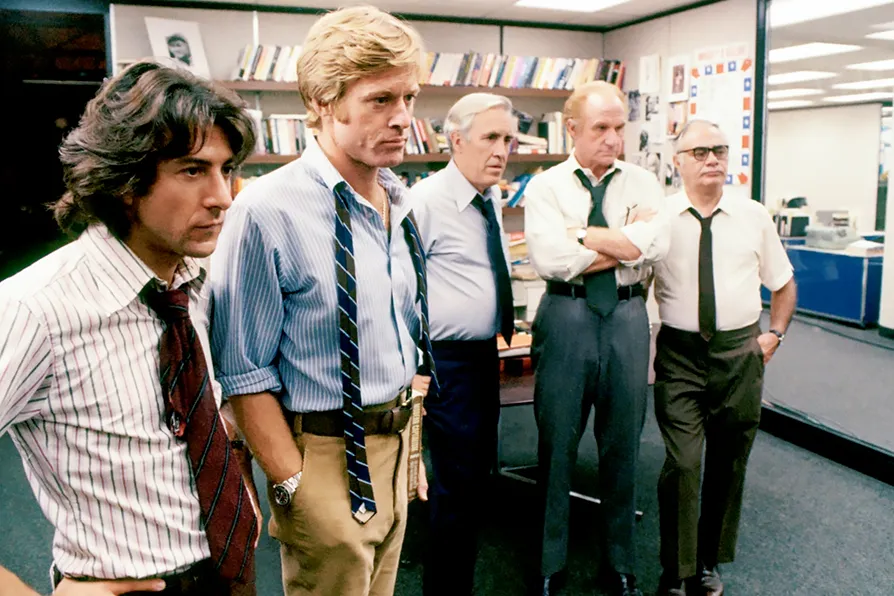
 PRECIPITATING NIXON’S DOWNFALL: Dustin Hoffman, Robert Redford, Martin Balsam, Jason Robards, and Jack Warden at the Washington Post in All the President's Men (1976)
GEOFF BOTTOMS applauds a world-class production King Lear that pits late feudalism against a rising bourgeoisie
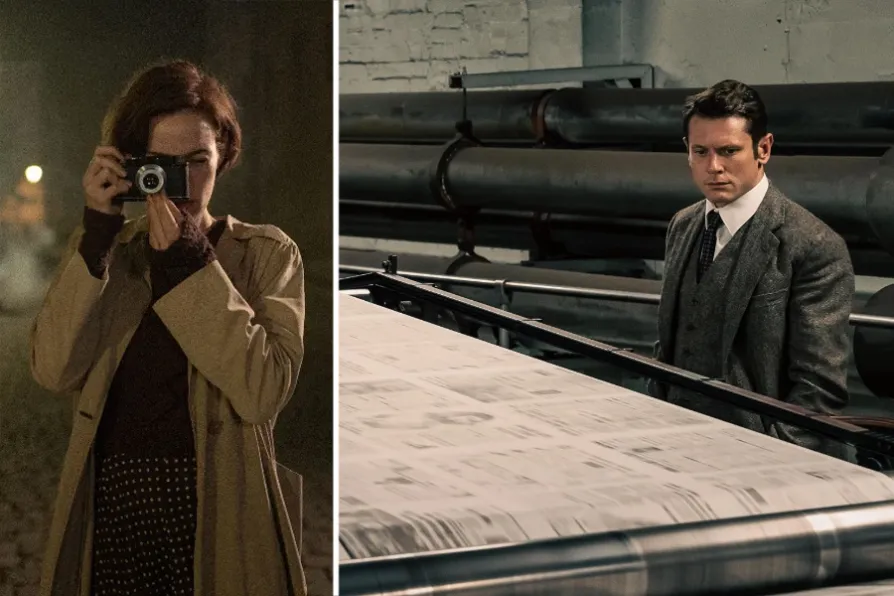
MARY CONWAY keeps up with the sheer pace of a drama about the terrible gap between sanitised reporting and real-life turmoil of race and gender
New releases from Brian Fallon, Antony Szmierek and Hollow Hand
APURBA CHATTERJEE explains how British artists in India used the “picturesque” to reshape colonial landscapes and celebrate imperial power
PAUL DONOVAN welcomes a revival of Reginald Rose’s classic play that reminds us of the fundamental need for trials with juries





BREAKDOWN: 1975 is a Netflix documentary highlighting US politics and society via popular films of that year, but also years before and after, as critics note, correctly. Morgan Neville is the director and producer. Jodie Foster narrates.
I select a few of these films and characters below to give readers a flavor of Tinsel Town’s political-social vibe.
One influential factor is President Richard Nixon’s resignation amid the Watergate scandal, a failed cover-up of a break-in at the headquarters of the Democratic National Committee, which was retold in Alan J Pakula’s All The President’s Men. “Tricky Dick,” born a Quaker, rode anti-communism, a popular ideology in the US, to the highest office in the land before his fall from power.
Another related factor is the US humiliation at the Vietnam war’s end. The failure to militarily defeat the enemy in Vietnam resulted in widespread revulsion against what president Eisenhower termed the military-industrial complex, a bipartisan creation of the political duopoly benefiting war corporations in all 50 states. A military draft also powered such revulsion.
Nixon’s disgrace and the US loss in Vietnam helped to set in motion the demise of a postwar economy. US’s global economic supremacy with strong labour unions faded in the face of German and Japanese corporate competition.
Deindustrialisation and financialisation followed. Income and wealth flowed from the bottom and middle to the top. Class inequality grew and grew.
The political-social turmoil of the mid-1970s spurred some in the film industry to question the legitimacy of US exceptionalism. That viewpoint exposed a gap in the reality and rhetoric of freedom and democracy in practice at home and abroad. Belief in the official sources weakened, as Network, a film that Sidney Lumet directed and Neville examines, expresses.
Into that gap of questioning authority stepped independent film production in the mid-1970s. This move partly reflected the weakening of ruling class indoctrination of anti-communism and Jim Crow segregation. As I see it, anti-war, civil rights/black power and feminist movements of the 1960s fueled cinematic spaces for independent perspectives.
Breakdown: 1975 features in part comments from actors, critics and directors. For example, Ellen Burstyn, Martin Scorsese and Oliver Stone weigh in on films, many of which involve firearms, from a half-century past. Embroiling the US in a society of perpetual war, violence is, well, as American as cherry pie.
Some of the films and directors in the documentary range from Chinatown (Roman Polanski) to One Flew Over the Cuckoo’s Nest (Milos Forman) and Taxi Driver (Martin Scorcese).
Two actors, Jack Nicholson and Robert DeNiro, embody the shifting characteristics of a national mood.
In Chinatown, Nicholson plays a private investigator, Jake Gittes, who uncovers a secret deal involving a big water source to develop Los Angeles. To say he finds corruption at the highest social-political level is a misstatement. Nicholson’s character discovers that extraction and exploitation are the normal operations of a capitalist social order.
DeNiro’s character, Travis Bickle, a Vietnam veteran, drives a taxi through the streets of NYC, meeting a wide swath of urban society. Loneliness haunts him behind the wheel in his metaphorical steel coffin.
A car-centric social order spawns a taxi driver alienated from himself and others. As Bickle spirals downward, he acts out in front of a mirror: “You talking to me?”
Mistrust and distrust rise, individually and socially. “Paranoia was rampant,” Foster narrates. That’s understandable given the loss of official legitimacy in the mid-1970s. If one can’t believe so-called leaders, who can one trust to tell the truth? The question finds expression in these films.
“Maybe there’s another CIA inside the CIA,” Robert Redford’s character says in Three Days of the Condor, which Sidney Pollack directed to box office success. Such an observation seems quaint a half-century later in the digital era, not the case in 1975.
Bickle’s individualism foreshadows its elevation to an integral piece of neoliberal capitalism. Possessive individualism in practice and theory constricts people to their personal lanes, avoiding solidarity with others. In this way, alienated labour can pursue personal interests. This pursuit tends to reject collective actions like labour unions.
Revolutions spur counter-revolutions. So swings the pendulum. Breakdown: 1975 reveals part of that swing in Tinsel Town.
Breakdown 1975 is on Netflix. Seth Sandronsky is a Sacramento journalist and member of the freelancers unit of the Pacific Media Workers Guild. Email sethsandronsky@gmail.com

Similar stories
STEVE JOHNSON savours a singing legend who stayed true to her working-class origins

Rereleases from Nazareth, and The Strawbs, and a fine collection of covers and new songs from Grey DeLisle & Les Greene

RITA DI SANTO takes us through the prize winners, and takes the temperature of a festival that prioritised narratives of exile, state violence and class division
With the recent release of Paul Thomas Anderson’s movie One Battle After Another, STEPHEN ARNELL gives the storied history of the British real-life left-wing urban guerillas