NICK WRIGHT laments the one-sided telling of French history in an otherwise entertaining spectacle


 Latest editorial
Rhodes must fall
ALEX HALL welcomes the memoir of a prominent British academic of Ugandan/Zimbabwean heritage
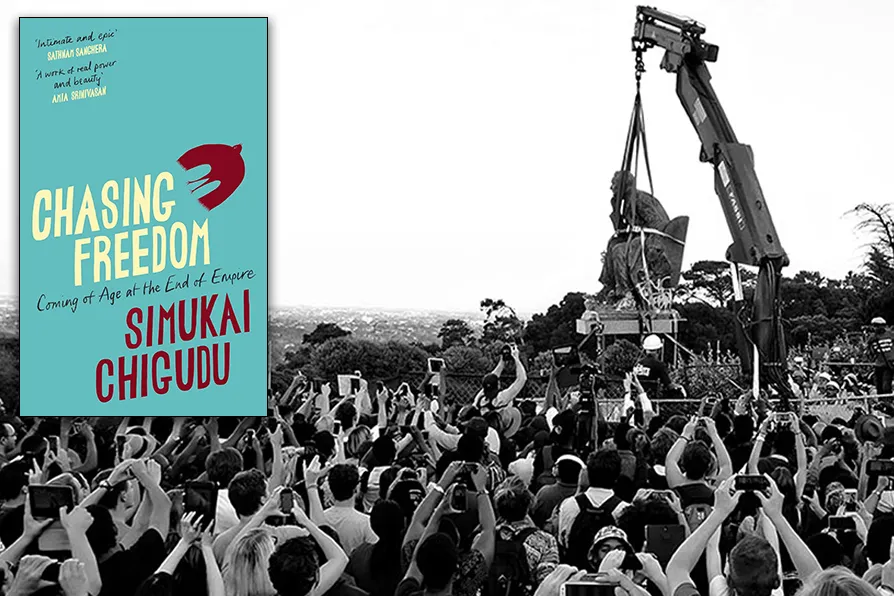 SYMBOLIC LIBERATION: Removal of the statue of Cecil Rhodes (sculptor: Marion Walgate) from the campus of the University of Cape Town, 9 April 2015 [Pic: Desmond Bowles/CC]
MARK TURNER relishes the warm, melancholy of jazz drummer-turned composer Sam Green
RITA DI SANTO assesses the winners of the most politically charged festival to date
KATARZYNA KOSMALA introduces a retrospective by one of the most significant figures in contemporary US photography
MAYER WAKEFIELD is entertained but let down by an audacious production that, sadly, doesn't ring true





Chasing Freedom: Coming of Age at the End of Empire
Simukai Chigudu, Bodley Head, £20
SIMUKAI CHIGUDU first came to wider public attention as a leading member of the Rhodes Must Fall campaign at Oxford University. The movement began in Cape Town in 2015 and later spread to universities worldwide, including Oxford, gaining particular momentum after the murder of George Floyd by racist US police in 2020.
Chigudu campaigned not only for the removal of statues celebrating the widely reviled colonialist Cecil Rhodes, but also for the broader decolonisation of academia.
These events are recalled in the closing chapters of Chasing Freedom, a memoir of Chigudu’s life and academic journey.
Chigudu was born in 1986 to a Ugandan mother and a Zimbabwean father, six years after Zimbabwe formally gained independence from Britain. He was part of the first generation of the “born free.” His parents’ marriage was clearly strained, and Chigudu remained an only child, his birth having been preceded by at least two miscarriages.
His father, Tafi, fought in the liberation struggle and remained loyal to Zanu(PF) in the post-independence years. Tafi comes across as somewhat enigmatic in this telling, having lived through refugee camps, exile, imprisonment, and brutal torture. Chigudu’s parents met in Kampala; his mother Hope later became a feminist activist and worked in international development.
It is clear that the family was relatively well off. Chigudu was sent to a number of elite schools, including St George’s in Harare and Stonyhurst in England, and travelled widely in England, Ireland, and beyond during his formative years. Much of the book covers this period — it is 200 pages before he reaches the age of 16.
Chigudu unpacks how the colonial story affected him. His generation was meant to be the beneficiary of the independence and freedom his parents had fought for. Yet he found himself defined by others — caught between the colonial outpost and the imperial metropole — and burdened by his parents’ expectations and sacrifices. From time to time, these expectations completely overwhelm him.
His academic goals shift from wanting to be a chemist at MIT to becoming a doctor — a goal he achieves at Newcastle University — and then moving into African studies, examining how politics affects health outcomes. He is presently an associate professor in African politics at Oxford.
Chigudu talks us through some of the post-liberation graft that marred Zimbabwe, and the political struggles of some of the main players. Things went wrong, but we are not told why.
The more thoughtful reader might reflect on how the struggle for freedom in Zimbabwe, and the contemporaneous struggle against apartheid in South Africa, were ultimately negotiated and managed rather than overthrown and smashed.
Both struggles ended colonial white domination. They may have done away with legal racism, but the new barriers were about wealth. The class structure remained.
Neither liberation movement seriously challenged the economic structure. Indeed, although Chigudu was “born free” in Zimbabwe, he still attended fee-paying elite private schools, including one in Harare that at the time educated the sons of “Rhodie” farmers alongside the sons of Zimbabwe’s new political elite.
This is Chigudu’s memoir. It is unapologetically about his experiences. It is a deeply personal story told in a compelling manner. Much of the book focuses on his childhood, so and there isn’t extensive political analysis. What it does provide is an account of the pressures of parental endeavour and expectations, set against continuing colonial structures and the weight of history.
The book offers an excellent backdrop for further work, and one hopes Chigudu is planning more writing. But this work would have been better if the associate professor of politics had associated more politics with his own story.
