Britain funds the policing of black culture 16 times better than the culture itself. The Diamond Jubilee is the moment to end that, argues CLAUDIA WEBBE


 Latest editorial

Passive income, active exploitation
Britain’s culture of ‘effortless’ wealth is built on someone else's labour. Challenging that system means talking about class again, says MATT KERR
 BOXING CLEVER: Renter-led demonstrations across Europe highlight the impact of high rents and demand controls, December 2024

Growing instability in the US economy and financial markets could have serious consequences worldwide because of the central role of the US dollar and financial system, argues MICHAEL BURKE
Despite Andy Burnham’s declaration defending the continued partition of the island, all major international and internal trends are converging to make Irish reunification inevitable
Humans are part of the ‘animal kingdom’ – and of nature in general – but also distinct from it and labour (work) is part of what makes us unique, declared Engels. His insights 150 years ago into how our species came to be and how we differ from the rest of nature, are as important today as they were then, says the MARX MEMORIAL LIBRARY
Growing instability in the US economy and financial markets could have serious consequences worldwide because of the central role of the US dollar and financial system, argues MICHAEL BURKE
From Margate to Deal, mining memories are being kept alive. National co-ordinator for General Strike 100, HENRY FOWLER continued his nationwide tour of partner organisations in the Garden of England





I KNOW his face — one of those with a scowl etched so deeply across it that it would survive his announcement of the outbreak of world peace.
Alas, he’s no newsreader. Instead he wanders Glasgow city centre speaking in best authority voice into his pal’s camera phone. Apparently there are hundreds of “serious buyers” out there — folk who want to relieve me of the burden of owning a home.
Not my home, you understand. Someone else’s. These serious types are apparently keen on relieving me of the heavy burden of the landlord’s life for “full market price,” and relaxing into retirement without even having to trouble myself with the effort of throwing my tenants out in the street. All heart.
I can’t fathom what sort of glitch in the algorithms has led to me being deluged with dross like this on my social media timelines, but rest assured that I am not now, nor have I ever been, a landlord. As for retirement? Well, I strongly suspect that’s not for me either.
Some, however, have retirement thrust upon them. It happened to my grandpa when they shut down Cardowan — not that he could ever stop himself working — and nearly three decades later John Reid retired to become Cardowan’s very own baron.
In their respective days, both were near enough retirement age; John Walker lifting a pit pension and a few bags of coal every fortnight for the remainder of his days, while John Reid carries — even now — the heavy burden of legislative responsibility for a mere £323 a day.
I wonder if when he gets home, discarding his expensively ill-fitting suit jacket to plonk himself down and focus on the silence ringing in his ears, does Mr Scowl — no, not Mr Reid, but the landlord guy — ever wonder about what happens when the serf tenants he’s happy to buy and sell ever retire.
Maybe he’s an ideologue who thinks it’s not for them, that they should have made provision, that they should have worked harder, that they should have been prepared to jump on the train with him back in the day.
Maybe he thinks he’s doing them a favour. As a councillor, I once had a landlord write to berate me for backing rent controls because they were good landlords, “only charged the market rent” of £900 a month on their dozens of properties, and “drive a Volvo, not a Ferrari.”
They would be forced to sell up, I was told, “and then where would people live?”
I suspect they even believed it.
Presumably they expected the new owners to demolish the scheme, who knows?
A decade of spiralling rents on, and the market has predictably found a way of wringing out every last penny out of that possibility by treating sitting tenants as a capital gain to sell to an ever fewer, ever richer, set of private profiteers.
Rent controls — the very least of state interventions — are on their way in Scotland, but not before a friend down the road has been handed notice they should expect their rent to rise from £650 to over £1,000 a month for a flat riddled with damp and sky where a roof should be. Challenge was met swiftly with examples of similar rents nearby. The market has spoken.
We’ll see about that.
Whatever happens, the future for Mr Scowl remains secure for now. His continued parasitic existence, while an insult, serves as a useful reminder that rent controls — even if they are one day properly applied by setting rent rather than increases — can take the edge off for tenants for a while but don’t seriously challenge the cult of “passive income.”
It’s quite a turn of phrase, money and lifestyle from thin air. Not even conjured — that would involve effort — no, it just arrives and apparently anyone can do it. Marvellous.
Trouble is that at least one landlord’s income is reliant on my friend having to give up his studies in engineering to take a full-time minimum wage job, alongside his father at all hours of the day and night. There is nothing “passive” about their income, every penny is grafted for, nor is there anything certain about it either.
The only certainty is that the landlord expects the lion’s share of their earnings on time every month, and he always demands more because the market — which his class rigs — says he can.
Centuries earlier people working that land would have been paying tribute to the laird for the similar privilege of hand-to-mouth existence, a passive income accompanied by a seat in the Lords to ensure it stayed that way.
The hereditary lords — they are no peers of mine — are now gone from that place. After more than a century of reform, the descendents of Norman overlords, amorous acquaintances of royalty, political appointees, and robber barons have now been overwhelmingly replaced by descendents of Norman overlords, amorous acquaintances of royalty, political appointees, and robber barons.
Passive incomes all round.
Falling into at least two of those categories is Baron Sarwar, who stands on the precipice of joining the club.
After striving for years for the Scottish Labour leadership only to be horsed in two Holyrood campaigns, at the age of just 43 he has taken an early retirement package with an airmiles bonus as a trade minister in the Lords.
His role as Scottish Labour leader will continue to be carried out by Jackie Baillie, whose survival in leadership apparently becomes more secure with each successive defeat she choreographs, as the decades-long march to becoming Labour’s sole MSP continues.
In the coming month there will be a contest to find her a suitable human shield however. Michael Marra was the chosen one, but Monica Lennon and Joe Fagan have both thrown their hats into the ring and Katy Clark will make her decision shortly.
There are so few MSPs now — 17 — that getting nominations from three colleagues is proving more complex than it sounds for candidates, and naturally there is talk of shenanigans to keep some off the ballot paper.
Such is life.
Fear not, this is not going to drift into deep analysis of the characters coming forward, that is for another day.
I merely make a plea: last week, as Glasgow welcomed people from around the world to the Commonwealth Games, a hard core of out-and-out racists accompanied by a combination of coked-up grandads who would fight a horse for something to do, and hundreds more whipped up into fear and anger didn’t just rally, they went on the rampage.
Folk were attacked and abused for the colour of their skin by people not just wearing T-shirts calling for immigrants to be hanged, but others proclaiming “I’m not far right.”
Robbed of the identity of workplace, of class, of a stake in their own future, the only strength many can see is in the scowl of the people who rob them day in, day out.
Political leaders pointing at them and howling will fail.
Far-right ringleaders are tied to capital, shamelessly flogging something-for-nothing passive income schemes from property to currency. Their world view rests not only on exploitation, but on the populace imbibing “it could be you” and getting angry when it isn’t.
If that is to be taken on, if we are to take the exit ramp off this road to oblivion, then the so-called centre’s tinkering, passive, leadership must be consigned to history.
Recognise the world as it is, not in acceptance, but in challenge.
Say the word. Class. Understand it.
Call landlordism what it is. Serfdom. Fight it.
Wipe the scowls from tired, stressed, scared faces.
Offer homes, not properties.
Offer security of income, not security of exploitation.
Offer a future worth fighting for, not a march to war.
Do that and we may just smile again.

Similar stories
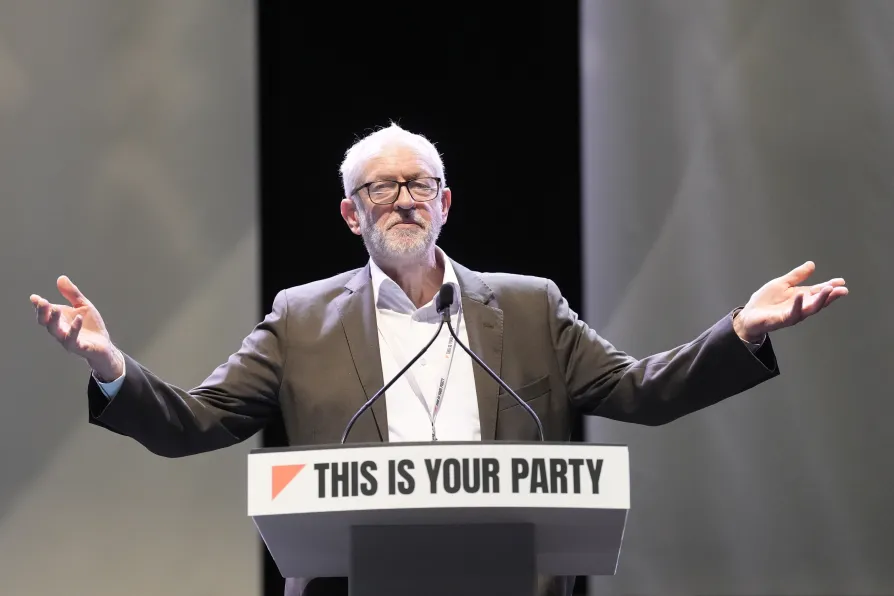

In a wide-ranging interview, JEREMY CORBYN talks to Ben Chacko about the difficulties the new Prime Minister faces and why he sees no future in Labour

The present drive to war is a cynical and deliberate diversion from deteriorating living standards, argues MATT KERR

Peter Murrell’s weakness for the allure of prestige goods is symptomatic of modern consumer culture, says MATT KERR