WILL STONE samples the 20th anniversary atmosphere of this eclectic end-of-season indie festival


 Latest editorial
Walter Benjamin, but not as you know him
GORDON PARSONS is intrigued by a biography of the Marxist intellectual and author, made from the point of view of his son
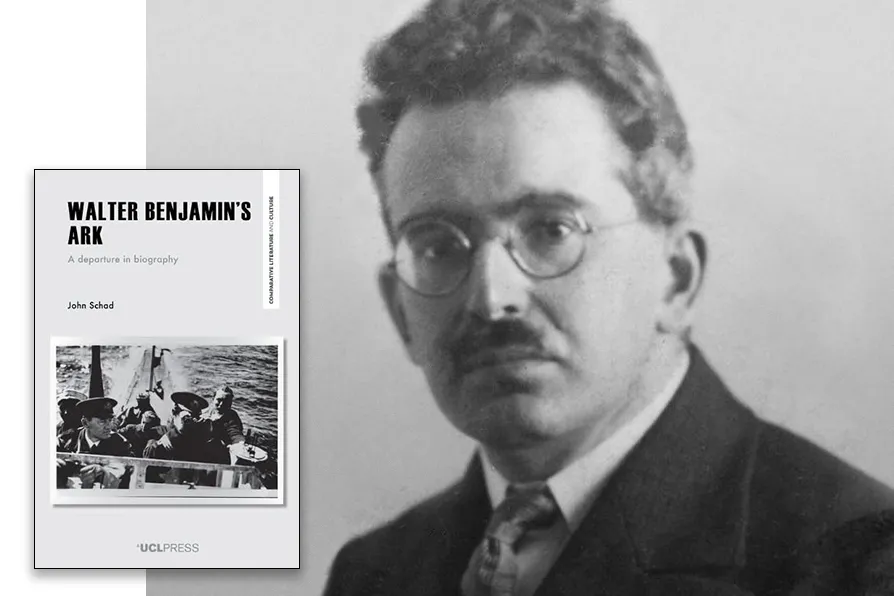 Walter Benjamin, 1928 [Pic: Akademie der Künste, Berlin/Walter Benjamin Archiv/CC]

Comics are not just superheroes and spandex – it can be public art, telling public stories, suggests HARRIET EARLE
The bard serenades the Diggers of Wigan and their festive followers
ALEXEI SAYLE speaks to Angus Reid about a lifetime of protest, how to hone political art – and what to do now
ANDY HEDGECOCK, JAMES WALSH, LEO BOIX and MARIA DUARTE review Just An Illusion, Everybody Digs Bill Evans, Blue Film, Oasis: Don’t Look Back in Anger, and Runner
MARIA DUARTE recommends a nerve-wracking reconstruction of the 72 hours before the Normandy landings





Walter Benjamin’s Ark
John Schad, UCL Press, £30.00
JOHN SCHAD subtitles his intriguing book on Walter Benjamin “a departure in biography.” He explains in his introduction that he is attempting ”to read the famous, even epic, life and work of Walter Benjamin via the obscure and difficult life of his only and estranged child, Stefan.”
Through his short life, which ended at the age of 48 when he committed suicide attempting to escape from the Nazis, the unconventional Marxist Walter Benjamin created works which reshaped modern awareness of culture and language.
The importance of his extensive cultural and literary criticism formed free of the limitations of the academic institutions which had rejected his earlier efforts were not fully recognised until the political reawakening of the 1960s.
Rather than relying on the standard subjective commentary by the critics, Benjamin believed that the ideal criticism should consist of a mosaic or montage of quotations, as reflected in contemporary art forms like cubism or serialism, with echoes of the word association of Jungian psychological practice.
His belief in language having not only a communicative but also a metaphysical, almost mystical value, led to his lifetime interest in his son Stefan’s early language, which he recorded in detail. The Ark of the title refers to a favourite toy he gave his young son and, of course, to the ship at the centre of his story.
While Benjamin was fleeing the Nazis in 1940, Stefan was aboard the “hell ship” Dunera in which over 2000 German, Austrian and Italian “enemy aliens” were deported to Australia in ghastly conditions.
John Schad’s book reads like a magic-realist novel, or the script of a surrealist film experienced through Stephan’s tortured mind throughout this nightmare voyage.
The remarkable fact that among his unfortunate fellow passengers were refugees with the same names as some of the leading intellectual writers of the 20th century enabled Schad to imagine Stefan playing out a fragmented mental drama reflecting the ambiguity of his love-hate relationship with his father.
This is a strange, almost pantomime-like performance, in which S (Stefan observing while playing himself) as the Prince, and the King (his father) engage with Virginia Woolf, Kafka, Wittgenstein, Rosa Luxemburg and three Oscar Wildes, supported by fictional characters such as the Actor, Zeppie (a clown), and even a useful unidentified Someone.
The dialogue employs actual broken fragments from the works of the famous writers including those of Benjamin himself. These injections may sound gratuitous, but they are all skilfully referential.
The cast even perform a truncated version of Hamlet, a play Benjamin had used in his critical treatment of the Baroque Trauerspiel (or play of mourning) and which clearly resonated in Stefan’s relationship with his father.
If this all sounds unduly complicated, then John Shad’s own “Unseens,” that introduce the chapters, and explanations inserted in the text, keep the reader in touch. In Schad’s “Unseen” to chapter three he explains the presence of Wittgenstein. “He is not quite, the famous philosopher, nor, indeed, the obscure Berlin furrier of the same name, who happened to be a deportee aboard the Dunera. Confusion thus ensues as this phantom Herr Wittgenstein speaks largely in the words of Wittgenstein the philosopher.”
The fantasy-fiction meeting between Wittgenstein and Walter Benjamin, still in the role of King, mark the confrontation of two antagonistic philosophical traditions that are, simply put, the subjective versus the objective.
In the final chapter Kafka emerges as a major figure. Walter Benjamin had produced a major essay on Kafka and the two writers, both European Jewish intellectuals, shared a sense of alienation from what may be termed the real world.
Those readers familiar with Walter Benjamin’s work will enjoy the recognisable current of references woven into John Schad’s book. Others will appreciate the author’s playful use of literary references while being encouraged to discover an important philosopher (Benjamin himself rejected the term) who will make them see our world afresh.
Walter Benjamin’s Ark is available as an open access (free) download here: https://uclpress.co.uk/book/walter-benjamins-ark/

Similar stories


FIONA O’CONNOR questions the achievement of this year’s Orwell prize winner for political fiction

BEN COWLES samples the many sonic and social therapies of Manchester Punk Festival 2026, and is ready again to smash capitalism
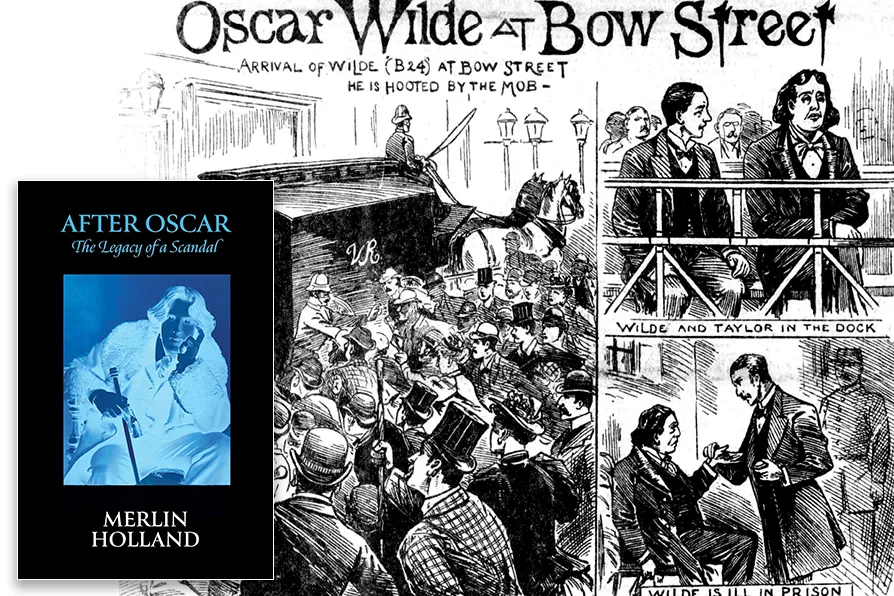
MARJORIE MAYO welcomes an account of family life after Oscar Wilde, a cathartic exercise, written by his grandson