DAVE WARD of the Communication Workers Union says unions must step up to meet the challenges of a transformed world of work


 Latest editorial
The rebellious past lives on in Bristol
LYNNE WALSH reports from the Bristol Radical History Festival, where the defiant tradition of resistance shaped by ordinary people was centre stage
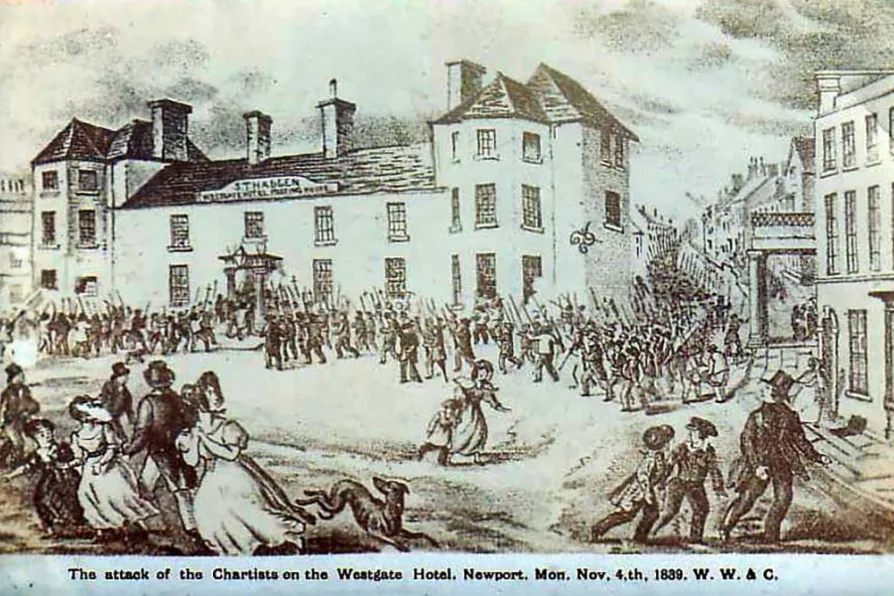 ANTI-ESTABLISHMENT: An illustration of the Newport Rising of 1839
Live music and musical education are both under attack and threaten to impoverish our culture. The Musicians’ Union seeks allies in the fightback, writes NAOMI POHL
Who should the trade union movement be fighting for: pimps or marginalised women, asks ANNA FISHER
This summer’s fire outbreaks highlighted once again the deadly cost of job, equipment and funding cuts to the fire service. Ten years after the Grenfell tragedy, serious lessons still need to be learned, says STEVE WRIGHT
As Cuba faces the most dangerous moment in its recent history, Britain must do more than condemn the US blockade at the United Nations, writes KEVIN COURTNEY, chair of the Cuba Solidarity Campaign
The events of 9/11 reverberated across the United States and then the world. JOHN WIGHT remembers the eerie atmosphere that exposed racial divisions at the heart of Hollywood





WAS I dreaming when I met a Chartist scarecrow, a riot of men in petticoats, and an underground rebellion at the BBC?
If that all sounds like some hallucinatory trip, brought on by too much coffee and a vivid imagination, let’s set the record straight. I was wide awake and at Bristol’s M Shed, for the Bristol Radical History Festival.
The museum, formerly a dockside transit shed, is home to 3,000 artefacts, including the statue of slave trader Edward Colston. The bronze structure was toppled, defaced and pushed into Bristol harbour by anti-racists protesters in 2020.
Bristol Radical History Group (BRHG), celebrating its 20th year, applies a working-class lens to history, challenging Establishment narratives. We covered 10 or so talks, of the 20 on offer. I was grateful for the support of the Comrade Husband, as we rushed between sessions on BBC Rebels in the 1970s, Jenkin Morgan — Chartist Scarecrow, the Rebecca Riots of the 1840s, and the 1926 Lockout in the Forest of Dean.
Historian Rhian E Jones, originally from NHS birthplace Tredegar, took a forensic look at those men in petticoats, the anti-tollgate protesters who adopted the name Rebecca.
“The riots tend to be thought of as a historical curiosity, a bit of an oddity,” she said, “and not something that fits neatly into the narrative of the radical tradition of Welsh histories.”
The events of 1839 to 1843 in west and mid Wales came out of the same crucible of desperate conditions as did the Merthyr Rising of 1831, and the Chartists’ armed rising in Newport in 1839.
The New Poor Law of 1834 was devastating for the working class, haunting their lives with the spectre of the workhouse.
The rural areas of Wales, including Carmarthenshire, could be described “albeit simplistically, as still feudal, divided between the gentry and peasantry.”
Widespread poverty, precarious work and rising unemployment devastated lives, made worse by the enclosures of land.
“People had used the land for gathering food, gathering wood for fuel, and even for houses — for squatting in; that’s how many people in south Wales survived.”
And then came the tollgates, their management outsourced by the government to turnpike trusts, who charged tolls and could make a profit.
“This might sound familiar to you — we’re now in the era of privatised infrastructure, and this was a very early example of it. There was almost no regulation or oversight.”
So the tolls increased, as did the tollgates. Locals saw this as a final straw, going out in the dead of night to smash the gates down.
Far from being a single-issue campaign, said Jones, “this grew into a much bigger, popular movement that encompassed all these wider, systemic issues.”
The protesters also stormed a workhouse, led by a woman, Frances Evans. Jones, in her book Rebecca’s Country, also describes Evans dancing on a table during this attack — a joyful image for we who remember the sisters dancing on silos at Greenham.
Threatening letters written to landowners would be signed Rebecca, bailiffs and gamekeepers were stopped in their tracks, and — much more worryingly for the gentry — Rebeccaites started meeting in secret with Chartists, taking up their demands for the vote.
The state sent in the troops, of course, as they did in Newport in November 1839, when 10,000 Chartists took the town. Former history teacher Ray Stroud knows his stuff when it comes to this incendiary uprising — he’s currently writing a book, Chartist Scarecrows: Five Prisoners of the Newport Rising of 1839.
This shines a light on lesser known activists, including one Jenkin Morgan from the Pillgwenlly area of Newport.
A milkman by day, Morgan was to be part of the insurgence. He paid the local blacksmith sixpence to make him a pike to fit on a staff. His actions on the day made him a hunted man, who later discovered that he had been betrayed by his own neighbours.
Captured and put on trial for treason, Morgan’s sentence was to be hanged, drawn and quartered, though this was commuted to five years in the notorious Millbank penitentiary.
Stroud said: “This is a story of betrayal, retribution and suffering.
“Pardoned by Queen Victoria on May 10 1844, he emerged from his incarceration a broken and impoverished man, described by MP and Chartist leader Feargus O’Connor as a Chartist scarecrow.”
A much more well-known character from this era is miner Richard Lewis, heralded as martyr Dic Penderyn. Charged with stabbing a soldier during the Merthyr Rising, he was hanged outside Cardiff gaol, with his final words, “O Arglwydd, dyma gamwedd” (English: “Oh Lord, here is iniquity”).
The 23-year-old was right — four decades later, a Welsh man who had fled to the US confessed to the crime. The campaign for a pardon for Dic Penderyn continues to this day.
At the history festival, our expert was Viv Pugh, who passionately described the events of June 1831, often called the most ferocious and bloody event in the history of Industrial Britain.
The little town had burgeoned, though certainly not blossomed for the workers, with four ironworks within a two-mile radius. There was little infrastructure, one road, no housing stock to speak of.
“So what happened to the workers? They slept in fields and ditches,” said Pugh.
When houses were built, they were basic, with no windows, and no fresh water supply, “and you’d be paying astronomical rents for them.”
The nearby river Taff was used for cooking and cleaning. It was also where dead bodies were taken, with no money for burials.
Ironmaster William Crawshay had built a lavish home, by comparison, Cyfartha Castle, a mansion with pheasants running around its grounds, while his workers and their families starved.
“Social and economic pressures were building up, and by 1831, people had come to the end of their tether,” said Pugh.
Protests which started in the streets in May spread to other areas. In June, the rebels stormed the town, attacking the debtors’ court and retrieving furniture and goods taken.
The Riot Act was read, and troops started firing on the workers. Claims of only a couple of dozen deaths were wildly underestimated, said Pugh. There were 10,000 citizens holding off the soldiers, and he feels sure more than 200 may have been shot dead.
When extra dragoons were deployed, the rioters took their weapons, their clothes and their expensive riding boots.
With the leaders all arrested, the rising collapsed. But Pugh had an extra word to say, “I think the true heroes were the women. They dragged the wounded men away — and the dead bodies, they dragged away, and buried them in secret on the mountain. They saved the men; they faced the bayonets.”
Women were involved in every struggle, he said, “There are reports of women meeting in secret on the mountain between Merthyr and Aberdare, listening to speakers during a thunderstorm, they were that committed to the cause.”
Among several speakers covering the theme of the General Strike, Ian Wright told how, during the 1926 miners’ lockout in the Forest of Dean, the wives used the historic folk custom of the Skimmington ride by banging pots, pans and kettles to create an almighty din, described as rough music, to humiliate returning miners.
Stuart Butler described an elaborate pageant happening at the same time in Swindon. The strikers created a mock funeral procession and cremation for the small number of returning train drivers. With rough music played along the way, it was followed by more than 1,000 people. Police even granted them permission to close the street for the event.
In a session on the theme of propaganda, Lucy Goodison and Colin Thomas, both working for the BBC in the ’70s, described acts of resistance, creating spoof editions of the Radio Times, fake memos from BBC executive Chris Brasher, and satirical newsletters with serious messages about editorial interference, casualisation, and self-censorship.
Bringing the Bristol audience right up to the present day was archivist Ghada Dimashk, speaking live from Lebanon, unable to attend in person due to the current violence.
She and her colleagues are intervening to preserve endangered digital records in Gaza and Lebanon.
Dimashk said the destruction of cultural archive was considered a war crime, but that had not prevented ongoing attacks on libraries and historical records in Palestine, and this had intensified in recent wars.
As a new Fighting Erasure Project says: “History is written by those who control what survives. Archives are how the silenced write back.”
That sounds like a battle cry we can heed. One way or another, we are all Rebecca’s daughters.
For more information visit brh.org.uk and sites.aub.edu.lb/fightingerasure. Additional reporting: Dominic McVey.
