ROB WARZYNIAK wades knee deep through a pile of ‘dead canaries’ of Trumpist policies which exacerbated the horrors of US capitalism domestically


 Latest editorial

The Palestine solidarity industry
RAMZY BAROUD decries the rats of Gaza, the rodent and human type. Both abound as profiteering from tragedy reaches obscene levels
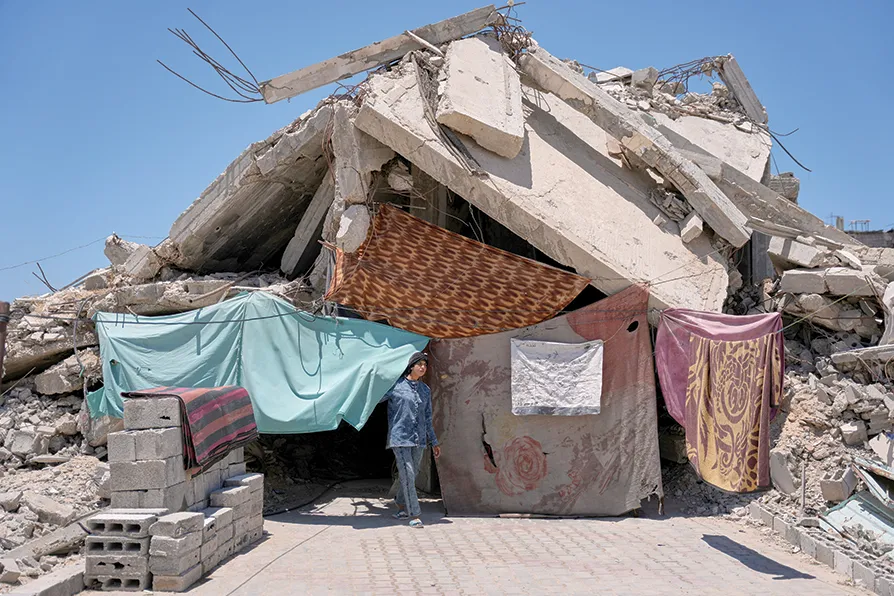 ABANDONED BY THE ‘CIVILISED’ WORLD: A member of the Abu Rish family stands in front of the entrance to her former house, in Khan Younis, southern Gaza Strip, destroyed by Israeli shelling, May 29 2026
Without evidence or Nato consultations Berlin’s answer to the Leipzig incident is a rupture of relations. SEVIM DAGDELEN examines why
FRANCISCO DOMINGUEZ introduces the background to a conference on defending Latin America’s sovereignty
The glacier collapse in Nepal is yet another warning that a warming planet is making Himalayan disasters more frequent and destructive – but the countries facing the greatest risks are often those least responsible, says LI YANG
Nick Blair is set to benefit from a hugely lucrative contract to ‘virtually’ train the British army for its next war. Like father, like son, writes SOLOMON HUGHES
Even when tragedy strikes, Western media cannot resist the opportunity to turn it into a sordid propaganda opportunity, as the Nepal-China border tragedy shows, writes CARLOS MARTINEZ
Trade unions should be at the heart of the anti-racist push for reparations for the historic legacy and continuing impact of slavery, writes ROGER McKENZIE





IT ALL started with a call to my family in a displacement camp in northern Gaza.
Since internet lines rarely stay connected, I managed to send a message to the widow of my cousin, who was killed along with all of his sons during the ongoing Gaza genocide. I asked her a simple question: what do Gazans want?
My purpose was to gather raw testimonies from her neighbours to weave into a letter to a European official whose country is active in pursuing justice for Palestinians.
I chose this approach to bypass cliched political discourse and avoid the pitfall of speaking on behalf of those enduring genocide and famine. Palestinians in Gaza are entirely capable of speaking for themselves.
The responses, however, reframed my entire approach. While I am deeply tied to my community in Gaza, I had anticipated a direct focus on macro-political language — on statehood, rights and global justice. Instead, I was met with the visceral reality of immediate physical survival.
“We want a life… we want a dignified life,” she said. “A dignified life with food, water, and even the ability to breathe. One feels so suffocated. We need so many things… so, so many things. We need psychological support, financial support, and moral support.”
Another neighbour said: “They [Israel] fight us with everything, absolutely everything; even when we are sleeping in our beds … the mosquitoes drain us. Insects and rats are all around us, fleas, and the heat is killing us. There are no fans and there is no electricity.”
Yes, many spoke about karameh (dignity), hurriye (freedom), and haq al-awda (the right of return), but these broad political and social rights were almost always tied directly to the everyday struggle for education, for water, for basic medical care, and — against rats.
The rats. This is the recurring nightmare in the minds of Gazan parents who find themselves unable to protect their children even from rodents. Nearly two million Palestinians remain displaced in horrific conditions, trapped in barely 40 per cent of an already tiny, besieged Strip.
I spent the day trying to process the pain, grief and humble expectations of these proud people.
Yet later that evening, a seemingly separate matter came to my attention. I learned of two characters — Aziz Abu Sarah, a Palestinian from the 1948 areas, and Maoz Inon, an Israeli — who have been touring for months, promoting what they call their “The Future Is Peace” tour.
These two individuals have achieved global celebrity status, sitting down with the likes of famed US comedian Jon Stewart on The Daily Show and ultimately meeting with Pope Francis himself.
To the untrained eye, the two are peddling a message of “peace” and “forgiveness,” routinely staging a display where they forgive each other at the end of their talks.
All of this serves as a promotional springboard for their week-long “peace tour” inside Israel, sold commercially at the competitive price of £3,120 per person, air tickets excluded.
The sad truth is that this corporate approach to “peace-building” is not unique; it is a symptom of a broader trend exploiting Palestine. Even more tragically, many individual Palestinians have capitalised on the well-intentioned but often misunderstood concept of “centring Palestinian voices” to accumulate personal wealth, status and prestige, while their own brethren cannot find drinkable water and teeter on the brink of starvation.
The Arabic maxim, famous in Palestine for generations, has long contended that “the revolution is a tree watered by the blood of the martyrs, and its fruits are plucked by the opportunists and the cowards.”
Shouldn’t mass extermination be a moral threshold that stops opportunists from feeding their pathological greed?
Desperate for solidarity, Palestinians in Gaza continue to hope that global efforts will eventually aid their raw struggle for freedom, dignity, clean water and relief from the rats. And millions worldwide are indeed well-meaning; they care about Gaza in ways that no social media post can ever capture.
The crisis is that the balance between genuine solidarity and outright exploitation at times risks tipping in favor of the exploiters.
We are witnessing the rise of a lucrative cult of personality, built on high speaker fees and business-class tickets, circumnavigating the globe under the guise of advocacy.
There are those who have experienced a literal “rags to riches” transformation since October 7, becoming overnight celebrities and acting like heroic figures surrounded by adoring fans, simply for doing their basic jobs or taking a public moral position.
There are organisations amassing massive budgets, hosting events costing up to £150,000 over a single weekend, simply to regurgitate the same old stances without strategy, slogans without action plans, and claims of stupendous “victories” while Gazans die of thirst and hunger.
On the other hand, Palestinian officials and those who tout the official line continue to turn their backs on the reality of Gaza while reaping the immense benefits of global solidarity: the prestige of diplomatic recognition, the red carpets rolled out for bureaucrats, and the standing ovations at international conferences.
The circle of exploitation grows wider, while the actual messages filtering out from the displacement camps grow more tragic by the day:
“I want my family back — the family Israel took from me.”
“I want to bury my children who are still under the rubble.”
“I want my father released from prison. We have no-one else but him.”
“The rats, the rats, brother. They are eating the flesh of our children.”
As I reflected on the horror of those parents helpless to protect their children, the word “rats” took on a heavier meaning.
The struggle for Palestinian freedom must remain anchored in the soil of Gaza. The global solidarity movement must not be permitted to mutate into a careerist industry for self-seeking individuals masquerading as saviours.
This creeping opportunism must be fought with the exact same urgency as the literal rats of Gaza.
Dr Ramzy Baroud is the editor of The Palestine Chronicle and a non-resident senior research fellow at the Centre for Islam and Global Affairs (CIGA). His website is www.ramzybaroud.net.
