Councillor SAM WHEELER says there’s a tangible shift in mood on the left in the city whose mayor has recently become PM — but there’s no room for complacency



Vietnam’s economic transformation reaches a turning point
Associate Professor BUI QUANG TUAN explains how modernisation and growth are helping to unlock new foreign investment in the Vietnamese economy
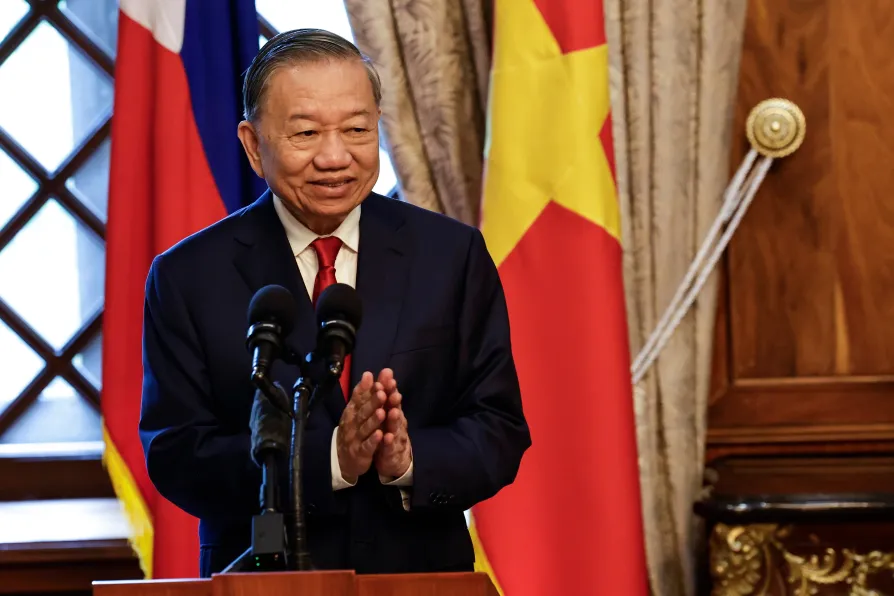
 STRATEGY: Vietnam President To Lam
Communist Party leaders Alex Gordon and Lorraine Douglas deliver vital medicines in trip to besieged socialist island
TUC Cymru is playing a leading role in tackling far-right ideas in the workplace, says LAURA DOEL
A New Delhi press conference in which Sheikh Hasina and her son implied the new order in Bangladesh is a security threat to India has sparked fears she is planning a comeback. SIAM SAROWER JAMIL reports on the fallout
Two months of student unrest have forced out India’s education minister and rattled the BJP regime. Could this be the beginning of the end for Modi, asks Communist Party of India (Marxist) general secretary MA BABY
MAT COWARD says the heatwave is a testing time for gardeners — but he has some tips





THE country’s upgrade to secondary emerging market status, coupled with regional-leading macroeconomic growth and deep institutional reforms, is unlocking large-scale opportunities for international institutional investors in Vietnam’s equity market.
Structural reforms and the long-term integration vision
Following nearly four decades of Doi Moi (economic renovation), Vietnam is entering a pivotal development phase, with the ambition of attaining high-income status. The core focus of this period centres on transitioning the economic growth model toward higher quality, efficiency, innovation, and creativity, while aggressively expanding its integration into the global economy.
Over the 2024-26 period, numerous strategic resolutions have been enacted, targeting critical pillars such as science and technology, digital transformation, private-sector expansion, energy security and human capital development.
These reforms are not merely long-term guidelines but directly enhance the investment environment, establishing a highly favourable foundation for international capital inflows.
Amid the ongoing restructuring of global supply chains, Vietnam has emerged as an attractive destination due to competitive operational costs, a strategic geoeconomic position and a remarkably stable political climate. These attributes are highly valued by international allocators seeking sustainable growth in emerging frontiers.
Macroeconomic tailwinds underpinning investment potential
In 2025, Vietnam recorded an estimated GDP growth rate of 8.02 per cent, placing it among the highest both regionally and globally. GDP per capita reached approximately $5,026, officially moving the nation into the upper-middle-income bracket. This growth momentum is well-balanced, driven by synchronised performance across industrial production, agriculture and the services sector.
International trade continues to act as a primary economic engine, with total export turnover exceeding $930 billion and a trade surplus widening past $20bn. Consequently, Vietnam is consolidating its position within global manufacturing and export supply chains.
Foreign direct investment (FDI) inflows continue to show robust expansion, maintaining Vietnam’s position among the world’s top 15 developing nations for FDI attraction. Crucially, these allocations are shifting toward high-value-added sectors such as technology, smart manufacturing and the digital economy, effectively raising the quality of corporate growth and expanding horizons for financial investors.
A key highlight of the current agenda is the regulatory overhaul aimed at streamlining procedures and lowering barriers to entry. The implementation of a non-prefunding mechanism for foreign investors, alongside relaxed foreign ownership limits (FOL) and mandated bilingual financial disclosures, has significantly enhanced market accessibility.
These interventions have brought the Vietnamese market much closer to international emerging market standards, while fostering a more transparent and accommodating environment for global funds.
The deployment of the KRX trading platform in May 2025 marked a major milestone in modernising market infrastructure. This foundation creates the technical capacity to introduce advanced trading instruments, including intra-day trading and controlled short-selling, in the near future.
Concurrently, a central counterparty (CCP) clearing model is being established, which is expected to mitigate settlement risks and elevate the efficiency of the clearing system, thereby satisfying the criteria for higher-tier market upgrades.
The stock market: a strategic gateway for international capital
Against this macroeconomic backdrop, Vietnam’s equity market is increasingly cementing its role as a vital channel for medium- and long-term capital, serving as the primary gateway for foreign investors seeking exposure to the domestic economy.
Following 25 years of development, the market has matured into a comprehensive financial ecosystem spanning equities, bonds and derivatives. The broader capital market has assumed a more prominent role within the national financial architecture, reducing corporate reliance on banking credit and converging with global standards. The legal framework is continuously being refined, while trading and settlement technologies undergo steady upgrades to ensure sustainable long-term expansion.
Market upgrade and the scale of investment expansion
A definitive turning point was reached in September 2025, when FTSE Russell officially reclassified Vietnam as a “secondary emerging market.” Beyond its symbolic weight, this reclassification triggers automatic structural inflows from passive exchange-traded funds (ETFs) and benchmark-tracking index funds globally.
By international precedent, such upgrades typically spark a multi-year cycle of passive and long-term active capital inflows, while lifting the market’s profile on the global investment map. For Vietnam, this milestone is widely viewed as the genesis of a fresh capital attraction cycle.
In tandem with the upgrade, by the end of 2025, Vietnam’s stock market recorded explosive growth in both scale and liquidity. The benchmark VN-Index closed near the 1,800-point mark, surging more than 40 per cent year-on-year.
Total market capitalisation reached the equivalent of 78 per cent of GDP, while average daily trading values surpassed 29 trillion VND (approximately $1.1bn) per session.
The total number of investor accounts approached nearly 12 million, reflecting the deepening retail and institutional penetration of the market. This broad base provides the necessary liquidity to comfortably accommodate larger tranches of international institutional capital.
Modernising market structure, institutional reform, and infrastructure upgrades
The sophistication of the financial sector extends well beyond equities, with other components expanding in lockstep.
The corporate bond market staged a notable recovery, with primary issuance rebounding to 539.2 trillion VND (c $20.45 billion) in 2025 — an increase of more than 23 per cent year-on-year — bringing total outstanding debt to 1.15 quadrillion VND (c $43.62bn).
Concurrently, the derivatives market continues to expand its suite of risk-management instruments, allowing asset managers to deploy more sophisticated portfolio hedging strategies. This synchronised depth ensures that Vietnam’s broader financial architecture can support highly diverse asset-allocation mandates.
A strategic window for international investors
Vietnam is actively stepping up its international investor relations, maintaining open policy dialogues with the world’s leading financial institutions. High-level investment summits hosted across global financial hubs — including New York, London, Hong Kong and Singapore — demonstrate a proactive stance in marketing the domestic market and anchoring investor confidence over the long term.
Looking ahead, Vietnam’s medium-to-long-term roadmap targets an upgrade to emerging market status under MSCI criteria, with the ultimate objective of joining the advanced emerging market bracket by 2030.
This trajectory will involve further legislative updates, liberalisation of foreign equity caps, product diversification, and corporate governance enhancements. If executed on schedule, these measures are poised to trigger a structural leap in both market depth and quality.
As global capital undergoes a broad-based reallocation, Vietnam stands out as a compelling frontier that bridges high growth, macroeconomic stability, decisive institutional reforms and substantial valuation upside.
The combination of a fresh market upgrade and an economy still in the early stages of an institutional re-rating cycle positions Vietnam’s stock market as one of the most compelling investment opportunities in Asia.
Backed by its current macroeconomic foundations and a transparent reform trajectory, Vietnam is steadily establishing itself not merely as an emerging market, but as a primary strategic destination for global capital over the coming decade.
For global asset allocators, the question is no longer whether to invest in Vietnam, but rather how early to deploy.
Assoc Prof Bui Quang Tuan is former director of the Vietnam Economics Institute, Vietnam Academy of Social Sciences.
