Councillor SAM WHEELER says there’s a tangible shift in mood on the left in the city whose mayor has recently become PM — but there’s no room for complacency



Congo’s deadly perfect storm
ROGER McKENZIE highlights how health workers in DRC are struggling to contain a deadly Ebola outbreak in a region already suffering conflict, aid cuts and a legacy of imperialist degradation
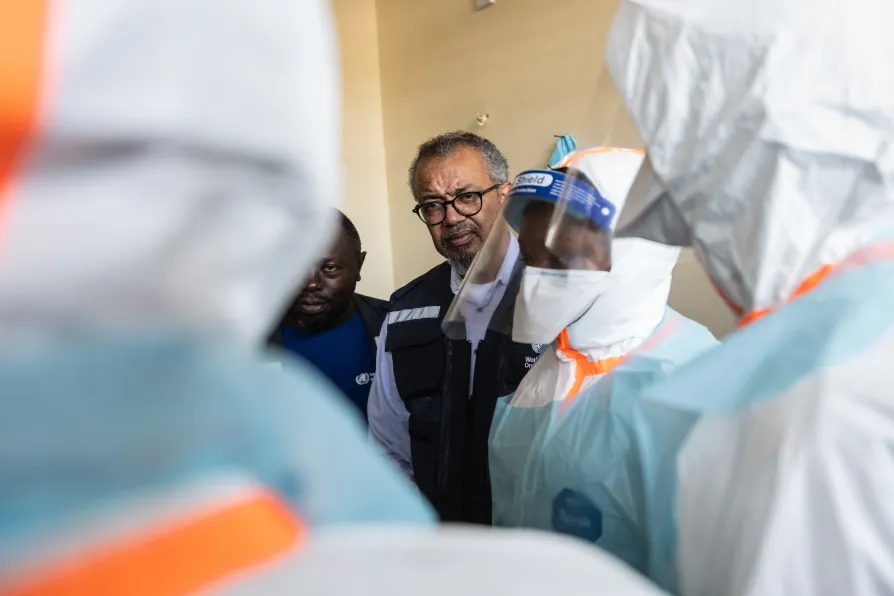
 OUTBREAK: Director General of the World Health Organisation (WHO), Tedros Adhanom Ghebreyesus, visits health workers at the Evangelical Medical Centre (CEM) in Bunia, DR Congo
Communist Party leaders Alex Gordon and Lorraine Douglas deliver vital medicines in trip to besieged socialist island
TUC Cymru is playing a leading role in tackling far-right ideas in the workplace, says LAURA DOEL
A New Delhi press conference in which Sheikh Hasina and her son implied the new order in Bangladesh is a security threat to India has sparked fears she is planning a comeback. SIAM SAROWER JAMIL reports on the fallout
Two months of student unrest have forced out India’s education minister and rattled the BJP regime. Could this be the beginning of the end for Modi, asks Communist Party of India (Marxist) general secretary MA BABY
MAT COWARD says the heatwave is a testing time for gardeners — but he has some tips





THE people of the Democratic Republic of Congo (DRC) have long had to contend with the forces of neocolonialism staging coups, assassinating its popular leader, fomenting conflicts and stealing the resources from under their feet.
Add to this the deadly Ebola virus and you have to wonder why what is happening in the DRC, as well as Uganda, is not getting both more humanitarian aid targeted and more media coverage.
The population as well as health workers in the DRC, the epicentre of the outbreak, have been struggling to contain an outbreak of the Bundibugyo virus, a kind of Ebola that has no approved treatment or vaccine.
Health workers have scant resources to help them to support the people being engulfed by this virus. In some areas, doctors have resorted to wearing expired medical masks while treating suspected patients.
According to the United Nations World Health Organisation (WHO), 1,077 suspected cases and 238 suspected deaths have been recorded as of the end of last week.
According to experts, the even worse news is that the number of deaths and suspected cases are both going to soar.
The stark truth is that if this killer virus was hitting anywhere in Europe there would not be the same silence.
The Ebola outbreak in the DRC has been declared a public health emergency of international concern by the WHO. But the declaration has largely fallen on deaf ears.
It is hard to escape the conclusion that African lives really do not matter to the rich former colonial powers.
I doubt anyone in Africa expects the United States to give a flying **** about the 1.4 billion people of the mother continent. As we saw during the outbreak of the Covid-19 virus in the US, the first Trump administration really didn’t care to make sure that its own people had access to treatments or even masks during a pandemic that killed millions.
They certainly won’t care about Africans who they routinely disparage in the most outrageous racist fashion on a regular basis.
This strain of Ebola takes two to 21 days for symptoms to appear. They come on suddenly and start like the flu or malaria, with fever, headache and tiredness.
As the disease progresses, vomiting and diarrhoea develop and it can lead to organ failure. Some, but not all, patients develop internal and external bleeding.
The virus spreads from one person to another by contact with infected bodily fluids such as blood or vomit.
The bottom line is that catching Ebola is a virtual death sentence that can be infectious to anyone that even touches the dead body.
The attacks by people on Ebola treatment centres in the eastern DRC highlight the serious challenges faced by the population as well as health workers and local authorities.
Last week, angry young men stormed a hospital treating Ebola patients in the town of Mongbwalu in Ituri province, the epicentre of the spread.
The attackers demanded the handing over of the bodies of two of their relatives killed by the virus.
After medical staff told the people of the dangers, medical staff were forced to scramble to evacuate the patients as gunfire rang out in the area as the relatives refused to take no for an answer.
In another attack on a treatment centre, 18 Ebola patients were forced to flee and are, as far as I am aware, still in hiding.
But alongside Ebola the DRC is also facing the perfect storm of emergencies. It was already one of the world’s worst humanitarian disasters.
Eastern Congo has for years seen attacks by dozens of separate rebel and militant groups, some of them with links to foreign countries or the extremist Islamic State group.
While the DRC government only loosely controls Ituri Province, the Allied Democratic Forces, a Ugandan Islamist militia linked to Isis, is responsible for violent attacks against civilian targets.
Before the outbreak, the medical group Doctors Without Borders said in an assessment that the insecurity in Ituri had worsened recently, causing doctors and nurses to flee and leaving overwhelmed health facilities and in some parts, “catastrophic conditions.”
Around a million people are already displaced in Ituri.
This means the deadly Ebola outbreak is spreading in communities that are already in dire straits.
Experts fear the disease might spread to the large displacement camps near the city of Bunia, where the first Ebola cases were reported.
So where is the help coming from? The answer is nowhere.
International aid cuts last year by the former colonial powers and the US were devastating for eastern Congo.
Aid groups say they don’t have sufficient resources to help the population. So the question arises as to whether Africa is able to help itself.
In the longer-run Sub-Saharan Africa (SSA) must place itself in a position where it does not have to rely on outside support for what is likely to be a growing number of emergencies, especially as the impact of the climate emergency begins to fully take hold.
The healthcare landscape of SSA is complex but also hampered by the actions of the (mis)leaders who have siphoned off millions (if not billions) that should have gone towards building the infrastructure of the continent after what Walter Rodney famously described as the continent’s deliberate “underdevelopment.”
SSA already grapples with a disproportionate burden of infectious diseases in addition to Ebola, including HIV/Aids, tuberculosis and malaria, alongside a rising prevalence of non-communicable diseases.
There is a severe shortage of trained healthcare professionals, many of whom prefer, not surprisingly, to go and ply their trade in the former coloniser countries where they can expect to get relatively better paid.
There are urban–rural healthcare disparities and financial barriers that make the situation worse, alongside those that I mentioned earlier.
The removal of the (mis)leaders who have fleeced their nations at the expense of people struggling to merely survive is a necessary starting point for reform on the continent of Africa.
The Alliance of Sahel States, Burkina Faso, Mali and Niger, has demonstrated that the removal of these charlatans so that genuine — rather than flag — sovereignty can be exercised can ensure their rich natural resources are used for the benefit of the people.
This can help to point the way towards three key pillars that can help to transform healthcare in SSA.
These are the strengthening of healthcare financing, improving governance and policy frameworks, and developing healthcare infrastructure and technology.
What is certain is that the DRC, in common with all other parts of the African continent, must break this Western-built cycle of dependency.
It is a dependency that ensures the former colonial powers and their new master the US continue to call the shots in Africa with the promise of humanitarian aid and sweeteners for the (mis)leaders.
These are scenarios that merely allow the colonisers to continue to plunder the wealth of the continent.
There can be no rebirth of the African continent until this cycle of dependency is broken.
