


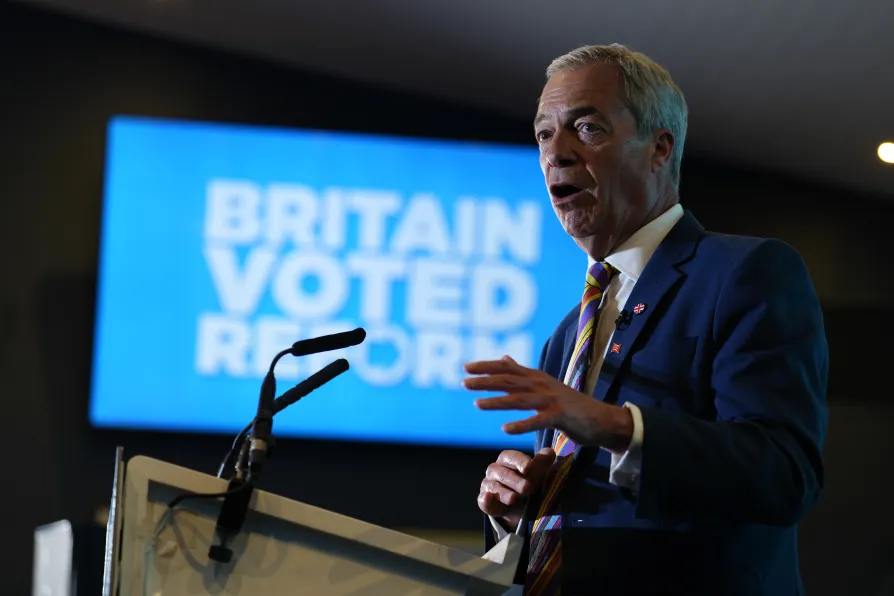
 Reform UK leader Nigel Farage speaks to supporters at Chelmsford City Racecourse, Essex, following the 2026 local election results, May 8, 2026






OPINION polling showing that trade union members increasingly support Reform over the Labour Party is alarming — but not surprising.
A survey reported in The Times found that the two parties each had the support of around 28 per cent of trade unionists.
And in the two major unions organising blue-collar industrial workers, Nigel Farage’s far-right outfit has a clear lead. Reform was preferred by 36 per cent of Unite members, as against 30 per cent for Labour, while among GMB members the corresponding figures were 31 per cent to 22 per cent.
Unison members narrowly preferred Labour, but the dimensions of the problem are clear, even if the figures hardly justify Farage’s bombastic claim that “Labour is no longer the party of the patriotic working class. That mantle now belongs to Reform.”
The party founded to advance trade union interests is now increasingly spurned by trade unionists themselves.
Labour has itself worked long and hard to get to this point. Until the 1990s it could still reasonably be regarded as the trade union party, even if that description did not capture all its aspects.
There were disagreements — most notably over the anti-union In Place of Strife proposals of 1969 and the social contract of the 1970s — but never a rupture.
New Labour changed all that. In opposition it aggressively dissociated from trade unions and diluted their constitutional position within the party.
In government it did nothing to repeal the anti-union laws of the Thatcher era and generally ignored union policy proposals.
The year-on-year devastation of basic industries under Labour and Tory alike also eviscerated the labour movement’s roots in working-class communities, diminishing trade union influence in society.
These disconnects were on visible display during the Brexit crisis, when party and unions alike paid scant heed to the millions of workers who voted to leave the European Union.
Above all, those workers wanted real change after a generation and more of neoliberal elite consensus.
Yet Labour under Keir Starmer has again failed to offer it. It still leans heavily into the Blair-Mandelson policy playbook and appears allergic to the sort of decisive action which could turn around working-class opinion.
Unite’s Sharon Graham was right to comment on the poll that Labour had “no natural right to exist” and that there was “no guarantee that workers will return.”
She added that “Labour has abandoned the working class, and the working class have abandoned Labour,” citing the now-familiar range of policy misjudgements by the government.
This is the vacuum Reform is cynically aspiring to fill. It is, of course, a Thatcherite authoritarian party, using xenophobia to mask its class essence. It offers no change in Britain’s prevailing socio-economic model and would rapidly disappoint anyone looking to it as a real alternative.
But the unions have to take responsibility for seeing Farage off too. Far too often they have acquiesced in the government’s course, or limited themselves to rhetorical dissent.
They need to accept that politics are not a sideshow and actually work with MPs and others in the constituencies to impose a new political strategy, given that there is no sign of them moving to support any new political venture on the left.
The looming leadership battle in Labour provides an opportunity. Trade unions should aim to coalesce behind a common set of policy demands and, if possible, a single candidate for Leader, based on reconnecting the party with its working-class roots.
Organising workers at work and campaigning in their communities are not an either/or. Both are essential if the far-right menace is to be seen off and union members reconnected to class politics.
