Councillor SAM WHEELER says there’s a tangible shift in mood on the left in the city whose mayor has recently become PM — but there’s no room for complacency



The tale of two Cedrics: the CEO, the GMB and the pig that upset British Gas
When gas company bosses gorged on assets, the GMB union fought back with the help of a 20-stone saddleback sow. MAT COWARD tells the story
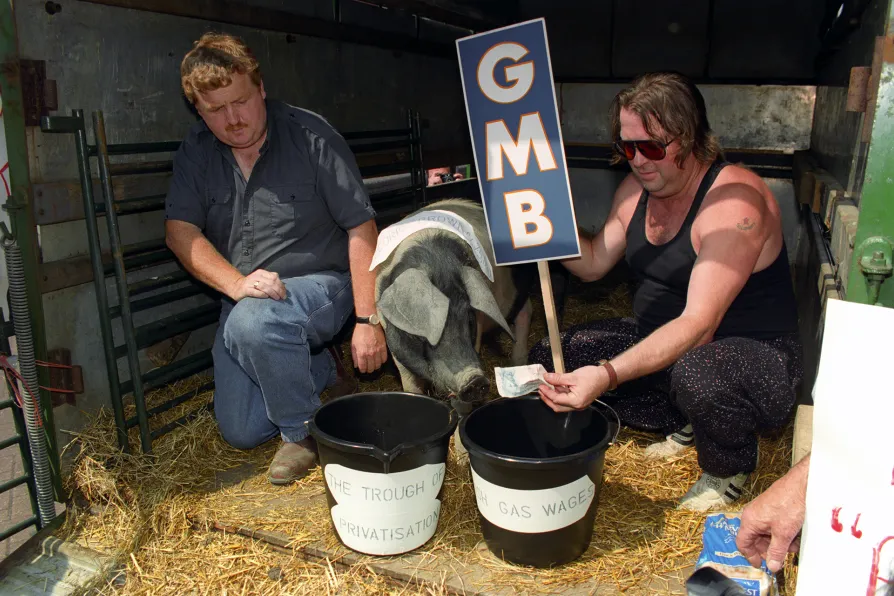
 Representatives of the GMB union staging a protest with Cedric the pig outside the London Arena before a British Gas shareholders meeting
Communist Party leaders Alex Gordon and Lorraine Douglas deliver vital medicines in trip to besieged socialist island
TUC Cymru is playing a leading role in tackling far-right ideas in the workplace, says LAURA DOEL
A New Delhi press conference in which Sheikh Hasina and her son implied the new order in Bangladesh is a security threat to India has sparked fears she is planning a comeback. SIAM SAROWER JAMIL reports on the fallout
Two months of student unrest have forced out India’s education minister and rattled the BJP regime. Could this be the beginning of the end for Modi, asks Communist Party of India (Marxist) general secretary MA BABY
MAT COWARD says the heatwave is a testing time for gardeners — but he has some tips





WHEN British Gas held its AGM in London on May 31 1995, its top boss, Cedric Brown, faced an unusual protest. Members of the GMB union had engaged the services of a 20-stone saddleback sow named Cedric the Pig.
Cedric stood with other protesters outside the meeting, though unlike them she had her snout deep in a trough full of swill. The symbolism was not subtle, nor was it intended to be.
Previously a patriotically owned utility, British Gas had been privatised and its management and new shareholders wasted no time gorging on its assets. Brown himself had seen his salary increase by 70 per cent since privatisation. Naturally, such good fortune did not descend on the workforce and in fact thousands of job losses were in the pipeline.
The scandal of bosses being paid millions while workers’ pay goes backwards was nothing new, but this particular example was so blatant and extreme that outrage over what was called “boardroom greed” was widespread, almost universal, far from being confined to trade unionists and leftwingers.
Cedric (the good Cedric, not the bad one) became a celebrity and made further public appearances. The phrase Cedric the Pig is still used today in discussions of “fat cat” salaries. In 2019, long after the pig’s death, the shareholders of Centrica (which now owned British Gas) approved a multimillion-pound package for their chief executive, whose name, remarkably, was Iain Conn. The GMB warned that “the ghost of Cedric the Pig would haunt them.” The boss’s boost amounted to a 44 per cent rise — the union pointed out that its members weren’t even getting 4 per cent.
In 1996, the year after the original pig protest, Brown stepped down as CEO. How well he performed in the role is beyond this column’s ability to assess, but business correspondents at the time remarked that formal complaints about British Gas service standards had reached record levels, doubling in the past year alone.
Brown admitted that the Cedric the Pig campaign “did hurt. If you are a human being then frankly it will.”
How much sympathy this gained him is uncertain, as the same report revealed that he would received a six-figure pension, a further year on a six-figure salary as a “consultant,” and would retain his secretary, office and chauffeur-driven Jag.
Life can be tough for humans, but it’s much worse for pigs. Days after Bad Cedric’s resignation, Mudchute Community Farm, where Good Cedric lived, announced that she was to be sent for slaughter. She had grown obese from treats given her by visitors, according to some reports, or had become infertile according to others.
“It is a shame,” the farm’s project director told one paper, “but she is just not productive enough. It is a hard world and Cedric has outlived her usefulness.”
The GMB saved Cedric’s life at the last minute, by granting her honorary membership of the union. Presumably some sort of sponsorship was also involved which allowed the workers’ sow to live out her days in quiet contemplation of the better world to come.
Four years later the union reddened its own face slightly by declaring that Cedric the Pig was to come out of retirement for one last battle against fat cat pay — only to be told by Mudchute that she’d died 18 months earlier. The cause of death was given as choking while attempting to eat an entire loaf of bread thrown to her by one of the many sightseers and well-wishers who travelled to the farm for an encounter with Britain’s most famous pig.
A picket-line animal famous in the US has occasionally been seen in action in this country. Scabby the Rat is a giant inflatable — described as having big claws, a “mean look,” “festering nipples,” a “scabrous” belly and “menacing” whiskers. He’s been used by US unions for decades to attract attention to disputes with anti-union employers.
Scabby made his British debut in 2013 at the Grangemouth oil refinery.
We can be pretty certain that the giant rat is an effective tool against union-busters, simply by noting that numerous attempts have been made in the US over the years, by companies and politicians, to get him banned. So far, courts have usually ruled that Scabby represents “symbolic speech,” which is constitutionally protected.
It’s not unusual for the unions’ enemies, therefore, to take matters into their own hands. Scabby the Rat has been vandalised, run over, graffitied, kicked, burnt and punched. In 2022 in Illinois, Scabby was supporting a strike at a funeral home when the business’s owner was arrested for allegedly stabbing the giant rat multiple times. Her name was Lauren Staab.
You can sign up for Mat Coward’s Rebel Britannia Substack at www.rebelbrit.substack.com for more strange strikes, peculiar protests, bizarre boycotts, unusual uprisings and different demos.
