A new generation of right-wing politicians have shifted from promoting deregulation to championing anti-migrant politics warns SOLOMON HUGHES


 Latest editorial

Congress: It’s all talk
But that’s OK, says MATT KERR, as talking is what will help us get things done
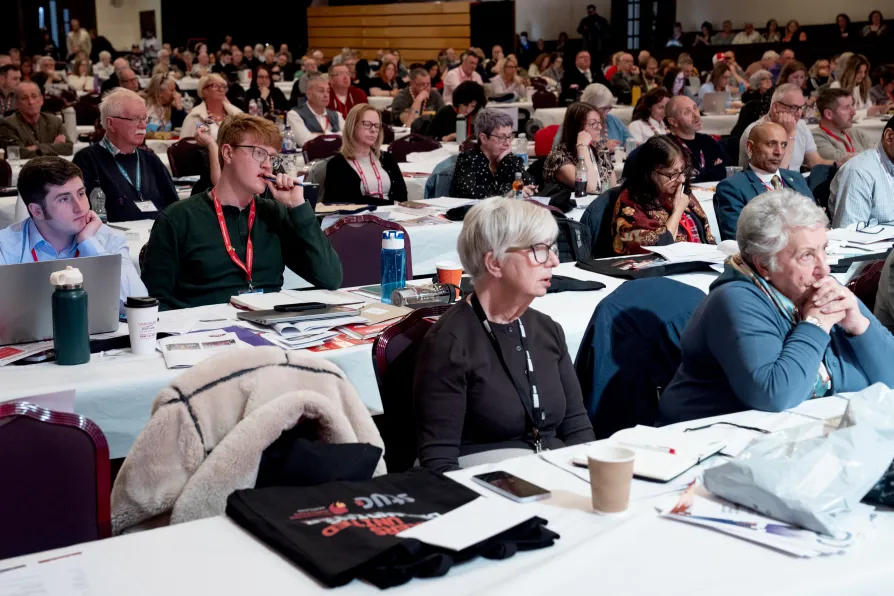 Delegates during the first day of the STUC conference in the Caird Hall, Dundee, April 20, 2026

by the Greater Manchester Workers’ and Tenants’ Association
The US relationship with Israel has evolved into a strategic liability, argues RAMZY BAROUD
A champion motorcyclist, trade union organiser and communist, Clem Beckett went from Britain’s speedway tracks to the battlefields of Spain, where he gave his life resisting Franco’s forces at Jarama. GEOFF BOTTOMS pays tribute to this remarkable anti-fascist
The greatest threat to democracy may no longer come from political parties but from unelected tech oligarchs like Peter Thiel and his powerful Silicon Valley network, argues JOHN GREEN
Claiming to ease a fertiliser shortage, the Trump administration has suspended tariffs on Moroccan phosphate imports – deepening US support for the Morocco’s control over Sahrawi territory, writes LUKE ROTELLO





THE thing about congress is that it’s all talk.
Those who would mistakenly call it conference are closer to the mark than the pedants would admit.
Conferring in the delegation meetings, and the pubs, conferring in the hall; hell, even conferring awards for services to the trade union movement.
Naturally, politicians were keen to get in on the action, there is after all a war (and an election) on. By convention, appearing like some sort of phantom pain from a long-amputated arm, the leader of the Scottish Labour Party does a turn at the STUC, the SNP first minister also returned, and for the first time in history the Scottish Greens were invited to send a leader along. They all believe in unions. They all think racism is a bad thing. Relief all round. Notes were taken. People forget.
Opening offers were presented. The negotiations will come later, and Mr Swinney even pledged a place for the movement in the room should talks about replacing council tax ever actually take place.
The most impressive offer in the Scottish election campaign so far seems to me to be Mr Swinney’s promise to introduce supermarket price caps on food essentials. For someone like me who has long complained of Holyrood’s institutional unwillingness to move beyond gesture, this could represent a glimmer of light squeezing itself through those shrinking windows in the “thought pods” under the crags. Who can say? If I was a cynical man, I might think that this will form a new set in the endless constitutional ping-pong bore-fest, with a showdown on the way if and when it falls foul of the UK Internal Market Act.
The Tory legislation was brought in to allow free trade within the UK and six counties after it left the EU, but the beautiful irony of the whole thing is that in all the most significant ways, it replicated the anti-state aid rules of the organisation it left for devolved governments.
Hungary’s attempts to cap the price of essentials was struck down by the Court of Justice of the EU a couple of years back after Spar sued, and even Germany has had its cap on rail fares turned over in just the same way. For the want of a heaven to forbid interference in the holy market, we can always rely on the EU and the Tory Party, unless it is to nationalise private losses.
Even the least doctrinaire among us can surely concede that in a country that saw almost a quarter of a million emergency food parcels issued to its citizens last year, limiting prices would be a start — after all, Mr Swinney has.
In Holyrood politics where even the slightest criticism of the EU seems unable to be countenanced though, it seems unlikely that any of his nominal opponents will point out the contradiction in his determination to rejoin. Maybe he thinks Scotland could steer it away from big business from within? Maybe he’s right, but I’d suggest both his own track record and the experience of Hungary and Germany indicate the chances of that are somewhere between slim and negligible.
Either way, I not only hope Swinney gets his price controls, but in doing so it embarrasses the UK Labour government into taking similar approaches, not only on food, but energy too. During the last spike in costs, the cap on domestic fuel bills proved itself to be as useful as a chocolate fireguard, plunging millions into fuel poverty to preserve profit while the millionaire boss of Centrica called for subsidies for bills.
In similarly ludicrous fashion, Sainsbury’s chief executive Simon Roberts called this week for the government to act to support food producers’ spiralling energy costs. He knows what he’s doing.
Food production is one of the few areas where both Tories and the EU love a bit of subsidy, but the cheek of the call coming from a man whose company raked in £1 billion in profits last year is quite something all the same.
After all, by definition, if that is occurring he is either not paying his food suppliers and his workers enough, or charging too much.
Most probably it’s both. I digress though, because the best offers, the best ideas, and by far the best speeches came from the dozens of rank-and-file trade unionists who took a deep breath, walked or wheeled themselves to the podium, and brought their experiences into debate.
The opening applause rings less hollow for first time delegates and speakers at the STUC than it does at most political party jamborees. The voices more diverse and the disagreement both more real and more comradely, the careerist briefcaser count kept to a minimum.
The tables in front of the seats tell us that we’re here to work, to read, to write, to prepare, to speak, and to listen without being spoken to.
Where else could the dietician debate with the meccy fitter, the postie with the social worker, the train driver with the singer?
After decades of privatisation and privations, closures of public halls and public houses, there are precious few spaces for workers to breathe, never mind test ideas up against experience. The congress is of course imperfect. Time is short and bridging gaps between delegations can sometimes serve to blunt the radicalism in the room.
That’s life though, if making the radical arguments was easy they wouldn’t be radical, they’d be the everyday. Not every working person is trade unionist, and not every trade unionist is a socialist, and shock of shocks, not every socialist agrees with every other socialist. Some will be lucky enough to have read the theory, some will even be lucky enough to understand it, but while arguments for a better world may rest on those foundations, they need the space to be tested, honed, and won.
Trades councils have consistently provided those arguments to congress. While congress meets but once a year, they meet monthly, offering a freedom even from the delegation meeting and a space to make mistakes, learn and thrive.
It is not because they are inherently morally superior to the STUC or any individual trade union that they lead the fight against racism and the far right. It is because they reach the parts others cannot reach. Untethered by bureaucratic constraints, they can operate not just in the workplace, but across the entire community.
In places like Aberdeen and Clydebank, it is the trade councils who have been able to build the long-term standing, to build the link between trade unions and the the communities to fight cuts, to oppose war, or to support the most vulnerable. Week in week out, they are a visible expression of what collective action is, and conversation by conversation, a recognisable one too. Even among opponents, they build credibility through patience, presence, and action.
Some are concerned that the decision to shift to a biennial STUC will undermine the voice of smaller trade unions and the sidestep the radicalism of the trades councils. If that happens, it would very much be the STUC’s loss.
If just one person who has spent their life and much of their energy facing an angry gaffer is given a glimpse of what is possible and, hangover or not, return to the fight refreshed and with renewed confidence in themselves and their class then we all take a step forward.
The last week has been a reminder to an old grump that talking matters. Without it, dreams leave no trace in the material world and sooner or later we forget they ever existed. If they are never shared, they can never be battered into shape, negotiated, never won or delivered. In world that seems determined to send us into perpetual shoe-gazing, to encourage is a radical gesture.
Keep talking.
