Councillor SAM WHEELER says there’s a tangible shift in mood on the left in the city whose mayor has recently become PM — but there’s no room for complacency



Palestinian journalists scream in anger against Israeli torture
ANDREW DRAPER reports on the deliberate targeting and torture of Palestinian journalists by the Israeli state
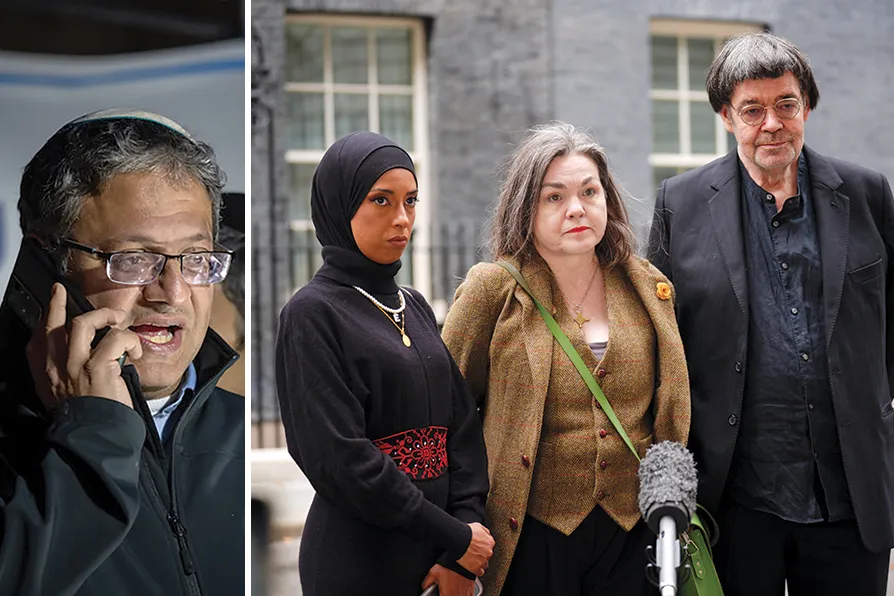
 CALL FOR ACTION: (L to R) Israel's national security minister Itamar Ben-Gvir; NUJ members (L to R) Mariam Elsayeh, Pennie Quinton and Mike Holderness, hand in a letter to No19, over the killing journalists in Gaza Pic (L): Shai Kandel/CC
Communist Party leaders Alex Gordon and Lorraine Douglas deliver vital medicines in trip to besieged socialist island
TUC Cymru is playing a leading role in tackling far-right ideas in the workplace, says LAURA DOEL
A New Delhi press conference in which Sheikh Hasina and her son implied the new order in Bangladesh is a security threat to India has sparked fears she is planning a comeback. SIAM SAROWER JAMIL reports on the fallout
Two months of student unrest have forced out India’s education minister and rattled the BJP regime. Could this be the beginning of the end for Modi, asks Communist Party of India (Marxist) general secretary MA BABY
MAT COWARD says the heatwave is a testing time for gardeners — but he has some tips





JOURNALISTS in Palestine marked World Press Freedom Day on May 3 with their union, the Palestinian Journalists’ Syndicate (PJS) organising a protest against the targeting by the Israeli occupation of journalists.
The protest was held simultaneously in the cities of Ramallah and Gaza. “Your presence is a scream of anger against the perpetrators of crimes against journalists,” the PJS told its members.
Crimes against Palestinian journalists are so rife, there’s a special term for it — journacide. It’s not a new term, but is not commonly used where the state of Israel is not involved.
An investigative journalist, Nick Turse, from Type Media Centre produced a paper in 2025 concluding that since October 7 2023 more journalists have been killed in Gaza than than during the US civil war, both world wars, the Korean war, the Vietnam war (including the conflicts in Cambodia and Laos), the wars in Yugoslavia in the 1990s and 2000s, and the post-September 11 war in Afghanistan, combined.
The International Federation of Journalists — the journalist unions’ union — reports at least 262 journalists and media workers have been killed since October 2023. Most were locals.
Torture in Israeli prisons
A shocking report from February by the Committee to Protect Journalists (CPJ) documented Palestinian journalists’ accounts of torture in Israeli prisons. Ahmed Abdel Aal remembered the moment the ear-splitting music started. For five days, he said, he was held blindfolded in a room in an Israeli detention site, stripped and beaten, while loud Hebrew and English songs played at an unrelenting volume.
Every time he drifted into unconsciousness, an electric shock or a blow jolted him awake, according to the report.
Another journalist, who asked not to be named for fear of reprisals, described similar treatment inside what detainees refer to as the “disco room.” He said soldiers bound his genitals with zip ties and beat him.
Israel a top jailer of journalists
The CPJ has documented the detention of 107 Palestinian journalists and one media worker in that period — 30 remained in custody, as of February 2026.
The CPJ’s 2025 Prison Census lists Israel as the world’s third-worst jailer of journalists since 2023. It began imprisoning Palestinian journalists rapidly following the start of the war on Gaza, it noted.
While conditions varied at different facilities, the methods those interviewed recounted were strikingly consistent.
CPJ regional director Sara Qudah said: “These are not isolated incidents. Across dozens of cases, CPJ documented a recurring set of abuse — from beating to starvation, sexual violence, and medical neglect — directed at journalists because of their work.
“They expose a deliberate strategy to intimidate and silence journalists, and destroy their ability to bear witness. The continued silence from the international community only enables this.”
The vast majority — 48 of the journalists — were never charged with any crime and were held under Israel’s notorious “administrative detention system.” This allows for an individual to be held without charge, typically for six months. It can be renewed indefinitely, on the grounds of preventing future offences. The remaining 10 were charged with incitement, anti-state activity or promoting terrorism.
Mustafa Khawaja, a journalist from the West Bank, said a beating in March 2024 in Shatta prison left him with fractured ribs, meniscus tears and spinal injuries. Another detained journalist, Mohammed Badr, said he was struck so hard his tongue was cut, leaving him barely able to speak or eat.
Other testimony included:
• trained dogs ordered to attack detainees
• metal instruments used to create long-lasting bleeding and scars
• intermittent use of electroshocking and pepper spray between beatings.
The Ben-Gvir effect
According to several testimonies, punishment took place shortly after a visit by Itamar Ben-Gvir, Israel’s national security minister. The minister has reportedly stated his pride in the worsening conditions of Palestinian prisoners in Israel. The CPJ said it emailed Ben-Gvir and the Ministry of National Security for comment but received no response.
The CPJ report documented reports of medical neglect — widespread scabies, unexplained rashes and boils, wounds stitched without anaesthetics, untreated bone fractures and eye injuries, asthma attacks, and the deliberate neglect of serious pre-existing and new health conditions.
Journalists also described unsanitary living conditions, chronic food shortages, and the complete lack of sanitary products for women.
Fifty-five of the 59 journalists interviewed reported extreme hunger or malnutrition. The CPJ documented 17 journalist testimonies involving sexual violence — including rape — and 19 more of humiliating strip searches.
Death threats
Numerous journalists report death threats. One called Amin Baraka said he was repeatedly interrogated for his work with Al Jazeera and threatened with violence against his family.
“An Israeli soldier told me, word for word in Arabic, that Al Jazeera correspondent Wael al-Dahdouh defied us and stayed in the Gaza Strip, so we killed his family, and we will kill yours too,” he said.
On April 22, the Israeli regime assassinated Amal Khalil, a well-known Lebanese journalist. She spent years documenting the lives of people in the south of the country amid Israeli invasion and bombardment. For two years, she received direct threats from the Israeli regime.
Reported allegations of torture, abuse and violence in Israeli prisons are not limited to journalists. The CPJ says the testimonies it collected of what Palestinian journalists experienced over the past two years is a systematic pattern of detention practices that rely on violence, humiliation and deprivation to intimidate journalists in Gaza and the West Bank.
The NUJ and its members have consistently highlighted and campaigned against Israel’s genocide in Gaza and passed motions in support of Palestinian journalists at its last delegate meeting.
Andrew Draper is a member of the South Wales branch of the National Union of Journalists (NUJ).
