


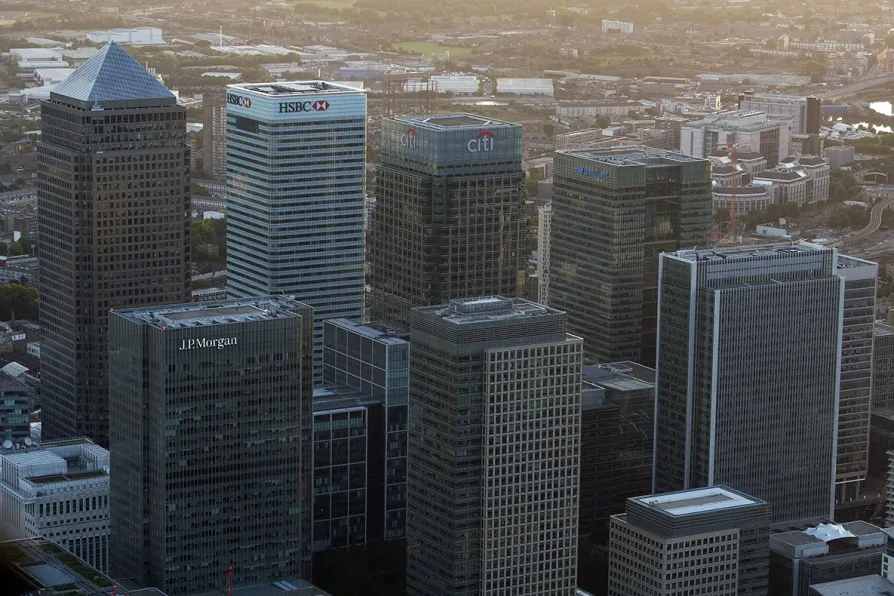
 An aerial view of the offices of HSBC, Citi, JP Morgan and Barclays banks in Canary Wharf, east London






ONE Labour official told the Financial Times this week that “this would be Labour’s first leadership election where the bond markets have a vote.”
That encapsulates the problem facing Labour as the Starmer maladministration enters its death agonies.
In not unrelated news, Jamie Dimon, boss of JP Morgan, has threatened to pull £3 billion in investment in Britain if Labour chooses a more left-wing leader.
The threat of market chaos hangs over the Labour Party as it considers the post-Starmer era.
It has been used as an argument for their being no post-Starmer era at all — the financial masters of the universe would get upset if their man in Downing Street was shifted.
The argument is that Britain has unsustainably high debt levels, and that the cost of servicing it escalates still further if speculators — the institutions that buy government bonds — get skittish and demand a higher premium for their cash.
That was the undoing of Liz Truss and Kwasi Kwarteng when their programme of reckless tax cuts threatened to inflate the deficit in 2022.
While their policies seemed wild enough, panic was reinforced by the sense that the government was in the hands of hare-brained fanatics bent on removing all institutional restraints on their profligacy.
That spectre has been used by Labour’s right-wing – above all Starmer and Chancellor Rachel Reeves – ever since to rule out any form of radicalism.
Indeed, as Diane Abbott pointed out, if the bond market gets a veto, then democracy dies.
It led them to ditch the £28-billion-a-year Green New Deal industrial investment plan before even reaching office.
It has since been used to justify Reeves’ commitment to the “iron fiscal rules” drawn up by the Treasury — this in turn led to disastrous decisions like the winter fuel benefit cut and the assault on welfare benefits.
In short, the fear of the bond market and its demands is used to keep Labour within the narrow tramlines acceptable to international capitalism.
Now it appears that a Labour leadership contest is unavoidable, following Wes Streeting’s resignation from the government today, the candidates must make it clear how, or if, they will break out of this straitjacket.
It may be assumed that Streeting, darling of the Labour right, will maintain continuity with the Starmer-Reeves policy on this point, and much else too.
Andy Burnham, whose potential route back into the Commons has opened with the resignation of Josh Simons MP, advocated relaxing the fiscal rules, but only to help fund the massive arms build-up Starmer has committed Labour to.
Angie Rayner has not addressed the issue directly, but it is rumoured at Westminster that she has committed to appointing a Chancellor from the party’s right if she succeeds Starmer in order to reassure the City.
Ed Miliband may have more radical instincts, but when he was Labour leader from 2010-15 he eventually committed to debt-cutting orthodoxy represented then by his shadow chancellor Ed Balls.
To turn the government’s fortunes around any candidate needs to find ways to spend more on meeting the people’s vital needs in the midst of a cost-of-living crisis, and to start investing in Britain’s industrial future.
In order to prevent the bond market derailing such a programme, tax increases on the wealthy and big business could ensure that borrowing requirements do not balloon, particularly if coupled with a dialling down of the unsustainable military spending increases.
Beyond that, there needs to be a plan to disengage from world capitalism and its pressures. That cannot be done overnight, but it is the only way to ensure that this is the last election to afford the specualtors a vote.
