


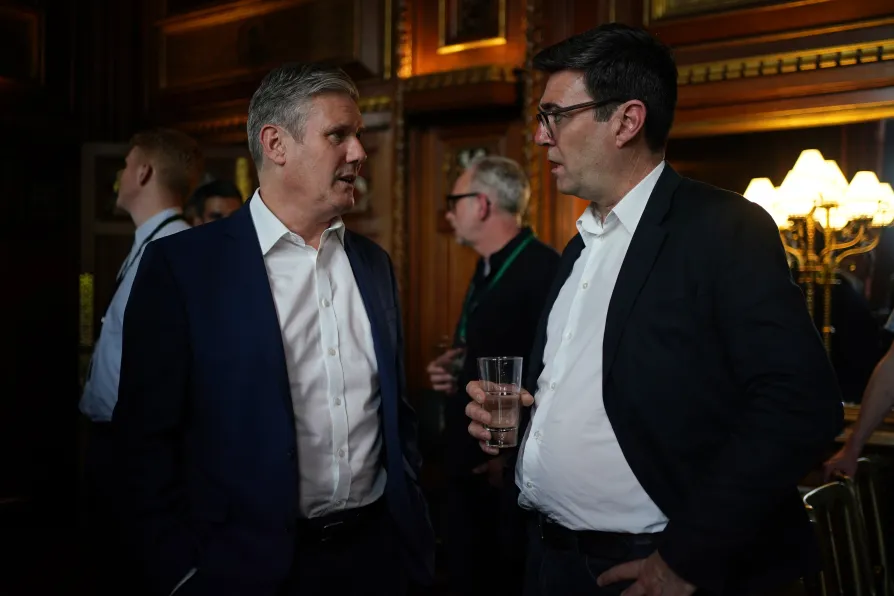
 Labour Leader Keir Starmer (left) with Mayor of Greater Manchester Andy Burnham, during an event discussing suicide prevention to mark Mental Health Awareness Week, at the Houses of Parliament in London, May 18, 2022





AS LABOUR turns its eyes to Andy Burnham as a possible saviour, rival demonstrations in London underline the depth of Britain’s political crisis.
The far-right — once again absurdly misnamed — “unite the kingdom” rally called by Tommy Robinson embodies a threat most Labour MPs have woken up to.
Reform’s sweeping wins at the May 7 local elections have precipitated a full-on political crisis.
Though a “Burnham bounce” based largely on popular loathing for Keir Starmer, whose exit now seems tied to the Manchester mayor’s availability to replace him, suggest Labour would be favourites to win a Makerfield by-election should Burnham indeed be the candidate, even he is only narrowly ahead of Reform.
A Reform win is a plausible outcome and would leave Labour with even fewer options than it has right now, besides reasserting the rise of intolerant nationalism as the dominant theme in British politics.
Robinson has chosen his demo date not to unite the kingdom of course but to maximise divisions by facing off against the annual Nakba demonstration, commemorating the expulsion of 750,000 Palestinians from their homes during the establishment of the state of Israel and demanding the UN-recognised right of return denied them and their descendants ever since.
The coinciding dates mean the Palestine solidarity demonstration will also take on a more specific anti-racist theme than usual — organisers promote it as “Nakba 78, March for Palestine, United Against Tommy Robinson and the Far Right” — while the far-right one will double down on Islamophobic and anti-Palestinian themes which anyway always feature strongly.
Listen to Labour ministers and both marches are a problem. The — real and alarming — rise in antisemitic attacks is blamed by both Labour and the Tories, with no evidence whatever, on the mass marches for Palestine.
It is Palestine solidarity demonstrations, not far-right ones, which ministers talk about banning and which are the intended targets of the repressive “cumulative impact” clauses added to the Crime and Policing Bill.
An absurdly biased Metropolitan Police — whose Commissioner Mark Rowley has smeared the Palestine Coalition with the false claim that it has tried to march past synagogues — will be using live facial recognition technology to police the demos for the first time.
Another ominous new development is the threat to hold organisations responsible for everything said from the stage, supposedly to crack down on “hate speech.”
A government that charges musicians with terror offences for allegedly unfurling a Hezbollah flag at a gig and a police force that rounds up pensioners by the hundred for holding placards saying “I support Palestine Action” are not trustworthy guardians of freedom of expression, and the warning to hold organisers responsible is — like the prosecutions of peace movement leaders Ben Jamal, Chris Nineham, Sophie Bolt and Alex Kenny — designed to intimidate the whole movement and make peaceful protest riskier.
Starmer-Labour clings to the illusion that it represents a sensible middle ground threatened by extremists of right and left.
It is itself extreme — in its authoritarianism and repression of civil liberties, in its dogmatic adherence to a bond-market orthodoxy that has gutted public services and British industry, and in its foreign policy alignment with the most aggressive states on Earth, the United States and Israel.
Its hostility to immigrants and hatred of the peace movement line it up, too often, with a far right that holds it and the whole labour movement in contempt.
Labour does not just need a new approach to public ownership or raising pay, though it does need both. Any leadership contender hoping for trade union backing should also clearly oppose the trajectory towards a police state.
The Saturday marches are not equivalent. The Nakba 78 march is for peace, justice, human rights and international law. Labour MPs should not be condemning it but joining its ranks.
