TUC president and POA leader STEVE GILLAN speaks to Ben Chacko on the eve of Congress 2026


 Latest editorial
Labour just about survives in the capital
KEITH FLETT looks at a post-election London
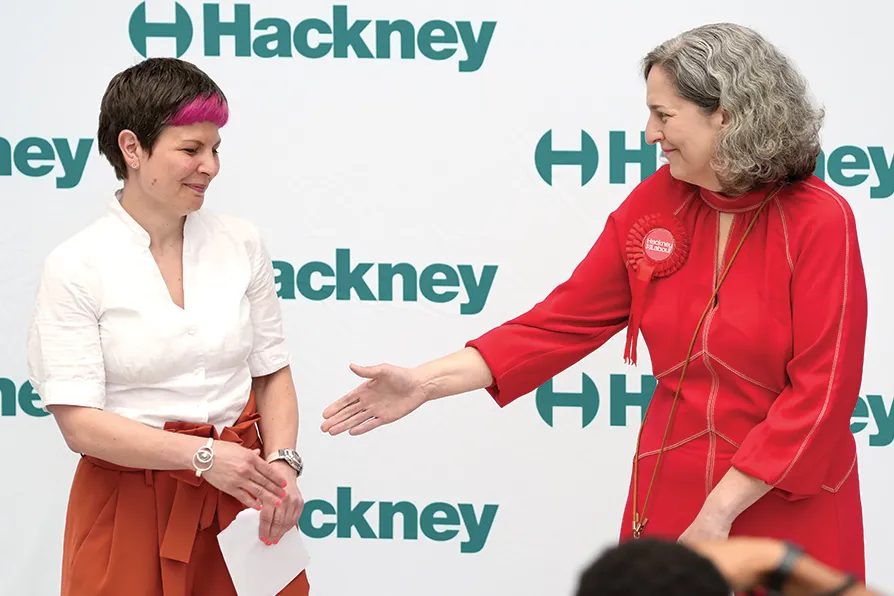 NO LONGER FRINGE: Labour candidate Caroline Woodley (right) shakes hands with Green Party candidate Zoe Garbett is elected mayor of London Borough of Hackney, Friday May 8 2026

DOUG NICHOLLS welcomes a turning point at this year’s Congress, where many motions call for a co-ordinated plan to revive British industry, a perspective outlined in his new book
HOPE VIRGO of campaign Dump the Scales warns MPs voting today they should be alert to the threat legalised assisted death poses to people with eating disorders
The Together Alliance is hosting two summits, North and South, to build power and plan action against the scourge of racism peddled by the right. DANIEL KEBEDE urges mass participation
The drift toward militarisation in Europe is not inevitable, left-wing and peace movements can preserve sovereignty and prevent war, says DÁIRE HUGHES MP
Whatever differences exist among international sympathisers of the Bolivarian revolution about its current trajectory, they should unite against the imperialist power that is the source of an enforced retreat, argues ROGER D HARRIS
Trade unions need to step up and force a turn in the policies of the labour movement to effectively confront the far-right threat, argues NICK WRIGHT





LONDON is a working-class city. It’s here we find, of course, the HQs of most trade unions and the Labour Party, mirroring the power structure of capital. But it’s a city with an organised working class and a labour movement.
As Eric Hobsbawm wrote in his essay on Labour and the Great Cities (New Left Review 1987) London became and remained a Labour stronghold after 1923 when it elected 20 per cent of the national total of Labour MPs.
Local elections in England on May 7 saw every seat on every council in London up for election.
As a labour movement activist and socialist in London for almost 50 years now, I’d also note that the London labour movement has echoed that of capital containing people from all over Britain who have come to work in London and indeed people from all over the world who have done likewise and are one of its great strengths.
It’s a reminder that London has not always been a Labour city. Liberals often held sway before the 1920s, although all men only got the vote in 1918 and women in 1928. Labour support was constructed from a working class that 100 years on remains central to the capital’s politics but has also changed in its composition significantly.
Hobsbawm saw Labour support built on distinct proletarian organisation, both in terms of trade unions but also football teams, like West Ham, Arsenal and Spurs. The political focus was on a good transport system and affordable housing.
The situation is of course not static. Hobsbawm notes the increasing division between where people work, in the city, and where they live, the suburbs.
While he sees a transition from a proletariat to a labouring poor in the inner city, in reality what exists is a modern working class — mostly not factory but office and service workers and consisting of a majority of women with a significant representation of ethnic minorities.
Unsurprisingly Reform polls badly here but Labour also struggles for several reasons.
First, because Labour councils over an extended period have managed cuts and decline of local services which affect the poorest the hardest.
Second, while in the 1980s some Labour councils recognised the changing nature of the electorate and declared nuclear-free zones and took action against apartheid South Africa, both of which were international issues that also had local impacts.
That broader sense of politics was lost in the New Labour era and it has remained lost. Hence the disconnect in the town halls between Labour and anger at genocide in Gaza.
The results in 2026 were not as bad for Labour as they were in May 1968, when all but three London councils went to Tory control. On this occasion while Labour lost seats and a handful of councils in the capital, the political generalisation was to the left of Starmer with the Greens winning seats.
Newly Green-controlled councils will come under pressure to implement cuts in services and Green councils where previously elected have had at best a mixed record on this. There will be battles to be engaged with and fought here.
It’s here that Hobsbawm’s analysis of Labour and the Great Cities remains key. It is working-class organisation, both in workplaces and communities, at the grassroots, that leads to support for socialist ideas and policies. It’s also that organisation that can build the power to make sure that those who voted for positive change on May 7 will actually this time get to see it.
