Cuban trade union federation CTC leader OSNAY MIGUEL COLINA speaks to Ben Chacko about life and work under a crippling US siege


 Latest editorial
Love, hope and unity on the streets today
As far-right rhetoric rises and political tensions deepen, an unprecedented alliance of organisations marches to assert that inclusivity, not exclusion, defines the majority, says STEVE GILLAN
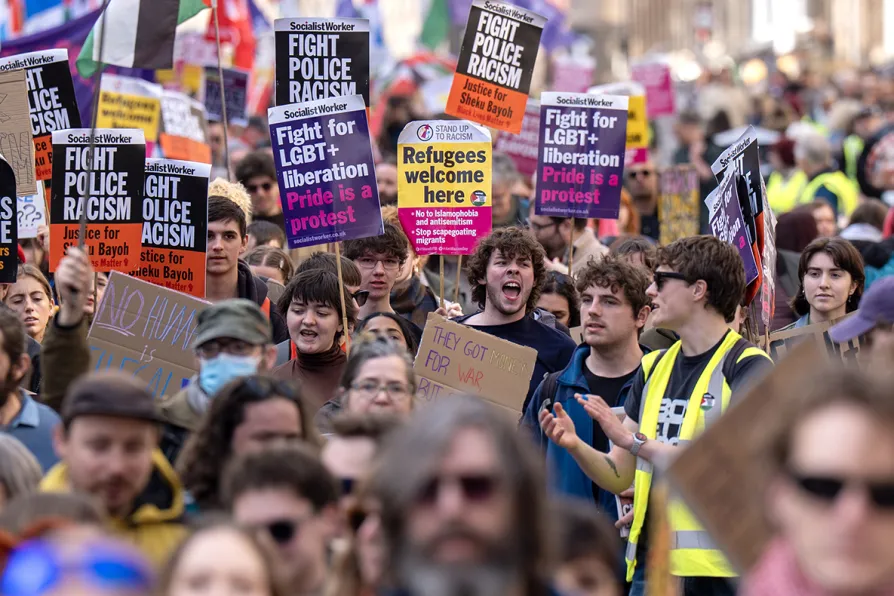 Counter protesters, organised by Stand Up To Racism, during an anti-immigration rally in Edinburgh, March 21, 2026
A part of the British empire’s network of slavery, today the Caribbean island of Nevis faces a new form of exploitation in the form of crypto-colonialism, CLAUDIA WEBBE writes
A new book by Victoria Holmes illuminates the many hidden histories of the oppression experienced by Gypsy/Roma/Traveller community, writes ROGER McKENZIE
Even the oligarchs of the artificial intelligence industries are warning that their creations have the capacity for the ultimate destruction of the planet and its population. ANDREW MURRAY suggests that there might just be other solutions
The Labour government must deliver on its commitment to bring back privatised services into the public sector. This not only saves money but also creates accountability and generates wider social benefits, argues ANDY MCDONALD MP
Public ownership of Great British Railways has enormous potential to improve our railway network, but that can’t happen unless jobs, employee rights and union recognition is at the heart of the transition, argues MARYAM ESLAMDOUST
Challenges from the unscrupulous misuse of AI to steal actors’ voice and physical likenesses is being met with a firm union response, writes LYNDA ROOKE





THE Together march today represents a significant moment of civic mobilisation in Britain. Far from being a routine protest, it reflects a broad-based effort by civil society organisations, trade unions and grassroots movements to respond to a growing climate of division, inequality and political polarisation.
Its importance lies not only in the issues we seek to address, but also in the coalition it brings together and the message we aim to project.
At its core, the Together march is a national demonstration in London organised by the Together Alliance, a coalition comprising hundreds of organisations representing millions of people. These include trade unions such as the POA, human rights groups, environmental organisations and anti-racism campaigns.
The scale and diversity of this alliance are crucial to understanding the march’s significance. It is not a single-issue protest but rather a convergence of multiple concerns under a shared framework of unity and solidarity.
One of the primary motivations behind the march is the rise of far-right rhetoric and activity in Britain. We wish to demonstrate the narratives of division, particularly those targeting migrants and minority communities. Trade unionists have become increasingly prominent in public discourse.
The march is therefore positioned as a counterweight to these trends, aiming to demonstrate that a substantial portion of the population rejects hate and exclusion in favour of inclusivity and co-operation. Equally important is the emphasis on human rights. Participating organisations will highlight concerns that rights and freedoms are being gradually eroded through policy decisions and political rhetoric.
By bringing people together in a visible and collective way, we seek to reaffirm a commitment to protecting these rights. In this sense the event functions both as a protest and as a public statement of values. Another key aspect of the Together march is its framing as a positive demonstration. Unlike many protests that are explicitly oppositional, we have stressed that this rally is not solely against something but also for something a unity, community and the common good.
This distinction is strategically important. By us focusing on shared values rather solely on grievances, the rally aims to broaden our appeal and encourage participation from individuals who may not always engage in political activism. The role of solidarity is central to the march’s significance. The Together Alliance repeatedly emphasises that meaningful change arises from collective action. In a context with social and political fragmentation can lead to isolation and a disengagement, events like this serve to rebuild a sense of collectiveness. They remind participants that they are part of a larger movement capable of influencing public discourse and policy.
Moreover, the march is designed to be highly visible. Public demonstrations have long played a role in democratic societies as a means of signalling public opinion. A large turnout can send a powerful message to policy-makers, media institutions and the broader public. In this case we hope that a strong showing will challenge the perception that divisive or exclusionary views are dominant, instead highlighting for inclusivity and social justice.
The timing of the rally also contributes to its importance. It comes at a moment when political tensions both domestically and internationally are high, and when debates around identity, migration and economic inequality are particularly intense. By mobilising people across the country, the Together march seeks to shape the narrative during this critical, asserting that unity is not only desirable but necessary.
In addition, the involvement of cultural figures and public personalities lends further weight to the event. Support from artists, actors and musicians helps to amplify its message and reached wider audiences. This intersection of culture and activism can be especially effective in engaging younger demographics and those who might otherwise feel disconnected from traditional political processes.
Ultimately, the importance of today’s Together march lies in our attempt to redefine the public conversation. It is an effort to move beyond fear-based narratives and towards a vision of society grounded in co-operation, equality a mutual respect. Whether measured by turnout, media impact or long-term influence, its success will depend on our ability to translate symbolic unity into sustained collective action.
In a time, characterised by division, the Together march stands as a deliberate and organised attempt to set a different vision, one in which strength is found not in exclusion but in solidarity. Let us not allow those who seek to cause division in communities and in workplaces to win. Together we can create the narrative that unity works for everyone.
Steve Gillan is general secretary of the POA and TUC president.
