


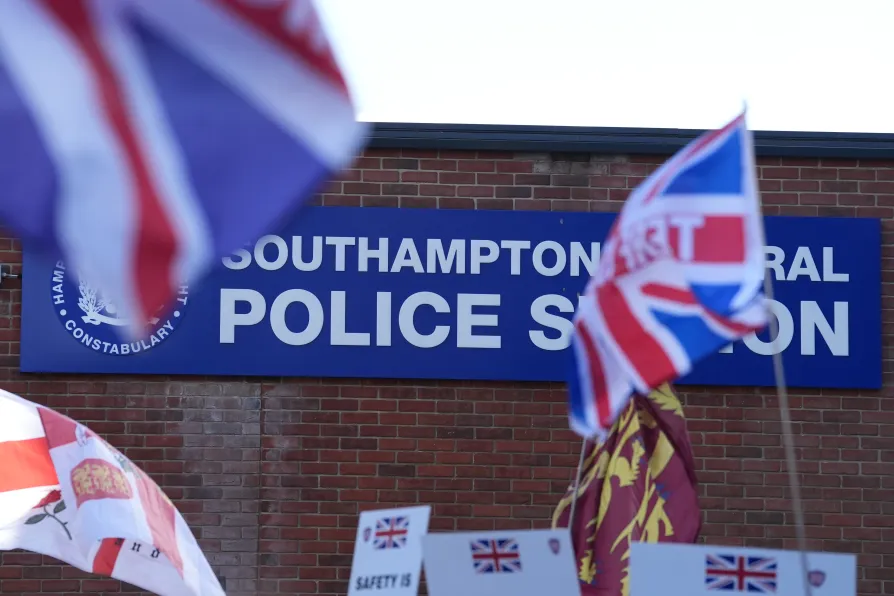
 People protest outside Southampton police station, June 2, 2026






NIGEL FARAGE is exploiting the police mishandling of a young man’s murder to fuel racial tension.
An investigation into how police misread the incident so disastrously, handcuffing Henry Nowak as he lay dying, is underway. His family have said they “do not want his death to be used to create further division, hatred or tension.”
The message is ignored by Farage, who seized on it to claim that “the rights and privileges of white people matter less than those of ethnic minorities” in Britain, before demanding Keir Starmer tackle “two-tier policing.”
His demand that the nation react with “cold rage” to Nowak’s murder was answered by the riot in Southampton on Tuesday in which a mob attacked police.
These are dangerous times. As we saw after the murder of three young girls in Southport followed by a wave of race riots in 2024, there are plenty of angry people ready to resort to violence if given an excuse — and cynical politicians providing the excuses.
If parts of Britain are a tinderbox the reasons include many rehearsed by this newspaper daily.
It is not unreasonable to feel those in power ignore your community and your concerns: this is the experience of most working-class communities, black and white, most of the time.
It is not unreasonable to distrust the police either: from Orgreave to the Spycops scandal and the murder of Sarah Everard, they have given us good cause.
The crisis in working-class representation — electorally as Labour has ceased to be recognisable as a workers’ party, industrially with the decline in trade union membership and socially through the decimation of communities by neoliberalism — means these grievances are no longer understood in class terms.
That opens the field to the racists and their lies.
To say that the police privilege black people over white people is completely untrue.
Research conducted by Inquest found that black people are seven times likelier than whites to die following restraint by police.
Dr Shereen Daniels’s 2025 report into racism in the Met found “force is more readily authorised” against black people while black children were victims of “adultification” and less likely to be treated as children.
Claims of “two-tier policing” are usually associated with public protest, and the false claim that right-wing mobilisations more harshly policed than left-wing ones. If arrests are higher, this is because violence is much more common on far-right demos — but, in the era of mass arrests for carrying Palestine Action placards, the notion that police are soft on the left is absurd.
Farage tries to extend it to wider policing, encouraging the idea that white people are oppressed. His aim is to scrap legislation and codes of practice introduced to counter state racism; he also lays the groundwork for the racially conceived “civil war” the likes of Elon Musk are already trying to provoke on Britain’s streets.
We cannot counterpose anti-racist work to class politics.
A class-conscious movement for change — one that wins confidence through battles for housing, pay and public services — is the only option for resolving the grievances the racists exploit.
But their misdirection has to be answered too. There is vast documentation of police racism in Britain. Measures to counter it are to ensure we are all equal before the law, not the reverse.
Building solidarity across communities and standing with each other when under attack is key. Misleading concepts such as “white privilege” (the absence of racial oppression is not a privilege) can be unhelpful: accusing ordinary people, most of whom struggle to get by, of being privileged divides worker from worker when we need unity.
Anti-racism is not a bid to disadvantage white people: it is a precondition of the working-class unity required to liberate us all.
