While riding the No 3 bus in Glasgow MATT KERR has ample time to dissect the moribund Scottish Labour decline into near oblivion and watch intriguing bus passenger dynamics


 Latest editorial

Pretensions to empire and a world at war
ANDREW MURRAY reviews a ruling class divided on how to adapt to Trump’s new world disorder — and the basis for united opposition to it
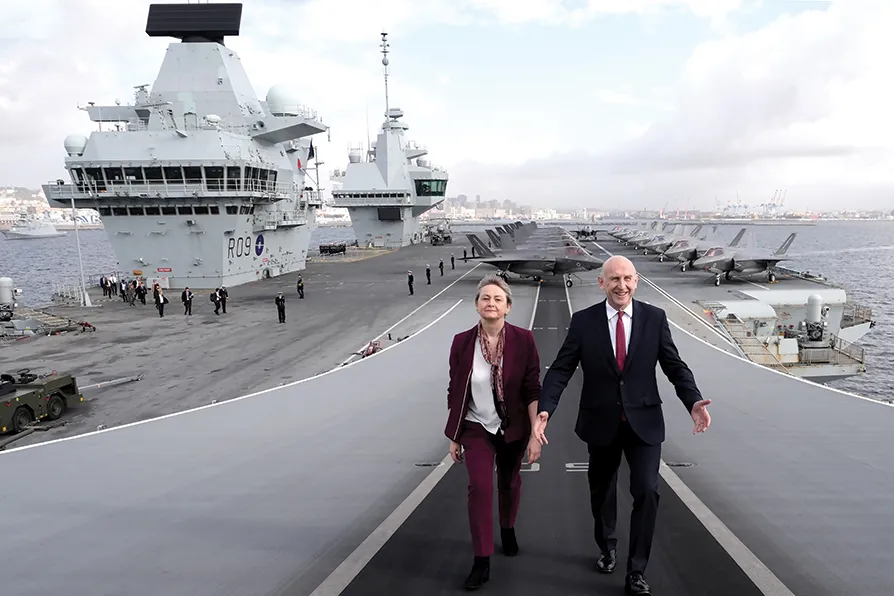 ON SECOND THOUGHTS: Defence Secretary John Healey and Foreign Secretary Yvette Cooper visit HMS Prince of Wales anchored in Naples bay last November. The aircraft carrier has now been redeployed to the Arctic for Nato exercise Operation Firecrest
The best wildfire service may begin with the community, argues KOMAL RAJ ARYAL
Dignity is important to all humans, argues the Marx Memorial Library and Workers’ School, but it does not come about automatically. In a less than perfect world, dignity can accompany suffering, but the collective dignity of working people is achieved through acting together to change the world.
The US aim to reshape the existing order in the Middle East needs to be resolutely resisted, argues PAYAM SOLHTALAB
Concessions to Washington by the post-Maduro leadership in Caracas are designed to preserve the core of the Bolivarian Revolution not betray it, argue Roger D Harris, Francisco Dominguez and Mara Paez Victor. How the solidarity movement responds is critical
ALMA EGAN suggests four days out that bring the region’s history of protest to life





THE Prince of Wales is definitely overstretched.
In Japan one moment, supposedly heading for the Middle East the next, and presently somewhere off Norway.
We are discussing not the heir to the distressed throne but the itinerary of the flagship of Britain’s fleet, one of its two sporadically functioning aircraft carriers.
Spread thin hardly does justice — pretending to fly the flag on which the sun never sets, when in fact it very much has, is a demanding enterprise.
Still, there was some surprise when the carrier believed to be heading towards the Iran war zone turned the other way upon leaving the port. It turned out that this was not another mechanical failure because its destination actually was the far north.
Defence Secretary John Healey — whose career attained its apogee writing press releases for the TUC 30 years ago — has attempted to give these peregrinations a unifying theme.
It is Russia. The carrier was conducting exercises with Japan to “counter Russian imperialism,” presumably because Healey was under diplomatic orders not to mention the real target — the containment of China’s national and political aspirations.
The Prince of Wales is presently Arctic-bound to help plug a supposed “northern gap” through which Russian submarines are poised to pour, as per MoD press releases.
Had it instead headed for the Gulf, it would be to assist in a war in which behind Iran one may find “Putin’s hidden hand” — again Healey’s words.
All this frenzied charging hither-and-thither can be read two ways, both true. First, British imperialism is dragging the British people towards disaster, imperilling our future in a way it has not directly done in generations.
Second, the same British imperialism is a bluff waiting to be called.
To take the second point, the gulf between the establishment’s pretentions and its military capabilities is considerable, and the source of great angst on the political right.
“Global Britain” and “Nato first but not Nato only” are their slogans and yet here is the Prince of Wales, like the hero in Beau Geste, maintaining the illusion that the empire still fires from every rampart.
The decline of British imperialism is not a new story of course. Its landmarks — two world wars, the rise of mighty national independence movements, Suez etc — are well-known.
For generations, however, this was masked by a subordinate alliance with its successor as capitalist world hegemon, the USA, and never more so than in the post-1991 unipolar world order.
A succession of recent setbacks have imperilled British imperialism’s position still further — military defeat in Iraq and Afghanistan, prolonged economic slump and stagnation since 2008, undercutting the basis of neoliberalism, and now the lurch of the US into authoritarian and unilateral gangsterism.
One faction of the bourgeoisie — Farage, Badenoch and Blair — are desperate to cling to the old forms and alliance, bending only in the face of public opinion. They are deeply distressed that Britain was not at Trump’s elbow in the aggression, partying like it was still 1956, and that our military budget, although still the world’s sixth largest, does not permit an aircraft carrier in every port.
Another faction believes that it is only through maintaining the pretence of the sanctity of legality and international institutions that British finance capital can hope to sustain its present world role. That is where Starmer uneasily sits, wanting to be the US’s best ally, but a more “normal” US please.
There is no discernible difference, however, on the politics of escalating militarism, the development of a war psychosis, and the subordination of the needs of working people to the headlong arms build-up.
Nor, indeed, have the two positions ended up so far apart on Iran. Starmer, having engineered appropriate legal advice to cover his shift in position, is wading ever-deeper into the illegal aggression, whatever verbal gymnastics he obscures this with.
Not only has he placed no practical impediments on the use of British bases by the US for its attack, he is redeploying military assets to the region at pace, having creatively upgraded the Iranian response to being attacked to “unprovoked” and “offensive.”
He speaks of “de-escalation” yet the Defence Ministry boasts there are now more British fighters in the Middle East than at any time since the Iraq war.
Moreover, Starmer is bent on confronting Russia wherever it is and wherever it isn’t, whatever the cost to the British economic and popular wellbeing.
After the impoverishment, and with the whole of society manipulated onto a “war footing” will come the bloodshed. Today’s neocolonial wars will be succeeded by even larger conflicts, against Russia, China or both. Will Britain even survive?
Yet the bases of this enterprise are rotten. Neoliberalism’s death throes have beggared the economy, exacerbated social divisions and discredited the political leadership.
One response is all too clear. The Farage-Badenoch plan is for an intensification of neoliberal methods buttressed by a new authoritarianism, propped up by uncritical subordination to Maga, and concealed by super-charged culture-war antipathies.
It is the road of repression and war — war to prolong a world order already manifestly collapsing. The depravity of the Farage-Badenoch programme is an earnest of the straits British imperialism finds itself in, with its “special relationship” hanging by a Trumpian thread, its economy enfeebled and its military resources well adrift of imperial aspiration, but that is no guarantee of its success.
On every point — the war in Iran, the full return to Thatcherism, the assault on freedoms — it is rejected by the majority of the people, a majority that is crying out for coherent political articulation. That is the most critical weakness, the essence of the as-yet uncalled bluff.
Unity in opposition is as ever the key. For example, there is no worthwhile anti-imperialism which does not also foreground the struggle against anti-Muslim hatred, daily more unchained, here in Britain.
And no worthwhile response to the economic crisis which pivots on further arming the British state to support its multiple aggressions.
British imperialism, the infrastructure which sustains the coercive transfer of value from across the world into the pockets of the City of London, is no paper tiger, but it is no king of the jungle either.
It is as rudderless in the new situation as one or other of its aircraft carriers are on any given day. Britain has a stark crisis of political leadership and legitimacy, and the coalition that can offer a people’s response is slowly coming into view.
The catalytic factor must come from within the labour movement. The position is different to the 1930s, when the imperialists gambled with the people’s future.
Then Labour was in opposition and in no immediate position to affect the parliamentary leadership, even if it was ultimately decisive in the eviction of Neville Chamberlain in 1940.
Today, it is in a more responsible position still — it can strike the decisive blow for a new policy before global war has commenced. And keep the Prince of Wales and John Healey in port.
The impact of 1956: thoughts from Willie Gallacher
My first Communist Party branch meeting, half a century ago, was not supposed to be a row about the 20th congress of the Communist Party of the Soviet Union twenty years earlier, but it ended up as one.
The arguments were already familiar to a generation of Communists and they remain alive to this day.
There may be no fresh perspective to bring to bear, so here is an old one, courtesy of the Willie Gallacher papers in the party’s archives in Manchester.
The legendary founder of the party and its most celebrated MP wrote privately to the party leadership in March 1956, as the controversy was getting its first airing: “I would strongly object to any attempt to minimise the mighty service Stalin gave to the people and the international working class.”
The 20th congress was about more than the “cult of personality.” It also proposed new strategies for the advance to socialism, something already developing in some parties, including the British. “Peaceful transition” moved from possibility to dogma, in Europe at least.
Gallacher was not enthusiastic about that either. “With our policy gone there will be little justification for our party,” he wrote in a letter the next month. “The Tory Party playing loyal opposition means no ‘dictatorship of the proletariat’ and no dictatorship eliminates the need for…a party of a new type.
“Do we try to stabilise capitalism or do we try to…knock it out of business?” he asked.
Not the final word on anything, but Willie Gallacher was more militant, class-conscious and well-versed in Marxism than almost any subsequent working-class leader. He has earned a hearing from history.
