
The UK Prime Minister may have the regal touch in northern England, but he’s been wrong-footed on the constitutional challenges posed by the Celtic Alliance of first ministers from Scotland, Wales and Northern Ireland, argues KENNY MacASKILL

What is superexploitation?
As capitalism lurches from crisis to crisis, more and more workers are ‘superexploited’ – they receive less than the minimum deemed ‘socially necessary’ to support themselves and produce the next generation of workers, writes the Marx Memorial Library and Workers’ School
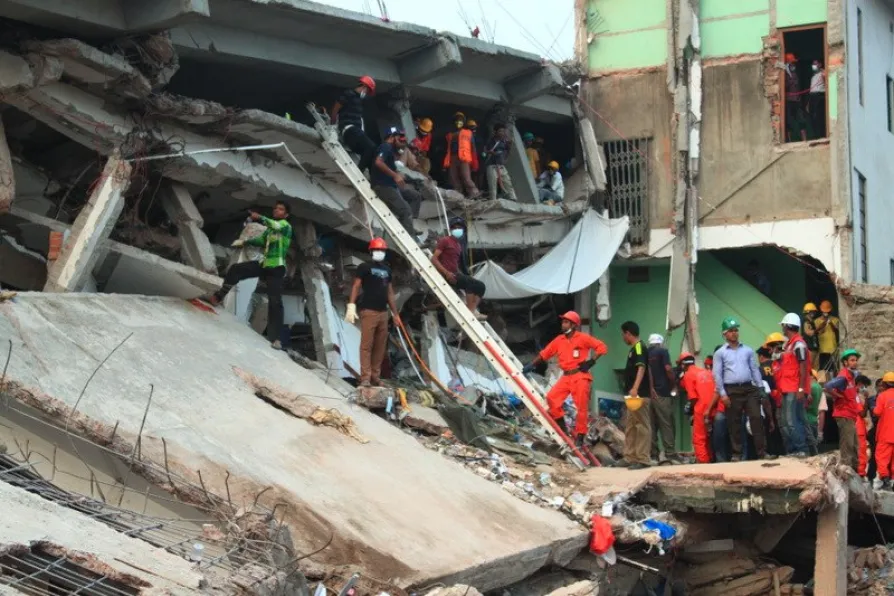
 A side view of the collapsed Rana Plaza building, which collapsed due to structural failure in 2013 [Pic: Sharat Chowdhury/Creative Commons]

NEIRLAY ANDRADE, a member of the Communist Party of Venezuela’s political committee, outlines her party’s position on the crisis facing the country
A look at Taylor Wimpey’s accounts shows why Labour’s market-led housing strategy won’t deliver more, cheaper homes, as promised, says SOLOMON HUGHES
DAVID HORSLEY remembers the remarkable life and death of US black revolutionary George Jackson, whose politically passionate prison letters were published as Soledad Brother
Cuban trade union federation CTC leader OSNAY MIGUEL COLINA speaks to Ben Chacko about life and work under a crippling US siege
A part of the British empire’s network of slavery, today the Caribbean island of Nevis faces a new form of exploitation in the form of crypto-colonialism, CLAUDIA WEBBE writes
Challenges from the unscrupulous misuse of AI to steal actors’ voice and physical likenesses is being met with a firm union response, writes LYNDA ROOKE





AN EARLIER Full Marx feature (the first in the series) explained that the term “exploitation” — colloquially used to mean taking unfair advantage of someone, emotionally or physically — is used by Marxists in a very specific, technical sense, relating to the way in which goods and services are produced and traded under capitalism and who benefits.
A unique feature of humans is labour — the production of “use-value,” the basis for survival. Its products, and the way they are produced has changed through history, and in class societies involves power relations and the appropriation of part of that product by a ruling class.
Under capitalism this typically takes the form of waged labour, where workers are paid only a part of the value of what they produce — generally enough to feed, clothe and house themselves and their families and to produce the next generation of workers. The rest — “surplus value” — is taken by the owners of capital as interest, rent or profit, invested in more capital to make more profit.
That’s “exploitation.”
So — what about “superexploitation” — a term increasingly used as people realise the complex ways in which capital exploits people, individually and collectively? The concept goes beyond the basic Marxist understanding of exploitation by suggesting an intensified and oppressive form of exploitation that systematically limits or threatens a worker’s health, happiness and sometimes their life or life expectancy.
Neither Marx nor Engels used the term “superexploitation.” However its features were clearly identified in Capital as the “forcible reduction of wages below their value” and as one of the factors which capitalists could use to offset the tendency of the rate of profit to fall. In his discussion on primitive accumulation Marx documented instances of non-salaried labour, such as colonial slavery and coercive indentured or bonded servitude, where labour power is depredated, disposable and devalued.
Later Marxists coined the term “superexploitation” in recognition of the fact that this “depressed consumption” is by no means an exceptional case but rather a permanent and structural feature of capitalism. This is particularly the case in the global South whose ruling classes compensate for their unfavourable position in unequal international trade by remunerating labour power below what would otherwise be deemed necessary to support their workers and their families. Much of the extra surplus value is then realised in the capitalist nations, helping to sustain their financial and military superiority.
Superexploitation is central to the relationship between the imperial capitalist “core” and its neocolonial “periphery” — a key element of “dependency theory” (the subject of an earlier Q&A). It is a structural feature of the global economy, where it helps maintain higher profits (and concessions to labour like the British “welfare state”) in the imperial metropolitan centres.
It relies on global supply chains and sweatshop labour at the expense of workers (including women and children who often endure appalling conditions for minimal pay) in sectors ranging from mining and manufacture (especially of and for electronics and technology) to agriculture and food processing in the “periphery” of the global South.
Key features include paying workers less than a “living wage” — what would “normally” be considered necessary to maintain themselves and support a family, often involving long hours of intense effort in unsafe working conditions, frequently leading to physical or mental exhaustion or ill-health.
Workers themselves are made to pay: sometimes with their lives. Only rarely do the consequences hit the headlines, as in the 2013 Rana Plaza factory collapse in Bangladesh, which supplied brands including Primark. This exposed the fatal consequences (1,134 dead and some 2,500 injured) of poor safety standards resulting from cost cutting and profit-seeking.
Engels himself compared the appalling conditions of workers in British colonies with marginalised working-class groups like Irish immigrants in England and rural cottage industry workers in Germany, where workers were systemically underpaid and survived only because they had some other means of subsistence, including charity or perhaps a small garden.
Today as global capitalism lurches from crisis to crisis, superexploitation is becoming increasingly common in the capitalist “core” nations. In Britain it’s manifest in the increased use of zero-hour contracts, piece work and phoney “self-employment.” These are particularly prevalent in hospitality, retail and social care.
The result is financial precarity: unpredictable income and debt bondage, making budgeting and securing things like rental agreements or loans extremely difficult. Many, especially young people today, have long since abandoned any expectation of being able to rent (let alone buy) their own home and live in shared accommodation or with their parents or friends.
Many workers feel immense pressure to accept every shift offered for fear of not being allocated future hours, placing them at the mercy of managers. Employers use zero-hours contracts to evade obligations such as paid sick leave, maternity pay and redundancy payments, further depressing the overall incomes below what is socially necessary for a worker’s wellbeing.
Piece rates (payment per unit of work delivered) are often set so low that workers struggle to earn a living wage, despite working long and intense hours and they may push themselves to extreme physical limits or involve unpaid family members in an effort to meet quotas, leading to exhaustion and health issues.
Similar problems arise from the “voluntary” commitment of teachers, NHS nurses, doctors and paramedics, praised during the Covid pandemic and largely ignored since by governments — both Tory and Labour.
Superexploitation is often enforced through mechanisms like the creation of “reserve armies” of labour (unemployed and underemployed populations), the use of restrictive contracts, the suppression of labour rights and unions, and the use of racial and gender discrimination to justify unequal pay. “Flexibility” for employers often translates into financial insecurity for vulnerable workers.
All this is compounded by widespread wage theft and deception: there have been numerous reports of migrant farm workers being underpaid by hundreds or thousands of pounds, with employers sometimes creating false payslips to cover their tracks. Here in Britain, Leicester garment industry workers report earning as little as £3 to £4 an hour; far below the legal minimum.
Some examples of superexploitation have become official policy. With approval of the Home Office, those held in immigration removal centres (IRC) can be paid the paltry sum of £1 per hour for work — cleaning, maintenance, kitchen work etc — that keeps them running. It can be argued that such payments — on top of accommodation costs — are to the benefit of inmates: however they also contribute to the superprofits — from 25 per cent to over 40 per cent — of private companies such as G4S, Serco and Sodexo.
The concept of superexploitation has also been expanded to incorporate race and gender, analysing who the “superexploited” are within specific national and global contexts. This includes the disproportionate representation of ethnic minority and immigrant workers in underpaid domestic work (mainly women) and “gig” work (mainly men). It has progressed from a descriptive observation to a theoretical and analytical tool to examine the survival mechanisms of global capitalism.
Earlier Q&A – on value, wages and exploitation, primitive accumulation, the social wage, dependency theory and on housework can be found on the Marx Memorial Library and Worker’s school website https://tinyurl.com/FullMarx which also has links to their text on Morning Star Online. MML&WS upcoming events include an exhibition on the social impact of design at the London Museum (Wednesday February 25) and an online seminar on the 1918 equal pay strike together with the General Federation of Trade Unions and the Working Class Movement Library (Thursday February 26).
