The attacks on black academics are well-funded and relentless, writes DIANE ABBOTT, and they need to be fearlessly resisted by all concerned



De-banking - a new form of censorship
JOHN GREEN argues that the spreading practice of closing bank account without proof of criminality is an infringement of an elementary human right
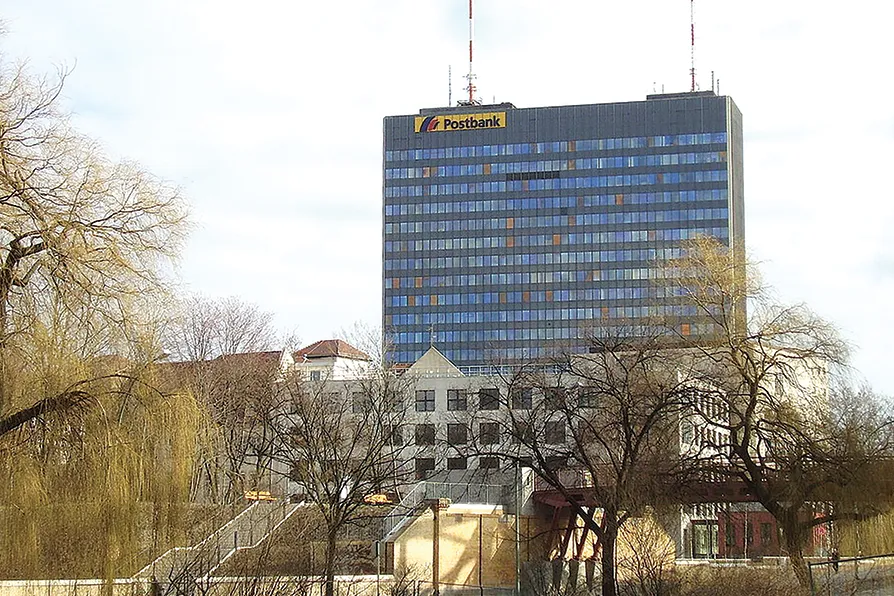
 TAINTED PAST REVISITS PRESENT: Postbank in Berlin [Pic: EmptyTerms/Creative Commons]
Extreme hot weather resulting from environmental change needs to be tackled through greater firefighting investment instead of fewer jobs and less resources, writes COLIN BROWN
There are many intricate details about the new Saudi, Turkish and Pakistani alliance we do not yet know, suggests ROGER McKENZIE, but its impact could be considerable
Holyrood incompetence has cost jobs and put the future of Clydeside’s Ferguson Marine shipyard into jeopardy. Its future should have been assured, argues KENNY MACASKILL
Hot and dry conditions are threatening British species unequipped for drought, explains PAUL ASHTON
The Baltic state is set to reverse its constitutional prohibition on nuclear weapons and foreign bases as part of accelerated Nato war preparations, warns TOM UNTERRAINER





A NEW and insidious form of censorship and infringement of democratic rights is happening before our eyes, but few will have heard about it. It’s called “de-banking.” It involves the closure of bank accounts of organisations and individuals, thus denying them access to any form of banking, credit cards, loans, etc.
In today’s world, that amounts to economic ostracism and ruin for those hit by it. There is no legal justification for such actions, and they are often taken by financial institutions unilaterally, even if under pressure from state agents.
In Germany such action has now been taken to an extreme. The Postbank (a subsidiary of the Deutsche Bank) is losing accounts of associations dedicated to supporting victims of the Nazis.
The bank has closed the accounts of the anti-fascist VVN-BdA (Association of those persecuted by the Nazi Regime — Federation of Anti-fascists). In doing so it illogically cites the parent company Deutsche Bank’s commitment to Israel.
The association has criticised the closures as a contradiction of Deutsche Bank’s efforts to deal with and come to terms with its Nazi past.
It is an irony of history that it is the Postbank, a subsidiary of Deutsche Bank, which had Nazi ties, that is now kicking anti-fascists out of the door: It has terminated the accounts of four Berlin associations belonging to the Association of Victims of Nazi Persecution/League of Anti-Fascists.
Those affected are the regional association and three other non-profit associations. The terminations take effect on March 31 2026.
After 1933, Deutsche Bank “Aryanised” its board of directors and participated in the plundering of Jewish assets and the countries invaded by Germany.
In a statement the organisations hit by this measure stated: “It is quite something that Postbank, a subsidiary of Deutsche Bank, is closing the accounts of anti-fascist associations.”
The motives for the terminations are unclear. Is it carried out on the basis of surveillance carried out by the German domestic intelligence service, or as compliant accomplice to a ban on anti-fascist organisations by the Trump administration?
Deutsche Bank emphasises its commitment to combating anti-semitism and coming to terms with its Nazi past. It supported the illumination of the Brandenburg Gate with candles by the “Nie wieder ist jetzt” (Never Again is Now) initiative — a
symbolic gesture warning everyone not to forget the atrocities committed by the Nazis.
But while Deutsche Bank is supporting this initiative with €1 million, its subsidiary, the Postbank, is closing the accounts of anti-fascist associations.
The Association of those persecuted by the Nazi regime — Federation of Anti-fascists was founded in 1947 by concentration camp survivors, in other words, by the very people whom the bank once expropriated.
The fact that a bank spokesperson describes the accusations that the bank is discriminating against the victims of the Nazi regime as “incomprehensible” demonstrates either a total lack of awareness of the problem or deliberately feigned ignorance.
A bank spokesperson emphasised the bank’s commitment to combating anti-semitism. It supports the Yad Vashem Holocaust Memorial, publicly condemned the Hamas attacks of October 7 2023, and, as part of the “Never Again is Now” initiative, donated €1m to charitable organisations which teach tolerance and empathy to young people.
Those who take a stand against anti-semitism but at the same time support a government that disenfranchises Palestinians are practising a highly selective form of solidarity.
The Israeli government is pursuing policies that are condemned internationally as right-wing extremist and fundamentalist — and with the systematic displacement of Palestinians from the West Bank, the further expansion of illegal settlements and a
policy that is described as apartheid. This, however, does not seem to concern Deutsche Bank.
This latest case is only one of a series of account terminations against politically active organisations. Just recently, Sparkasse Gottingen terminated the accounts of the prisoner aid organisation Rote Hilfe (Red Aid), citing the US sanctions list.
For years now, organisations and individuals across the political spectrum have been losing their bank accounts. Often without any comprehensible justification and frequently in close proximity to public debates.
Left-wing associations are particularly affected, but also local branches of the right-wing AfD (Alternative for Germany), critics of coronavirus measures and journalists of various political persuasions. Banks usually invoke their freedom of contract to take such measures.
Organisations like PEN International are warning of an “indirect form of censorship” through such account closures. The ability to silence unwelcome voices by withdrawing financial infrastructure jeopardises fundamental democratic rights, they say.
Account closures targeting political actors are, though, not only happening in Germany.
In Britain, there are similar cases. Recently, a retired British couple, members of a grassroots pro-Palestine organisation had its bank account frozen and they too have had their joint personal account closed without explanation.
John Nicholson and Norma Turner, who, as treasurer and chair respectively, were signatories to the Greater Manchester Friends of Palestine (GMFP) account with Virgin Money, said their account with Yorkshire Building Society (YBS) was intended as a nest egg.
The Co-op bank recently faced legal action after launching an attack on British Palestine solidarity groups, closing their accounts and refusing to handle their finances. The bank said its action was based on “risk appetite,” whatever than means.
There are also the cases of numerous Russian-born individuals in Britain who have experienced bank account closures or freezes due to tightened sanctions and increased de-risking by financial institutions following the Ukraine conflict.
British banks have often engaged in “blanket” closures of accounts belonging to Russian and Belarusian-born citizens to “comply with anti-money laundering regulations and sanctions.”
In Switzerland, there is the case of Jacques Baud, a former Swiss officer and agent of the Swiss Federal Intelligence Service (FIS). Last December, the EU slapped him with sanctions barring him from travel and freezing his bank accounts. The measures hit him harder than many sanctioned Russians. He lives in Brussels.
The same has happened to Nathalie Yamb. The Swiss-Cameroonian dual national has been sanctioned since last summer. Unlike Baud, Yamb still enjoys a certain degree of freedom of movement. Based in West Africa, the influencer thanked Niger’s rulers in August last year for appointing her as a special adviser and for giving her a diplomatic passport, which she has since used for an official visit to Venezuela.
Baud’s case is different. He is accused of appearing in Russian media and acting as a mouthpiece for pro-Russian propaganda. A quick search reveals one of his appearances on Sputnik International’s Telegram channel.
Baud is number 57 on the EU sanctions list. The next individual on the list, number 58, is sanctioned on similar grounds. He is a French national and former military officer. A military background is thus likely to play a role.
Baud positions himself as a military expert and analyst. In his 2024 book The Russian Art of War, he spells out the rationale behind Russia’s invasion of Ukraine.
Our government needs to be pressed into introducing new legislation to guarantee everyone’s access to banking facilities. Today such a right is almost as important as a right to clean water, food and shelter — a fundamental human right.

Similar stories

Faced with crises in every direction, Volodymr Zelensky is rewriting his country’s complex history by paying homage to the founding fathers of Ukrainian ultra-nationalism and courting their modern heirs, writes KENNY COYLE

SEVIM DAGDELEN asks why the European Union is targeting the Swiss academic Jacques Baud, cutting off his access to banking services
Western nations’ increasingly aggressive stance is not prompted by any increase in security threats against these countries — rather, it is caused by a desire to bring about regime changes against governments that pose a threat to the hegemony of imperialism, writes PRABHAT PATNAIK

After NGOs and the EU, UN condemns Germany’s crackdown on Palestine Solidarity, writes LEON WYSTRYCHOWSKI