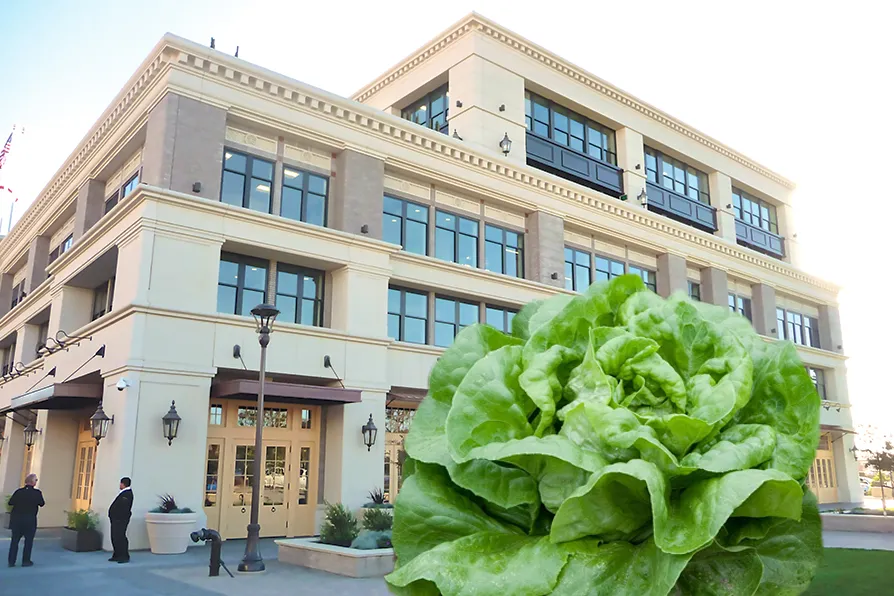
ROB WARZYNIAK recalls the emblematic 1906 book, The Jungle, in its analysis of the crisis presently engulfing the US Food and Drug Administration


 Latest editorial

Join us as the Daily Miracle faces its next test
The Morning Star’s AGM tour comes at a critical moment for both the British left and the newspaper itself, as it battles political fragmentation and media industry upheaval. Editor BEN CHACKO issues a clarion call to readers to play their part in the coming period
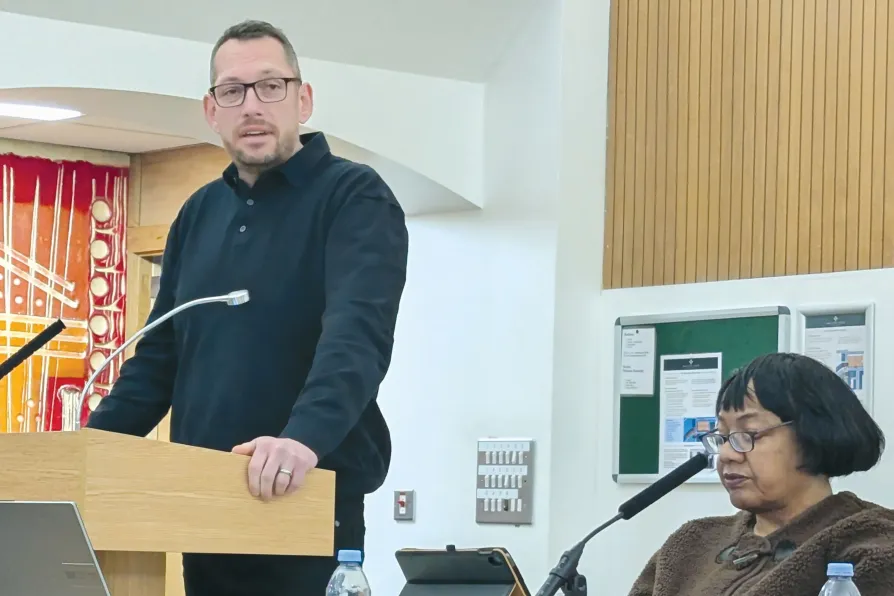 FBU leader Steve Wright and Diane Abbott at the Morning Star conference in AprilFBU leader Steve Wright and Diane Abbott at the Morning Star conference in April
Welsh wanderings showcase fiery destruction, alternative water ways and revive memories of a local mining legend, writes MARK SEDDON
As thousands die in the eastern DRC, a global health emergency is being starved of funds, says S KRISHNASWAMY
MAT COWARD explains how in the 17th century a row over whether to kneel at communion became a battle over religion, class and royal power
Renewed illusions in social democratic reformism are sprouting as a result of Andy Burnham’s rhetoric, but material conditions are already intruding into the debate, argues NICK WRIGHT
Andy Burnham could learn a few lessons from a previous Labour government in the pre-privatisation era on how to tackle water shortages, writes KEITH FLETT





THIS week the Morning Star hits the road — our annual travelling AGM kicks off this Thursday evening in London.
On Friday night we’ll be in Glasgow, before heading to Sheffield on Saturday and Cardiff on Sunday reporting to our readers and debating our paper’s priorities for the next year.
I hope to see as many of you as possible on that tour. The challenges facing our movement are huge — and so are those facing the daily paper of that movement. Labour’s long monopoly on the left-of-centre vote has gone, but the party of organised labour has not been replaced.
The left vote is fragmenting — to Greens, to independents, to nationalist parties — but none of these alternatives are rooted in the trade unions and most are not socialist.
The same could be said of a majority of Labour’s elected representatives at all levels, but conversely most of the remaining union-oriented MPs, councillors and so on are still Labour, and most unions still see the party as the most logical vehicle to advance their demands.
For all the awfulness of the Starmer regime and its determined effort to destroy Labour as a grassroots force, no assessment of the British left can write off Labour members, even if it would be equally wrongheaded now to treat Labour as the only game in town.
That presents us with two big political challenges: how do we ensure that class politics doesn’t disappear in a fragmenting left? And how do we build the necessary unity of action to defeat the threat of the far right if the left vote is scattering in all directions?
We see the Morning Star as playing a crucial role in both.
As a platform, it brings together more of the left than any other — a glance at our pages will show they are open to the whole of the left, with contributions from Labour, Greens, Communists, nationalist parties and socialists of various traditions; from right across the trade union movement; and from activists across the peace, anti-racist, women’s movements and more.
That is replicated at our conferences (this year’s, in April, being the biggest yet) and at local level via Readers’ and Supporters’ Groups (RSGs). These in particular have a place when it comes to bringing left voices together, regardless of party affiliations, to discuss and determine the way forward.
The Morning Star can do that because of its unique structure — a co-operative owned by its readers and by the trade union movement.
Any shareholder has the right to attend one of our four regional meetings and vote on the composition of our management committee (which appoints the editor and business manager) as well as resolutions on our priorities and direction (which any shareholder who can find a seconder has a right to submit). No matter how many shares you own, you have an equal vote.
Besides individual shareholders, we have 13 national trade unions and one trade union region holding maximum shareholdings (£20,000) which give them a seat and a vote on the management committee alongside those members elected at AGM.
This makes the Morning Star unbuyable, the only example of media owned and controlled by our class in the national press.
It is not subject to the whims of a wealthy owner and is rooted in the labour movement not just in its ownership model but in its history, back through the Daily Worker and its predecessor titles to the General Strike and beyond.
This is the paper whose founding editor covered the Spanish civil war on the front line, the paper that brought out a special edition to mobilise against the Blackshirts at Cable Street, whose printing presses were destroyed by Luftwaffe bombs.
Over the decades it was the paper exposing imperialist war crimes in Korea, the first to cover the Grunwick strike, the only one to stand with the miners. And it stays true to that tradition today: the only daily that campaigns against the drive to war, that prioritises unions and their disputes, a vital voice for our movement that must never be silenced.
Some say printed newspapers are on the way out. We don’t believe that.
Our own sales, both in print and online, continued to rise last year, admittedly not by much but bucking a trend of decline across the industry; Morning Stars are a valued presence at demonstrations and conferences.
Our online readership has grown and we want and need to diversify our online content (find out more at the AGM), but print sales remain our biggest source of income by a big margin, and a Morning Star that was no longer “the daily paper of the left” would be a fading presence. A resolution to this year’s AGM raises this question specifically.
Why? Because even if our sales aren’t falling, a contracting newspaper industry is a real threat.
Our printers, Reach, are closing their Watford print site, the print and distribution hub for the Morning Star (and others including the Mirror and Guardian) right across the southern half of the country.
This forced us to scramble to find other arrangements, and the only viable one was to shift to being printed by Newsprinters at Broxbourne — where all national dailies will now be printed for distribution in the south. The last few weeks have been a mad rush to adapt to this new reality and get new systems in place. Today’s edition is the last printed by Reach.
Printing and more especially distribution of newspapers is now even more monopolised than newspaper ownership and these changes are going to cost us.
The Morning Star has been dubbed “the daily miracle” because commercially, we’ve never been a successful project (newspapers in general are not, wealthy owners tolerating their losses because of the political influence they exercise) but we’ve always kept going.
We adopted a five-year plan last year to get ordinary income (print, digital and advertising sales) to the point where it meets ordinary expenditure by our centenary in 2030.
We’ve hit the one-year targets in that plan across print and digital sales. But the unexpected change of printers throws the plan into disarray. We need to raise income more quickly than we previously thought if we’re to make that centenary. Selling more papers, subscriptions and adverts is crucial, but it’s likely price rises may have to be in the mix too.
We have plans and ideas. We want yours, too — and as ever it is the Daily Miracle’s readers and supporters who will determine whether the Morning Star will keep shining. Be part of that conversation and that effort — come to whichever leg of our AGM suits you (the Glasgow meeting is a hybrid one that can be joined online) and let’s keep this show on the road.
