Councillor SAM WHEELER says there’s a tangible shift in mood on the left in the city whose mayor has recently become PM — but there’s no room for complacency



Tony Blair has learned nothing – and forgotten nothing
Nearly two decades after leaving office, the former PM is still trumpeting the same futile militarism and failed free market dogmas. The question naturally arises: why does anyone still listen to him, says ANDREW MURRAY
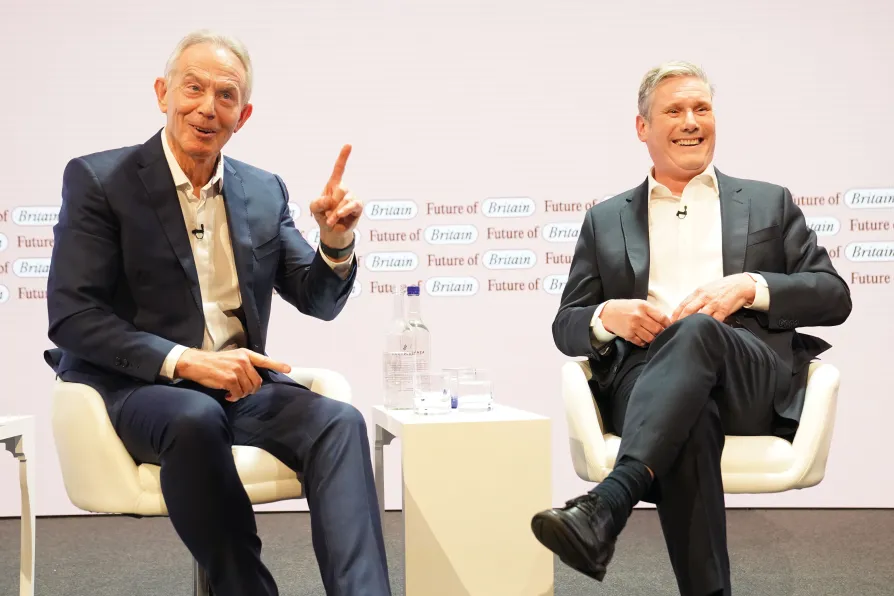
 UNWELCOME INTERVENTION: Tony Blair (left) pictured with Labour leader Sir Keir Starmer in 2023
Communist Party leaders Alex Gordon and Lorraine Douglas deliver vital medicines in trip to besieged socialist island
TUC Cymru is playing a leading role in tackling far-right ideas in the workplace, says LAURA DOEL
A New Delhi press conference in which Sheikh Hasina and her son implied the new order in Bangladesh is a security threat to India has sparked fears she is planning a comeback. SIAM SAROWER JAMIL reports on the fallout
Two months of student unrest have forced out India’s education minister and rattled the BJP regime. Could this be the beginning of the end for Modi, asks Communist Party of India (Marxist) general secretary MA BABY
MAT COWARD says the heatwave is a testing time for gardeners — but he has some tips





BRITISH politics has a Tony Blair problem. It is this: everyone still treats this cadaverous incarnation of war and greed with far too much reverence.
Even those critical of his intervention this week nod gravely and first of all declaim that he has made important points and raised serious issues.
He has not. His call for a debate on policy to precede a debate on personalities in the context of Labour’s leadership crisis is a platitude. Does anyone ever suggest forgetting policy and focusing instead exclusively on individuals?
He observes that Labour’s 2024 victory was due not to any enthusiasm but to the country being fed up with the Tories — a truth proclaimed here on day one and now the accepted wisdom.
Blair notes that the government has no plan. Sixty-nine million people are living that reality daily, and most have noticed somewhat earlier than the former premier.
But Blair has a plan. His essay sets it out clearly.
First, stick close to President Donald Trump and follow his agenda whatever illegalities, inanities and cruelties that consists of.
Second, do “whatever it takes” to stop asylum-seekers reaching British shores.
Third, abandon “net zero” or any other programme to address climate change.
Fourth, take an axe to welfare, working with the Tories to do so.
Five, scrap employment rights for workers.
Blair accuses Labour of living “in its comfort zone.” The zone he is comfortable with is where you can already find Nigel Farage and Kemi Badenoch.
There is nothing in his programme with which they disagree. Conservative pundits have been reduced to arguing that Blair’s time in office, which ended 19 years ago, was the source of many of the ills he now deplores.
And Blair himself dismisses the idea that saving the country from Reform in any way constitutes a worthy objective.
The only world leaders he invokes in a broadly positive way are Trump, Italy’s Giorgia Meloni and Argentina’s Javier Milei — all of the far right.
“You can like them or dislike them,” he generously allows while praising the grisly trio for being “not constrained by conventional thinking.”
He rationalises this political positioning with the familiar argument he describes as the “perennial delusion that when we lose seats to the right the country is really signalling it wants Labour to move left.”
In fact, Labour is losing far more votes to the left than to the right. If Reform is taking the seats it is because the Greens — in England, at least — have taken the votes.
That is of no interest to the Davos Darklord, who has long been clear that even if Labour could win an election by turning left, it should not do so.
Instead, he hymns the virtues of the “radical centre.” This involves “radical change” which, Lampedusa-style, leaves everything the same.
Blair in office extended the Thatcherite “settlement,” imposed by an accountant’s pencil and a policeman’s truncheon in the 1980s, by a further generation.
He now wants it to endure still longer. But he can see that the traditional governing parties in Britain are, as elsewhere in the world, no longer up to the job. So some form of techno-managerial regime, with only limited democratic restraint, is now the answer.
Not that he dismisses the efforts of the Starmer government entirely. Blair praises “reforms in planning, parts of the health plan, openness to the digital revolution, parts of the immigration and policing agenda, smoothing out some of the worst trade friction with Europe and a debate around at least some of the necessary welfare reforms.”
That is to say, he approves of those policies focused on deregulation, marketisation of public services and welfare cuts. The “parts” of the policing agenda he likes are, one can assume, those that involve curtailing the right to protest and arresting elderly dissidents with placards.
Elsewhere, he endorses both Starmer’s escalating militarisation of the economy and Rachel Reeves’s stern fiscal rules, again joining hands with Reform and the Tories in doing so.
Both Starmer’s most likely successors, Andy Burnham and Wes Streeting, have distanced themselves from Blair’s prescriptions. Burnham scored their former leader’s lack of interest in inequality in particular.
This is not a bug in Blairism, it is a feature. His was the first Labour government in history to see inequality in society, already expanded under Thatcher, widen still further.
That disgrace, more than any factor other than the Iraq aggression, for which the sordid old war criminal remains characteristically unrepentant, conditioned the party’s subsequent move to the left, culminating in Jeremy Corbyn’s election as leader.
For Corbyn, although far less bound by conventional thinking than any of the authoritarian neoliberals he prefers, Blair expresses nothing but contempt.
So here is a fact which this columnist will keep on repeating until it has become common wisdom — Jeremy Corbyn’s Labour in 2017 secured more votes in England than Tony Blair’s Labour did at its 1997 peak.
In the wake of that shock, which discombobulated the whole ruling class, Blair confessed: “I don’t really understand politics any more.” It was a rare moment of self-insight he would have done well to have stuck to.
Anyway, why would inequality be on Blair’s agenda? His whole career since leaving office in 2007 has been centred on self-enrichment, most often in grotesque company, a trajectory which Corbynism could only have imperilled.
Today, the former premier disgraces his old office by being the only person not a real-estate speculator or shady Trump consigliere to be granted a seat on the neocolonial executive board set up to run Gaza.
And every policy he advocates in his meandering essay is measured by one criterion — will it help big business, will it boost profit?
“The priority is growth. That comes with a vibrant private sector which has suffered years of economic instability, and we are going to go all out for making business feel respected and supported,” he intones, setting out his view of what Labour should have said on coming to office.
Thus, as well as dissenting from the limited new workers’ rights agreed by the Starmer government, Blair opposes the rise in the minimum wage and the willingness to tax the non-domiciled wealthy, two policies which, to however modest an extent, combine to diminish inequality.
Moreover, he argues that the government should have raised VAT, which hits working people, rather than employers’ National Insurance, to deal with its revenue shortfall.
He is at least consistent in his service of the bourgeois class interest, as he is in his adhesion to the whims of any right-wing occupant of the White House, no matter how demented.
However, in his haste to serve the rich, Blair discards his own insistence on long-term, strategic thinking. What other than the most purblind short-termism can explain dismissing the consequences for the climate of expanding oil and gas production, as he advocates?
The particular short-term interest he is serving here is of big tech, which needs cheap energy for the data centres artificial intelligence is powered by. And Blair is, literally, on their payroll.
But perhaps grifting is no longer the summit of Blair’s ambitions. In his agenda for the future he wants government “run by ministers not exclusively from the ranks of Parliament if they have the necessary experience and capability in change management.”
Who could he be thinking of drafting in to administer this managerial utopia which now represents his last-ditch hope for a further prolongation of rule by and for the Epstein class? Where will he find those only too happy to serve the project without the tiresome requirement of democratic election?
Perhaps it is relevant that two very significant words appeared nowhere in his lengthy exegesis on Labour’s travails, even though he is more than closely acquainted with them. It is a noisy silence.
Peter Mandelson.
