


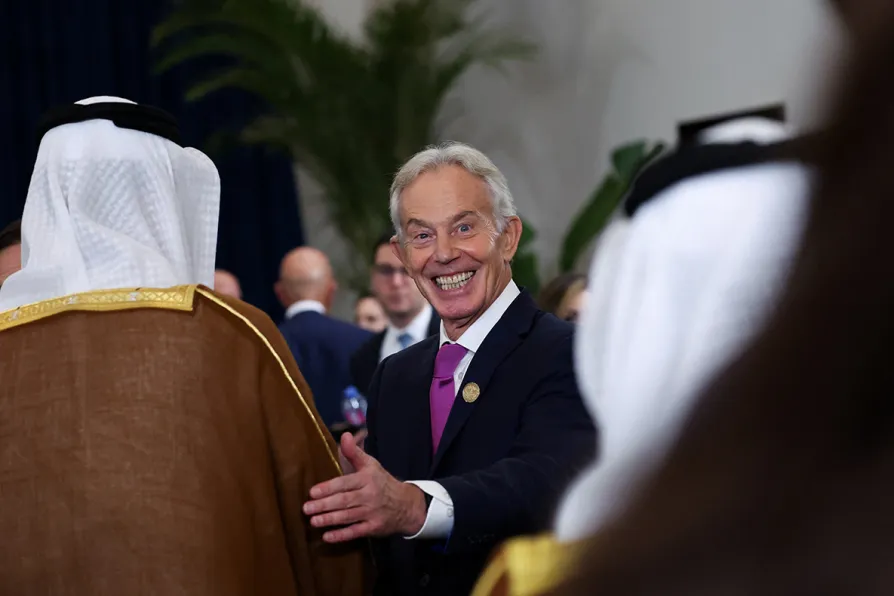
 Former prime minister Sir Tony Blair during the Sharm El Sheikh ‘Peace’ Summit in Egypt, October 13, 2025





THERE can be no surprise that Tony Blair has said he believed Britain should have backed the illegal US-Israeli attack on Iran from the start.
It shows that he has learned nothing from the disaster of backing George Bush’s criminal war against Iraq 23 years ago, a decision from which his reputation will never recover.
The former Labour prime minister thus joins Kemi Badenoch and Nigel Farage in berating Keir Starmer for being insufficiently pro-Trump.
Indeed, you are unlikely ever to hear a breath of criticism of the US president from Blair. Trump has appointed him to the “executive board” dealing with Gaza operating under his notorious and preposterous “Board of Peace,” the only non-US citizen so honoured.
Matters of legality or even decency always take second place, with Blair, to his belief that Britain must at all times subordinate itself to the whims of whoever is in the White House.
No president can be too deranged, no war so gratuitous, that Blair-Farage-Badenoch will not step up in support. They persist even in face of Trump’s gross US imperialism and brazen authoritarianism.
That position was rejected by millions at the time of the Iraq war and it is rejected by millions today.
Nor is it the Establishment consensus. Starmer’s initial reluctance to back US strikes represents not just the echo of Iraq and the huge mass movement against war, but a split in the ruling class.
Some sections can only see Britain losing from the collapse into global disorder which Trump is promoting. The City much prefers predictable profits to the uncertainties of chaos in a world without regard for laws or international institutions.
They also rightly fear the economic consequences of endless war in the Middle East, which Starmer was highlighting today. Soaring oil prices will set back such modest plans for economic growth as the government has developed.
Yet the elite are also desperate to maintain British imperialism’s important, if diminished, position in the Middle East.
They want to maintain RAF bases in Cyprus, which have most recently been used to support Israel’s Gaza genocide. Cypriots are now increasingly demanding their removal.
And they are anxious to maintain ties with the Gulf states, major buyers of British arms and heavily invested in Britain. Were they to turn elsewhere it would be a considerable setback for British capitalism in the global competitive struggle.
These pressures add to the direct demands of the irascible Trump and the strength of the pro-Israel element in the Establishment for full-on backing for the aggression.
Hence Starmer’s swerving over the last week. He has moved from blocking the use of British bases by the US to permitting it, after some legalistic jiggery-pokery.
And he is increasingly anxious to be seen to be moving Britain’s own military directly into the conflict — not because it will make much difference to the war, but as a means of retaining influence.
Hence the overexcited descriptions of British fighters in action and continual speculation as to the whereabouts of British warships.
While Starmer vacillates, the labour movement must speak out absolutely clearly against any British involvement in the conflict whatsoever, and for international pressure to bring the fighting to a halt.
From that point of view, Blair’s intervention is helpful. It serves as a vivid reminder of where the Washington-first policy can lead. Iraq has of course not recovered to this day, and nor has New Labour’s reputation.
Holding Blair to account for his crimes is unfinished business. Starmer already has support for the Gaza genocide on his charge sheet. We need no “heir to Blair” in Downing Street today.
