


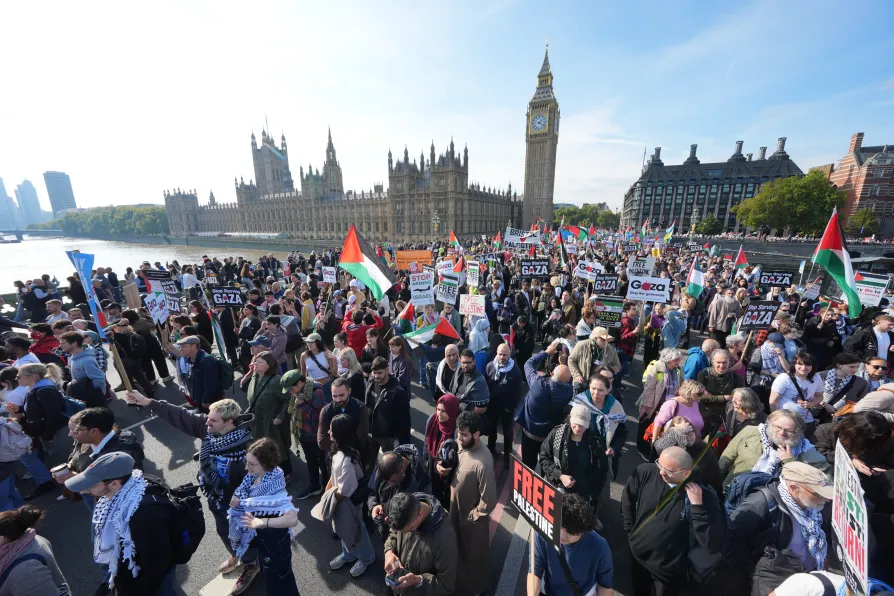
 People on Westminster Bridge as they take part in a Palestine Solidarity Campaign march in central London, October 11, 2025






THE Establishment has renewed its push to suppress the Palestine solidarity movement, hoping to exploit antisemitic attacks in Golders Green last week for this purpose.
This cause unites Keir Starmer and Kemi Badenoch, the Met Police and much of the media. That is nothing new.
Westminster was deeply hostile to Palestine solidarity marches from 2023 onwards. An attempt to ban them by Tory home secretary Suella Braverman backfired, leading to her own ejection from government.
In opposition, Starmer peddled dishonest claims that the Palestine movement put MPs in danger, which were used to abuse parliamentary procedure when Speaker Lindsay Hoyle blocked a vote on a Scottish National Party motion on a ceasefire in Gaza.
In government, Starmer renewed Braverman’s anti-democratic crusade with a crackdown on a Palestine demo in January last year, resulting in mass arrests and prosecutions of peace movement leaders.
That’s aside from the absurd ban on Palestine Action as a “terrorist” group, prompting some of the largest mass arrests of peaceful protesters in our history — something the Met itself has cited as diverting officers from other duties including keeping the streets safe.
So we should not see the revived push for protest bans as a response to the Golders Green attacks. Politicians are reasserting an existing repressive agenda.
There are good reasons we must keep marching for Palestine. The Israeli state is out of control.
It routinely violates its “ceasefire” in Gaza, and its land theft in the West Bank is accelerating.
Its “ceasefire” with Hezbollah in Lebanon is even more imaginary. It does not preclude dozens of air raids on the country daily or the mass expulsion of the population south of the Litani river.
That in turn is a major sticking point in talks between the United States and Iran on ending a Gulf war that has killed thousands and wreaks havoc with global trade.
Pressure on Israel’s allies makes a difference. Progressives within Israel, such as the Communist Party Knesset member Ofer Cassif, call on the international movement to maintain mass protests.
Israel’s internal regime is becoming ever more extreme, the restoration of the death penalty on an apartheid, Palestinians-only basis the latest example. The state is becoming a pariah — hence the desperation of Britain’s ruling class to shut down criticism of it.
So they make the unsubstantiated assertion that mass demonstrations against genocide inspired the antisemitic attacks in Golders Green. They insinuate too that Iran is behind the attacks, another unevidenced assertion designed to justify prolonging a catastrophic war.
We know Starmer, Badenoch and allies are not motivated by a desire to challenge antisemitism, since they are silent on a grotesque cartoon of Jewish Green Party leader Zack Polanski that echoes traditional antisemitic imagery. They are not concerned for British Jews, but for the Israel alliance.
Attacks were antisemitic
Condemning this should not stop us opposing claims on parts of the left which downplay the antisemitic character of the attacks. These rest on two elements to the case, that the attacker earlier knifed a Muslim man and that he had mental health issues.
While the Muslim Council of Britain rightly objects to the relative lack of attention given to the attack on a Muslim, this was an assault on a longstanding acquaintance of the perpetrator at his home. It is not directly comparable to the decision to travel to a Jewish area of London and attack passers-by, for which the obvious motive remains antisemitism.
Nor are mental health problems a switch after which somebody is “mad” and their actions random. They can intensify prejudices and fixations and do not preclude racist attitudes.
The attacker’s mental health history is relevant, because the lack of proper provision for mental health services and support for the mentally unwell places they and others at risk. But it should not be used to deny antisemitism as a motive.
