


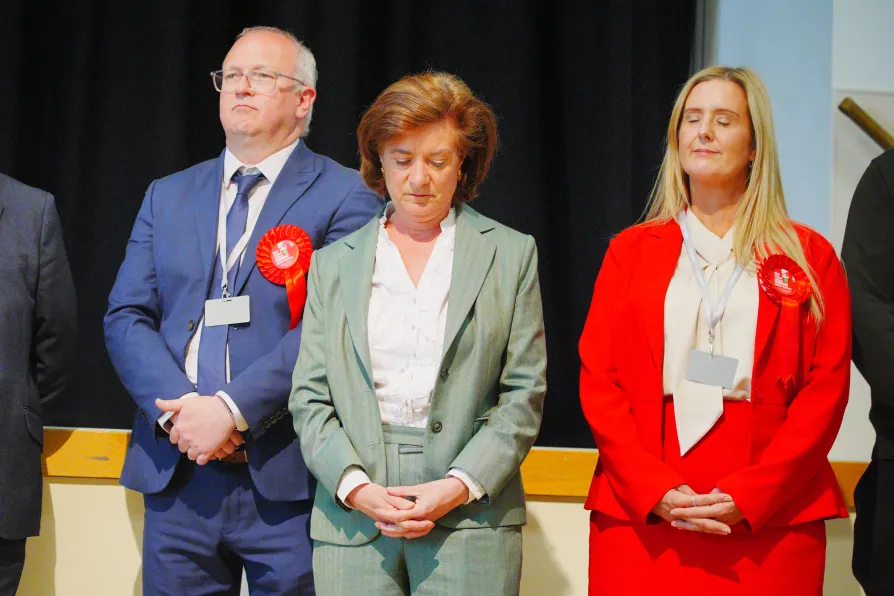
 First Minister of Wales Baroness (centre) after losing her seat in the 2026 Senedd elections at Ysgol Bro Teifi, in Ceredigion, May 8, 2026






WALES TUC meets this year in a transformed political landscape. For the first time since devolution Labour is not in office in Cardiff Bay. For the first time in a century it does not dominate Wales.
For a Welsh trade union movement that has worked closely with Labour — a relationship that even delivered a Social Partnership and Public Procurement Act in 2023, giving unions a statutory voice on services and procurement that is unique in Britain — it presents new challenges.
Labour’s rout at the Senedd — coming a distant third to Plaid Cymru and Reform with just nine of 96 seats — is no blip.
We have seen the collapse of “red walls” in Scotland and north-east England at previous elections, and nowhere has Labour yet recovered.
Wales held out longer, partly because the movement had such deep roots in the country, partly because union density is even now higher in Wales than elsewhere (the decline of Labour is everywhere connected to the decline of trade union culture) and partly because leaders like Rhodri Morgan and Mark Drakeford put enough “clear red water” between themselves and Westminster to lessen the sense that the party had betrayed its own.
But the collapse has come. Some in Welsh Labour will feel stung by this. Welsh Labour governments can point to real achievements — and not just ones delivered a generation ago like the abolition of prescription charges in the NHS (which is still the envy of English patients).
Wales brought its railways into public ownership in 2021, raising pressure on Scotland to do the same and helping make the wider case for rail renationalisation now accepted by the British government. Welsh Labour was reopening closed lines like Ebbw Vale before it secured significant funding at British level in last year’s spending review for major works including building seven new stations.
It banned for-profit provision of children’s care last year, a pioneering policy which — as Unison Wales has argued — should be extended to the rest of social care, where private equity firms and big chains are driving costs up and standards down.
Listing these wins is not to whitewash the administration’s mixed record. It points to the need for radicalism if the party is ever to regain a hearing. Wales has been no exception to the Britain-wide experience of falling real living standards and declining services, and people are in no mood to reward parties for incremental gains. Sharp breaks with existing policy that catch the eye and bring tangible benefits are needed fast — something Labour at Westminster needs to take on board as it replaces Keir Starmer.
Plaid does not come from a position of hostility to unions. But the relationship with government will change. Pushing for concrete commitments — like the motion to Wales TUC demanding that the current requirement that public procurement be “socially responsible” should be strengthened to bar contracts to companies which don’t recognise trade unions — will be necessary.
It is not quite accurate to see unions’ relationship to government as having gone back a century, to the period when organised labour negotiated with Liberals for concessions rather than having a political vehicle of its own. For one thing Plaid is not a leading party of the British ruling class as the Liberals were; for another Labour has not really been a vehicle of the trade union movement for generations. But the structures through which unions have got used to intervening politically are dramatically affected by the Labour Party’s existential crisis.
Finding a way to work with others on the left, including Plaid, is essential if that crisis is not to lead to a Reform government at British level. The Senedd vote — in which Reform ran Plaid fairly close, and actually received a proportionally higher vote than in England — show this is a menace that needs to be confronted in Wales as everywhere else.
