


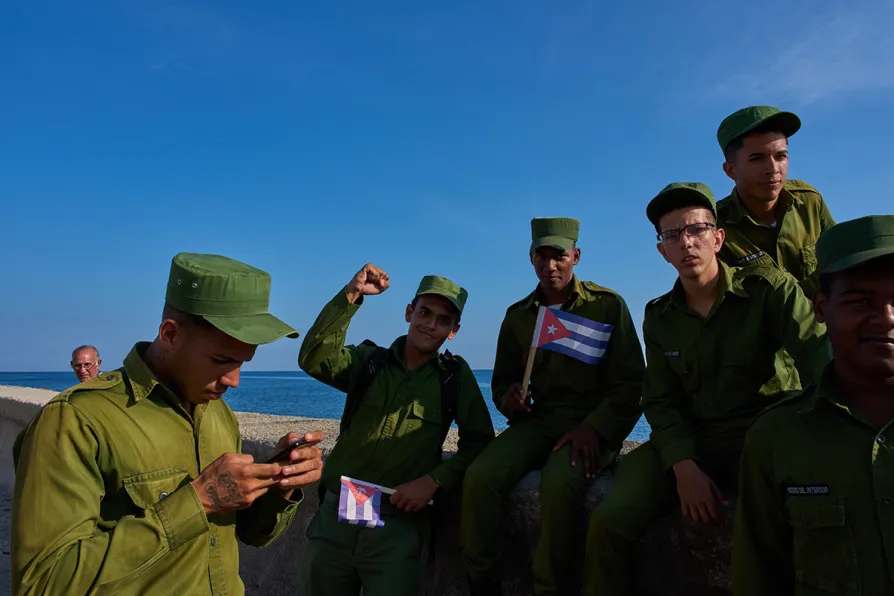
 Soldiers attend an event marking International Workers' Day at Jose Marti Anti-Imperialist Square in Havana, Cuba, May 1, 2026





THE international peace conference in solidarity with socialist Cuba over the May Day weekend spoke important truths.
It linked the “multidimensional economic, financial, political, security and environmental crises” engulfing the planet — and noted that the “aggressive escalation of American imperialism” is intensifying them all.
It identified the United States as “the primary threat to global peace and security,” not so much a world policeman, as it has often thought of itself, but a global gangster that bullies, steals and destroys.
It connected US aggression against Cuba and Venezuela in the western hemisphere with its violence in the Middle East, and the genocide perpetrated by its ally Israel against the Palestinians.
And it brought together grassroots organisations, trade unions, peace campaigns and youth groups on an international basis to plan co-ordinated resistance.
No festival is so international as May Day, the workers’ day, with marches in Havana and Chicago, London and Rome, Baghdad and Beijing.
Rallies took up the message of defiance everywhere. Over 100 US unions took up the call “no work, no school, no shopping” for May Day, with specific marches like New York’s highlighting the connection between corporate power and state brutality under the slogan “Amazon delivers Ice.”
The Israeli police raided youth club premises to snatch Palestinian flags ahead of the demos, fearing any show of solidarity with the victims of their state’s relentless terror. In Cuba, electricity and energy workers took centre stage, as a whole nation saluted those trying to keep the lights on and the power flowing in the face of a brutal US siege.
So it was fitting that the International Meeting of Solidarity with Anti-Imperialism, dubbed 100 Years With Fidel, called on the world to stand with Cuba just as Cuba — exporter of medical care and education, valiant ally of the anti-apartheid struggle in South Africa, beacon of socialism on the doorstep of the world’s most aggressive capitalist power — has so often stood with the world.
It made important commitments. One, to keep promoting convoys to breach the blockade and deliver essential supplies to Cuba. This is practical solidarity, like that organised in Britain by the Cuba Solidarity Campaign through its Cuba Vive appeal.
Two, to build links between left media organisations to counter the labyrinth of lies built up by the news and opinion monopolies that dominate global communications.
Three, international mobilisation and protest. The ceasefire in Gaza — hugely inadequate and regularly violated as it is — was brought about by the global scale of protest for Palestine. Trump told Benjamin Netanyahu, “you can’t fight the world.” The US should be made to feel, through protests at embassies and pressure on governments, that to attack Cuba is to fight the world.
The US threat to Cuba is urgent — Donald Trump reiterated military threats on May Day itself. It is not something we can’t do anything about.
The US needs to know it will pay a heavy price for attacking Cuba, and that means pressure on our own government to grow a backbone. Britain votes against the illegal US blockade of Cuba every year — why can’t it stick up for its own sovereignty and protect British companies that trade with Cuba from extraterritorial US punishment, as China has just done for its companies sanctioned for trading with Iran?
As we saw in Havana, building ties across borders provides the surest defence against the world war Trump threatens, which our own rulers seem willing to join.
The international peace conference in London on June 20, following one in Paris and preceding one in Madrid, is key to confronting the militarists, averting war and charting a more rational future.
As they say in Cuba, another world is possible.
With the most reactionary racist, climate-denialist, violence-worshipping zealots taking US imperialism on a global rampage, winning that world is not just an existential question for Cubans, but for us all.
