


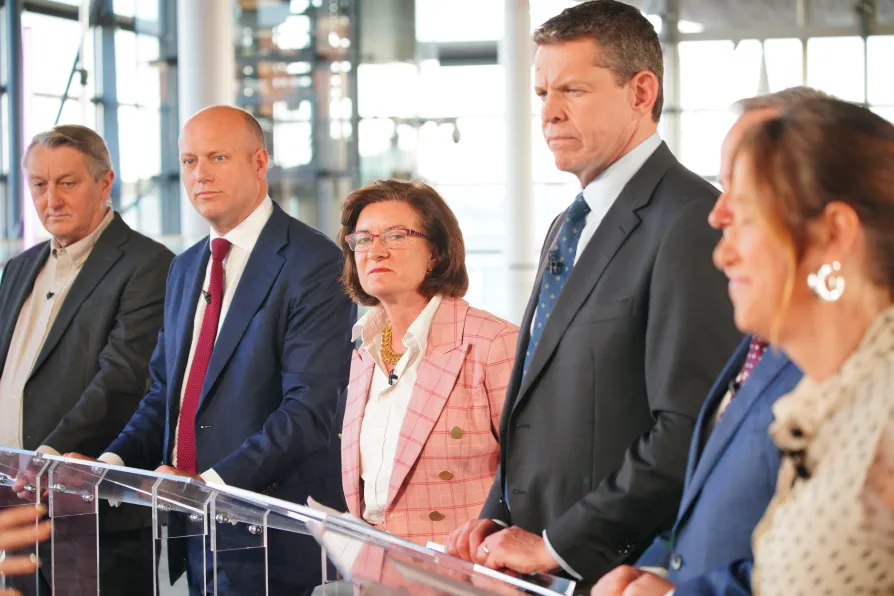
 Wales Green Party Leader Anthony Slaughter, Reform UK's Dan Thomas, Welsh Labour Leader and First Minister Eluned Morgan, Plaid Cymru of leader Rhun ap Iorwerth, Welsh Conservative leader Darren Millar and Welsh Liberal Democrat Leader Jane Dodds






RARELY has Wales featured so prominently in all-Britain election coverage as today in the run-up to polling day on May 7. Certainly, it is difficult recall such media interest in any of the six general elections to the National Assembly of Wales and its successor, the Senedd, over the past quarter of a century.
The London-based mass media usually show little interest in Wales unless a gruesome murder, a royal visit or a sporting spectacle has attracted journalistic attention beyond the M25 bubble.
Indeed, the Morning Star is one of the very few “national” newspapers even to employ a Welsh-based staff correspondent. BBC, ITV and Sky newscasters are clearly more at home with reports from the farthest shores of America, Europe, the Middle East and Asia than with the occasional story that comes from a seemingly unpronounceable place-name in Wales.
What’s so different this time around? The big story is that the Labour Party is set to be replaced as the biggest electoral force in Wales for the first time in 100 years. The old certainty of a Labour victory (and most often a Labour landslide) is dying.
In terms of both the popular vote and the number of seats to be won, the main struggle appears to be between Plaid Cymru — the left-of-centre Welsh nationalist party — and Reform UK, the decidedly right-wing British nationalist party.
Both are approaching 30 per cent in the opinion polls, with Labour down to around 15 per cent and the Tories and Greens at 10 per cent each.
How the right-wing media are rubbing their hands with glee at the prospect of a Labour and left-of-centre bastion falling, especially if it’s to the benefit of the right!
Why could this happen? Welsh Labour is suffering from over-familiarity and its all-too-supine relationship with Keir Starmer’s government at Westminster. Many thousands of habitual Labour voters in the south Wales valleys are likely to switch to Plaid Cymru, despite not yet sharing that party’s aspiration for Welsh independence from the UK. A smaller number may go Green, and many more probably won’t vote at all.
They don’t feel the change promised by Starmer’s party. They dislike his lack of honesty and integrity. Many are repelled by his refusal to condemn US-Israeli massacres of the innocent in Palestine, Iran and Lebanon.
Neither do they remember — unless forcefully reminded — of the achievements of Welsh Labour and Labour-Plaid coalition governments despite the lack of powers and resources at the disposal of the Welsh parliament: free NHS prescriptions, free hospital parking, free bus travel for the elderly, the reintroduction of student maintenance grants, free museum entry, primary school breakfast clubs, financial penalties for holiday home ownership, aid for the Welsh steel industry, nationalisations to invest in Cardiff-Wales Airport and Transport for Wales rolling stock, etc.
For most disillusioned working-class Labour supporters, voting Tory is still seen as an act of betrayal of their family heritage, of their class and of Wales itself.
And the overall result? Enter Reform UK, carefully replacing all their English flags of St George with the Union Jack and even, but without the same conviction, with the Welsh Dragon.
Their appeal is that they are not “Liebour,” not Tories (although many of them have been), not disloyal separatists and not net-zero Greens. What they are, in reality, is a rag-tag bunch of Thatcher-worshipping reactionaries whose leader and candidates in Wales have been hand-picked by Nigel Farage. They would prefer not to have a Senedd at all and thereby return to the days when all important decisions about the Welsh nation were taken in Westminster and its overwhelming majority of English MPs.
Reform UK in Wales: patriots? Traitors, more like.
