


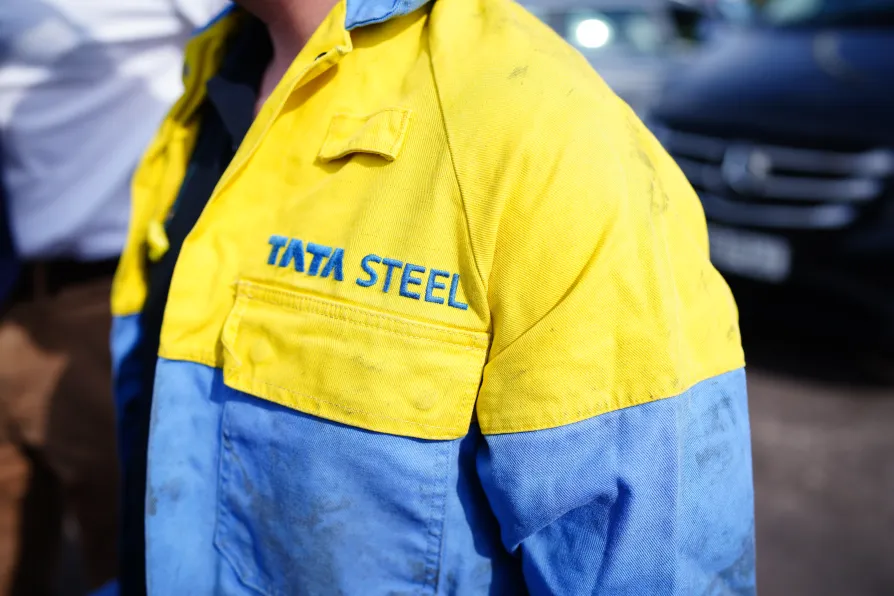
 A worker outside Tata Steel's Port Talbot steelworks in south Wales, as around 3,000 jobs are at risk at the plant as part of a planned restructuring, September 15, 2023






TO SEE how contemporary monopoly capitalism goes about its business, consider the giant Tata conglomerate.
The Indian-based company owns JLR cars as well as Tata Steel in Britain, not to forget Tetley tea. Its main business, however, seems to be wringing cash out of the taxpayer.
It secured £500 million from the government to keep the huge Port Talbot steelworks in south Wales open, although this did not save primary steelmaking or 2,800 jobs on the site.
Now we learn that the conglomerate has shaken down the government for another £380m to build a new battery plant for electric cars in Somerset.
The company allegedly hinted that if it did not get the cash it might close some or all of its car assembly factories in Britain, including large plants at Solihull and at Halewood, Liverpool, moving production elsewhere.
Trade unions have of course welcomed such state assistance. That is entirely understandable – it preserves at least some existing jobs and offers the prospect of new ones in Britian’s beleaguered manufacturing sector.
But we should nevertheless be clear about what such subsidies represent. It is the use of public money to prop up private profit rates, to eliminate the differential in terms of what Tata could make here as opposed to investing abroad.
If the balance of forces — including trade union organisation and social expectations entrenched over generations — do not permit a high enough rate of surplus value in exploiting British workers to justify preferring investment here over elsewhere, then the state makes up the difference in effect.
This is rooted in the essential dynamics of capitalism, hyper-articulated in the age of globalisation which enshrines international competition for investment and profit-seeking as a foundational principle.
It allows for corruptible relations to develop between politicians and civil servants handing out the money, on the one hand, and companies receiving it on the other. This leads to the “revolving door” between state and private interests so beneficial to much of the Establishment under neoliberalism.
It is true that it is more useful to spend taxpayers’ money on securing investment in productive capacity than it is to hand it over to City speculators in inducements, tax breaks and the like, as so many governments have preferred over the last 40 years.
But it is notable that the state is not securing any holding, nor any slice of future income, from the handouts to Tata. At least when the banks were bailed out after the 2008 crash, the state became their owners — alas, only temporarily and without the stake being used for any purpose of strategic economic direction.
The point is not that trade unions should resist such handouts, which are manifestly in the immediate interests of the workers concerned.
It is that they should be used as a lever to demand more ambitious proposals. The government has already taken much of the steel industry back into state hands through the failures of private ownership — why not Tata too?
That would permit an integrated plan for the steel industry, vital as it is to the overall health of the manufacturing economy.
Likewise, if the car industry is to make the transition to electric vehicle production without disruption or job losses, it can only be through comprehensive planning.
The subsidies are, among other things, a tacit admission that private capitalism cannot guarantee the future of key industries on its own. Rather than simply guaranteeing bosses’ profits, the Labour government and the wider labour movement should be taking a direct hold of industry in the interests of their workers and the community as a whole.
