The Defence Universities Alliance is a bit to co-opt higher education into the wider drive to war — we should resist as earlier generations of scientists did, argue say ROX MIDDLETON, LIAM SHAW and MIRIAM GAUNTLETT of SCIENCE AND SOCIETY


 Latest editorial

The mainstream media’s dangerous omissions
IAN SINCLAIR looks at how we are made to swallow, without question, the porkies fed to us by the mass media
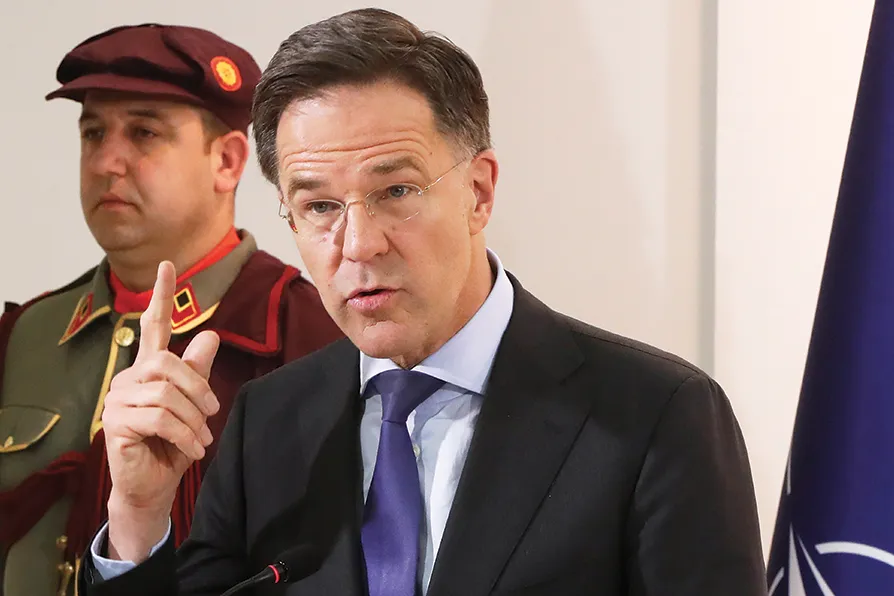 ‘PARANOID HYSTERIA’: Nato Secretary General Mark Rutte at a news conference in Skopje, North Macedonia last Tuesday. North Macedonia became a member of Nato in March 2020, as the 30th member state
In the third of a four-part serialisation from her new book No to Nuclear, LINDA PENTZ GUNTER explains how the world had a chance to build an energy system around renewables more than 70 years ago — instead, it chose nuclear
In the fourth and final part of our serialisation from LINDA PENTZ GUNTER’S book No to Nuclear, she asks how anyone can see nuclear as value for money given its constantly ballooning costs
Elon Musk says AI will make work optional. The world of abundance he predicts actually spells the end of the capitalist system, argues FAWZI IBRAHIM
CARLOS MARTINEZ responds to liberal hawk Simon Tisdall’s evidence-free China-bashing and asks whose agenda it really serves
Indian students have fought for the right to education, schooling us all in the process. Comrades from the Students’ Federation of India (SFI) — UK comment on the resistance and its ripples here





“OMISSION is the most powerful form of lie.” Widely attributed to George Orwell, recent news stories demonstrate the continuing relevance of this quote for understanding media performance.
In October last year, the Morning Star was one of the few UK news outlets to report some hugely positive news from India — that the state of Kerala, which has a population of around 35 million people, had announced the elimination of extreme poverty.
“The Communist Party of India-Marxist (CPI-M)-led Left Democratic Front (LDF) government committed to eliminate extreme poverty by this date shortly after re-election in 2021,” the newspaper noted, “implementing a poverty elimination campaign involving community mobilisation, the despatch of hundreds of volunteers to poor areas (as practised in China’s absolute poverty elimination programme), and provision of ration cards and health insurance to thousands of families.”
Keen to find out more, I listened to a BBC World Service report aired in December titled Did India Just End Poverty In Kerala? Over a nine-minute segment, the BBC’s Shruti Menon, based in India, provided context and insight into the changes in Kerala.
An Extreme Poverty Eradication Project was established in 2021, she noted, with health workers and local councils undertaking surveys to identify families in need, before the implementation of tailored plans for each family.
Astonishingly, Menon failed to mention one crucial fact — the political orientation of the Kerala government which introduced the policies that led to the reduction in extreme poverty.
In the world of the BBC huge social gains are made, seemingly by magic, without any political agency or struggle.
This inability or refusal to mention key, if inconvenient (at least for the West), facts characterised much of the reporting of the Syrian war.
The assertion by the Guardian’s foreign affairs commentator Simon Tisdall in 2018 that “Western democracies” have been “hovering passively on the sidelines in Syria” was indicative of much of the coverage across the UK’s print and broadcast media.
Back in the real world “Washington did provide aid on a large scale to Syrian armed opposition,” as Steven Simon, senior director for the Middle East and North Africa on the US National Security Council during the Obama Administration, explained the same year in the New York Times.
Timber Sycamore was the name of the CIA programme to train and equip the Syrian rebels. Despite the Washington Post describing it as “one of the agency’s largest covert operations,” you’ll be hard pressed to find many references to the programme in the UK press.
Marc Lynch, professor of Political Science and director of Middle East Studies at The George Washington University, confirms the impact in his new book America’s Middle East: “Covert interventions by the United States and its allies in Syria extended and exacerbated one of the most brutal civil wars in modern history.”
Similarly, hundreds of US troops have been occupying parts of Syria since 2015, with minimal interest from the UK press. This near silence slipped into absurdity when the Guardian printed a map in 2024 titled Syrian Territorial Control, which failed to mention the presence of US troops, though did mention all of the other main armed actors in the country.
Another map published in the newspaper in January confusingly showed a “US-declared deconfliction zone” without mentioning why it’s there — to protect the US base at Al-Tanf.
The omission of important information essential to understanding events has also been a mainstay of British media coverage of the Russian invasion of Ukraine.
For example, it largely refused to engage with the considerable evidence showing the UK played a key role in stopping potentially fruitful peace talks in spring 2022. And it shows little interest in the shifting opinions of Ukrainians themselves.
The New York Times recently noted that a May 2022 poll from the Kyiv International Institute of Sociology “found that 82 per cent of Ukrainians believed that the country should not surrender territory under any circumstances.”
In contrast, a poll conducted by the institute last month found “40 per cent of respondents said they would support giving up the Donbass in exchange for security guarantees.”
With the UK government and its cheerleaders in the media pushing for greater defence spending because of the supposed threat Russia poses to the rest of Europe, it took the writer Steve Howell to provide the crucial context on his The Rest Is Bullshit Substack: 2023 figures from the Stockholm International Peace Research Institute (SIPRI) showed the combined military spending of the UK, France, Italy, Germany and Poland is 2.5 times more than that of Russia.
Indeed, in December the veteran Russian expert Anatol Lievin described Nato secretary-general Mark Rutte’s claim that Russia will attack Nato as evidence of “paranoid hysteria that is impervious to evidence and rationality.”
SIPRI’s 2024 figures seem to provide a reality check: they estimated the Russian military budget was £111.6bn, while the total military expenditure by Nato members amounted to £1.286bn, with European Nato members spending £340bn.
When it comes to the wider context and causes of Russia’s illegal and aggressive invasion, despite numerous US diplomats and experts warning of the dangers of Nato expansion, research from Dr Florian Zollmann found the UK, US and German press “de-emphasised frames that depicted Russia as a country with a national interest struggling against Nato expansion.”
This relative absence has serious real world implications, with Zollmann noting “the dominant causal framing links to remedies that have been evoked to solve the conflict.”
Military means are favoured over diplomatic solutions, for example. Furthermore, it’s worth considering the obvious question: if Nato expansion is a central concern of the Russian government, then how will they react to the UK and French governments’ pledge to station UK and French troops — that is, troops from Nato countries — in Ukraine itself, after a peace deal is reached?
When you start thinking seriously about what the media aren’t telling you, you realise how little coverage there is of huge swathes of the world. And how little interest, let alone moral outrage, the media has for political repression in certain nations (which often seems to correlate with whether the UK government considers the nation in question a friend or foe).
In Uganda, President Yoweri Museveni, in power since 1986, was declared the winner in the recent general election, following claims of vote rigging and an internet shutdown in the days before the poll.
The opposition leader Bobi Wine remains in hiding, presumably in part because Museveni accused the opposition of being terrorists in his victory speech.
These are hugely concerning events in this African nation of 50 million people but not something the British news media has deemed important enough to dedicate serious time and resources to.
In UK ally Kuwait, the hereditary head of state suspended the Gulf nation’s relatively powerful (for the region, at least) parliament in May 2024, with no public criticism from the UK government, and minimal coverage in the UK media.
Similarly, the crushing of the pro-democracy protests in Bahrain and Oman in 2011 didn’t seem to overly concern the editors of the British press. Ditto the creation of a new Typhoon squadron in 2018 between the RAF and autocratic rulers of Qatar, and Saudi Arabia’s UK-US-supported decimation of Yemen, a conflict that led to 377,000 deaths by late 2021, according to the United Nations Development Programme.
I used to think the title of US journalist Danny Schechter’s influential 1997 book The More You Watch, The Less You Know was deliberately provocative, his catchy maxim likely not accurate beyond one or two specific case studies and surveys.
The performance of the UK Fourth Estate certainly makes me wonder, though. Because when it comes to key aspects of UK-US foreign policy, the UK media, usually echoing the government’s framing of events, often helps to obscure, rather than explain and illuminate, the dirty reality of what the UK does around the world.
Follow Ian on X @IanJSinclair.
