Councillor SAM WHEELER says there’s a tangible shift in mood on the left in the city whose mayor has recently become PM — but there’s no room for complacency



Cherish yesteryear victories that shaped the present
Ignorance of working-class history leaves working people open to deceptive narratives, demagogy and political manipulation, writes SAN SENIK
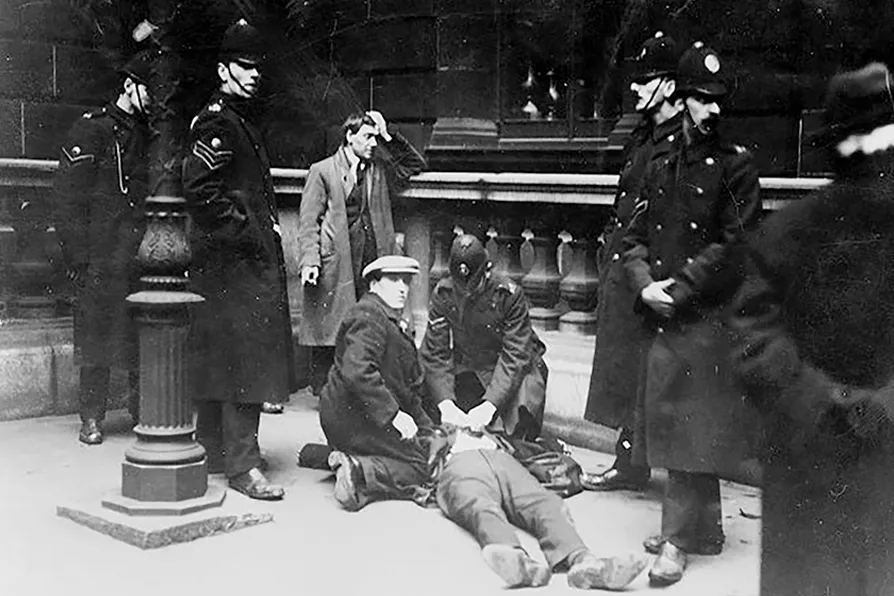
 STATE BRUTALITY: Scottish politician, trade unionist and socialist activist from the East End of Glasgow David Kirkwood MP on the ground after being struck by police batons during the Battle of George Square, January 31 1919 / Pic: Public domain
Communist Party leaders Alex Gordon and Lorraine Douglas deliver vital medicines in trip to besieged socialist island
TUC Cymru is playing a leading role in tackling far-right ideas in the workplace, says LAURA DOEL
A New Delhi press conference in which Sheikh Hasina and her son implied the new order in Bangladesh is a security threat to India has sparked fears she is planning a comeback. SIAM SAROWER JAMIL reports on the fallout
Two months of student unrest have forced out India’s education minister and rattled the BJP regime. Could this be the beginning of the end for Modi, asks Communist Party of India (Marxist) general secretary MA BABY
MAT COWARD says the heatwave is a testing time for gardeners — but he has some tips





CURRENTLY, neither workers’ history, workers’ rights nor the trade union movement is something that is taught in the formal education system.
Schools and colleges are supposed to equip young people with the tools and knowledge to participate in wider society, this includes having a real awareness of their rights.
Ignoring teaching students about trade union movement and the history of the working-class means young people are growing up ignorant of their rights under employment law. This ignorance makes our class vulnerable to exploitation by the ruling class and bosses.
For years, successive governments and the media have repeatedly attacked the accurate teaching of history and the role of trade unions and ordinary people in transforming society.
The working-class has been let down and battered by imperial capitalist politics that seek to expand their wealth by exploiting the working-class. The working class has, over time, become submissive, forced to abandon its core principle of solidarity, and has fallen into a survival mode.
Gradually, the awareness of working-class ideology has diminished, and some individuals no longer identify themselves as part of the working class.
Union membership has gradually declined. Many people do not know how unions can benefit them and, worryingly, many young people do not know what a trade union is.
Employment rights are a vital issue affecting working people, yet most people are not aware of their workplace rights. Our class has vastly become apolitical becoming more inclined to exploitation. This serves to benefit the interests of the ruling classes alone.
It is therefore vital that workers, both current and future, are correctly informed about their rights as workers. We must act to change this grim reality.
Workers’ rights as human rights at work should be written into core teaching in schools.
However, centuries of struggle by workers and their unions to build an equitable society have been hidden and distorted at every level of our education system. Instead, our education system teaches an elite ruling-class perspective of history.
Our children learn nothing about the class power they hold in their hands. We must grasp that the wheels of capital do not turn without us.
How many of us know about the matchgirls’ strike of 1888 which not only resulted in the reinstatement of an unfairly dismissed colleague, but the young women were also successful in getting their docked wages paid.
They achieved that 137 years ago! What about the national coal strike of 1912 involving nearly one million miners? It was the first national strike by miners aiming to secure minimum wage and resulted in the Coal Mines Minimum Wage Act of 1912.
Or the Battle of George Square in 1919 when shipbuilding workers in Glasgow won the right to a shorter working week of 47 hours.
There are many examples that have been lost to history as they are not taught, including the General Strike of 1926 where 1.7 million workers walked out. The Battle of Orgreave and the solidarity shown by our own union.
As Milan Kundera said: “The struggle of man against power is the struggle of memory against forgetting.” We must teach our children to remember.
However, they cannot remember if they are not taught.
We have to show this and generations to come that unity is the way we have achieved our rights. That child labour was abolished as a result of union campaigning. The five-day working week. The minimum wage. Maternity and paternity leave. Paid holidays. Paid breaks. And more were all achieved by the trade union movement fighting for the working class.
We must find ways to educate all generations in working-class politics. An uneducated working class is always in danger of voting against its own interests and the union movement cannot allow for this to continue.
We must work, alongside other unions, to lobby the government to establish a Workers’ History Month and be involved with the writing of the curriculum to get the full benefits that we intend for our members and our members deserve.
An established Workers’ History Month will enable people off all ages, including union members and maybe even our prime minister and the members of the parliamentary Labour Party, to learn the meaning of working class, learn about the trade union movement, and celebrate historical achievements through collective action over time.
This would also enable us to recognise and celebrate the power of belonging to a union and help in increasing recruitment so that trade union membership can continue to grow and appeal to a wider range of employees.
San Senik is the BAME representative committee member for Aslef’s district 4 covering the north of England.
