ROB WARZYNIAK wades knee deep through a pile of ‘dead canaries’ of Trumpist policies which exacerbated the horrors of US capitalism domestically


 Latest editorial

Unconquerable Will: Palestine Hunger Strikers in British Prisons
VICTORIA HOLMES salutes the brave stand being taken by Palestine Action hunger-strikers in British prisons, and explains their demands
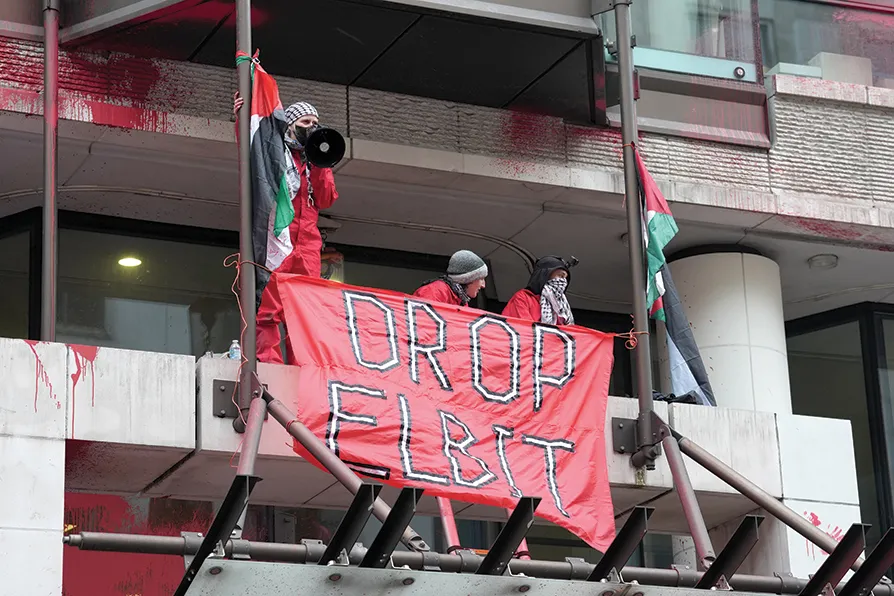 Members of Palestine Action occupy and deface the entrance of a branch of Allianz Insurance offices in Gracechurch Street, London, in protest over its links to Israeli Arms company, Elbit Systems on March 10 2025
Without evidence or Nato consultations Berlin’s answer to the Leipzig incident is a rupture of relations. SEVIM DAGDELEN examines why
FRANCISCO DOMINGUEZ introduces the background to a conference on defending Latin America’s sovereignty
The glacier collapse in Nepal is yet another warning that a warming planet is making Himalayan disasters more frequent and destructive – but the countries facing the greatest risks are often those least responsible, says LI YANG
Nick Blair is set to benefit from a hugely lucrative contract to ‘virtually’ train the British army for its next war. Like father, like son, writes SOLOMON HUGHES
Even when tragedy strikes, Western media cannot resist the opportunity to turn it into a sordid propaganda opportunity, as the Nepal-China border tragedy shows, writes CARLOS MARTINEZ
Trade unions should be at the heart of the anti-racist push for reparations for the historic legacy and continuing impact of slavery, writes ROGER McKENZIE





IN BRITISH prisons, a defiant silence rings, a hunger speaking louder than any shout.
Six individuals held by the state for courageous anti-war actions are turning their bodies into battlegrounds. These hunger strikers: Qesser Zuhrah (on remand since November 19 2024), Amu Gardiner-Gibson (on remand since July 3 2025), Jon Cink (on remand since July 3 2025), Heba Muraisi (on remand since November 19 2024), Teuta Hoxha (on remand since November 19 2024), and Kamran Ahmed (on remand since November 19 2024), wage a profound war of attrition.
Their incarceration stems from direct action targeting death’s supply chains, disrupting weapons for genocide in Gaza. Their desperate interventions have slowed war’s brutal mechanics and saved lives.
Their youth and fierce refusal echo chillingly from the past. In 1981, Bobby Sands, just 27, led young men in a fatal fast in Long Kesh. Like Sands, these current hunger strikers are young: none over thirty, Zuhrah a mere twenty, came of age in a cage.
They seek no martyrdom or death. As Heba Muraisi powerfully articulated, “this is not about dying, because unlike the enemy I love life.” This core defiance, a passionate affirmation of life, risking all for recognition, is no suicide pact; it is a desperate plea to be seen, to force a blind state to open its eyes.
These hunger strikes erupt against systemic violence. They expose the state’s true nature, not as a neutral arbiter, but as a brutal enforcer of capitalist interests. This is a state ready to criminalise dissent, to brand legitimate resistance as terrorism, and to disappear those who challenge its power.
Whether in the H-Blocks of Long Kesh or the modern prisons of Britain, the body is the ultimate, unconquerable territory, the last bastion of sovereignty, a vessel of self-determination beyond state possession or consent.
Hunger becomes a weapon, a checkpoint the state cannot cross. They choose consumption from within over state claim to that final, intimate territory. Bobby Sands’s slow-motion execution became a global symbol, his emaciated frame mirroring state brutality.
Prisoners for Palestine, a prisoner-led initiative, represents all those detained under charges related to Palestinian liberation.
Beyond the current hunger strike, their work is a continuous battle to fight criminalisation, assert their true identity, resist depoliticisation, and refuse to be turned into “systemised, institutionalised, decent law-abiding robots.” They declare: “Never will they label our liberation struggle as criminal,” echoing Bobby Sands’s own defiance.
This is the enduring legacy, a message echoing from Long Kesh to Gaza, and now from within British prisons: the body, transformed into a weapon of hunger and steadfast refusal. It speaks a universal sentence: ultimate refusal to be confined in state cages, asserting death in freedom is preferable to life in subjugation. This is not a desire for an end, but for acknowledgement: a desperate, vital need to be seen in the face of deliberate erasure.
The arrests stem from direct actions against Elbit Systems, an Israeli arms manufacturer with a blood-stained history, central to the Israeli military-industrial complex.
Dating back to its origins as an Israeli state-owned entity, Elbit has for decades supplied weaponry, surveillance, and targeting systems used in Palestinian occupation and repeated assaults on Gaza.
Its drones patrol besieged skies, its systems guide lethal strikes, its electronic warfare suppresses dissent.
Profits, stained with Palestinian blood, flow directly into occupation and apartheid. Elbit’s pervasive UK presence, through various subsidiaries and lucrative MoD contracts, directly implicates the British state. The hunger strikers’ direct actions against Elbit facilities were calculated interventions disrupting a supply chain fuelling genocide, preventing deaths in Gaza that Elbit’s products facilitate.
Their demands are clear and unyielding resistance against systemic injustice:
• End all censorship: they demand free communication, without prison interference or surveillance. For prisoners, whose voices are silenced, freedom of expression is fundamental. Censorship punishes resistance, suppressing political statements, letters, calls, and access to books.
• Immediate bail: they demand release from custody while awaiting trial. Holding individuals on remand, sometimes indefinitely, is abuse of power, punishing before conviction. A fair trial requires preparation in freedom, not behind bars.
• Right to a fair trial: this demands full disclosure of relevant case documents: records of meetings between British/Israeli state officials, police, attorney general, Elbit representatives, and others coordinating the “witch-hunt” against activists. They demand transparency on Elbit UK exports for five years, the public’s right to know what arms are made and exported, especially when contributing to genocide.
• Deproscribe Palestine Action: they demand immediate dropping of terror-related charges and an end to the Prevent strategy. Government use of counter-terror laws to target protest is an unjustified attack on legitimate dissent. Direct action, they argue, is not terrorism but a necessary tactic when democratic channels fail. An apology is also demanded from Yvette Cooper for her baseless smear campaign.
• Shut Elbit down: at their struggle’s heart is the demand to sever all state ties with Elbit Systems. With Elbit securing over £355 million in British public contracts since 2012, and a looming £2.7 billion contract to train British troops, they demand an end to this complicity in genocide and permanent closure of all Elbit UK sites.
These demands, like those of 1981, challenge state violence and corporate complicity in genocide. The urgency of their protest, the real threat to their lives, is underscored by over 100 medical professionals signing a letter of concern, highlighting severe risks and calling for their immediate release.
Solidarity, a lifeline in struggle, pours forth. Bernadette McAliskey, Irish liberation veteran and 1981 Smash H-Block Campaign spokesperson, unequivocally supports these hunger strikers.
Her backing, bridging decades of resistance, reminds us that the fight for justice is continuous and intergenerational. Furthermore, Palestinian prisoners, no strangers to the brutal “battle of empty stomachs” in Israeli jails, hail them as true comrades, recognising shared sacrifice and defiance.
Yet, despite growing support, mainstream media, particularly the BBC, maintains a deafening silence.
“Mainstream media will not talk about the six brave people currently on hunger strike,” as the band Craic Killers, deeply involved with these solidarity actions, starkly states. “Not only is this deliberate, but it’s also an abhorrent and brutally truthful display of the British state’s long-standing hatred of anti-colonial resistance. The hunger strikers are heroes, but how many heroes’ dead will it take for the state to cut ties with its beloved Israel?”
This deliberate blackout is censorship itself, denying vital public information on state repression and justice struggles. It betrays journalistic integrity, echoing historical narrative suppression.
But silence cannot extinguish resistance. Across London, dedicated people organise, mobilising vital solidarity.
Organised community action proves its potent force, including cultural resistance demonstrating how art from marginalised communities drives change.
On December 4, Moi Ko Theatre, of which hunger striker Jon Cink is a member, rallies protest outside the Home Office, directly challenging the state complicity.
Amplification of messages by various collectives and activists underscores a universal struggle for visibility and collective action against state oppression.
This struggle for liberation is ongoing, a continuous thread woven through history. From the H-Blocks of 1981 to the cells of today, these brave individuals have put their bodies on the line. Their sacrifice demands our unwavering attention and action. In the face of such courage, the least we can do is show up for them, echoing their defiance in our streets and communities.
The call to action is clear:
• Join the protests: Stand in solidarity with Irish in London for Palestine every Tuesday and Thursday outside the BBC and Downing Street. Your presence amplifies their voices and exposes the media blackout.
• Amplify the demands: Share the demands of the hunger strikers widely. Challenge the mainstream narrative and educate your communities on the injustices being perpetrated.
• Demand accountability: Pressure your elected representatives to deproscribe Palestine Action, end the Prevent strategy, and cease all contracts with Elbit Systems.
• Challenge censorship: Call out the BBC and other media outlets for their silence. Demand comprehensive and unbiased reporting.
This is not a plea for martyrdom, but a fierce assertion of life, dignity, and the right to exist in freedom.
It is a call to action, a reminder that solidarity is our greatest weapon, and that together, we can dismantle the cages of oppression and build a world where all voices are heard, and all bodies are truly free.
Useful Links:
• Irish in London for Palestine: @IrishinLondon4palestine
• Prisoners for Palestine: https://prisonersforpalestine.org/
• Moi Ko Theatre: @moi.ko.theatre
