Trade unions need to step up and force a turn in the policies of the labour movement to effectively confront the far-right threat, argues NICK WRIGHT


 Latest editorial

No more annual STUC: a study in hypocrisy
FRED BAYER says the cuts to the congress cycle could be disastrous for the Scottish trade union movement
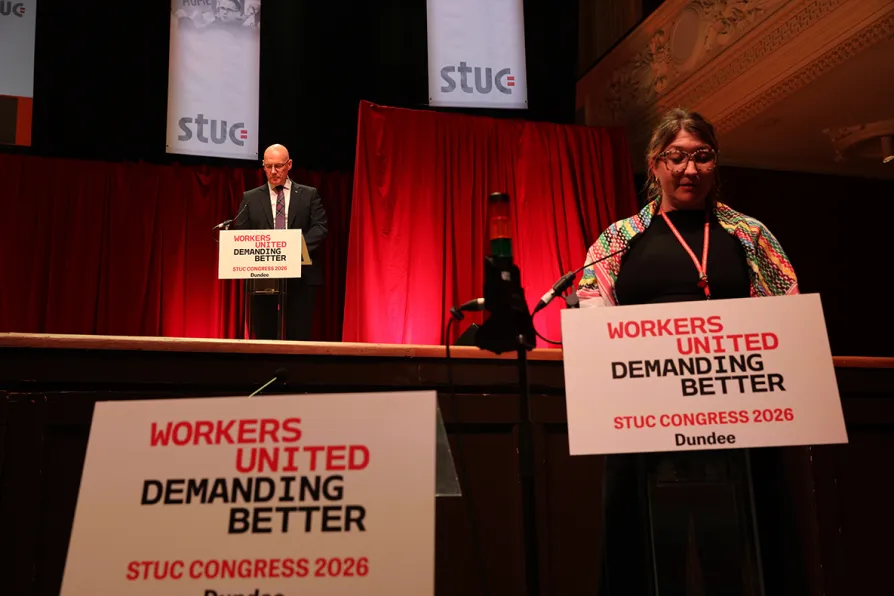 First Minister John Swinney addresses delegates during the STUC conference in the Caird Hall, Dundee, April 21, 2026

As the 90th anniversary of the outbreak of the Spanish civil war is marked, Teesside campaigners will gather to remember the local men and women who stood against fascism, explains TONY FOX
Whatever differences exist among international sympathisers of the Bolivarian revolution about its current trajectory, they should unite against the imperialist power that is the source of an enforced retreat, argues ROGER D HARRIS
Washington’s inability to subjugate Iran is an example of how it is trying to preserve a regional order that no longer exists, argues RAMZY BAROUD
US financial instability is exposing the limits of a dollar-dominated global economy — and giving the Global South a historic chance to build an alternative, says MURAD QURESHI
Deprivation is a fundamental factor in criminal behaviour that must be addressed but, KENNY MacASKILL argues, there needs to a major rethink in sentencing to tackle overcrowding





AFTER next year, 130 years of the annual Scottish Trades Union Congress will come to an end. Congress voted this year to move to a biennial cycle for itself and its equalities conferences.
Regular attendees of congress will have had a sense of deja vu, as the same thing was proposed last year, where it fell by just 0.6 per cent of the vote. This year, with Unison “switching sides” from opposition to support, it passed overwhelmingly.
The General Council did make a compelling case. Last year, this change was touted as a way of shifting the STUC’s focus “from convening to campaigning,” with little substance behind the catchy slogan. This year, the General Council wisely published a set of concrete proposals, concrete activities the STUC would have the time and resources to support without having to organise congress and five equalities conferences every year.
As an Aberdeen Trades Union Council delegate, I spoke against the motion, as did many other trades union councils across Scotland. This was in spite of the promises of greater resourcing for Trades Union Council activities as part of the General Council’s proposals, and based on both philosophical and practical concerns.
On the philosophical level, and as I pointed out in my speech opposing the General Council motion, this development seems completely incoherent with our position as a movement to oppose cuts. In the public sector, we consistently argue that budgetary constraints and workload issues should be addressed by raising public revenue and hiring more workers, not by cutting service provision.
The affiliated trade unions should be funding the STUC to a level where it can provide both these long-standing annual events and the various new smaller-scale activities affiliates want. Instead, we have opted for what we constantly lambast governments and local councils for: robbing Peter to pay Paul.
If the unions themselves can’t afford to increase the STUC’s funding to match needs, perhaps they need to ask themselves whether it is really viable to keep flat union dues for all members regardless of income (in the case of some unions) or indeed dues rate structures that were last adjusted for inflation in 2003 (in the case of others).
In practical terms, there are several problems this change will cause, the most glaring of which is that it diminishes the voice of the workers’ movement.
Congress and its decisions achieve a level of public impact which mere General Council statements cannot, and particularly with the ever-increasing pace of modern politics, this will become a growing problem. Imagine congress had been biennial all along: it may have taken the Scottish workers’ movement well over a year to respond meaningfully to the genocide in Gaza, the renewed blockade of Cuba, the advent of AI or the rise of Reform UK.
The commensurate change to the equalities conferences is even more problematic. Longer terms of office for General Council and the equalities committees were touted as a way to achieve greater stability and continuity, but for the youth committee they may achieve the exact opposite. Most young workers are now joining unions later than they used to. If you join at 23, become an activist at 25, attend your first youth conference at 27 and immediately stand for election to the committee, you will only be able to serve a single term before “ageing out.”
The gender care gap too has not been considered. Women are disproportionately likely to find themselves suddenly and unexpectedly facing caring responsibilities, which may then impact on their capacity to maintain other activities. It follows that the women’s committee is disproportionately likely to lose members mid-term, and a two-year term of office will exacerbate the resulting struggle with vacancies.
Lastly, there is the elephant in the room: the democratic deficit. Congress is the sovereign body; it alone can make fundamental changes to the STUC’s policy, its priorities, and the way it is run. This change therefore directly diminishes the ability of affiliates and equalities sections to set the STUC’s direction, particularly as not all affiliates are represented on General Council.
We can only hope, albeit with a healthy dose of scepticism, that the General Council is proven right in its determination that all of these drawbacks will be outweighed by the benefit of the various new activities the STUC will now work to deliver. Only time will tell.
Fred Bayer is assistant secretary of Aberdeen Trades Union Council and a former chair of the STUC youth committee
