ANDY HEDGECOCK and MARIA DUARTE review Late Fame, The Death of Robin Hood, Leviticus, and Gail Daughtry and the Celebrity Sex Pass


 Latest editorial

An introduction to Immanuel Kant
GORDON PARSONS enjoys Kant’s ‘mind-boggling’ theory of human reality: that we create the reality we experience
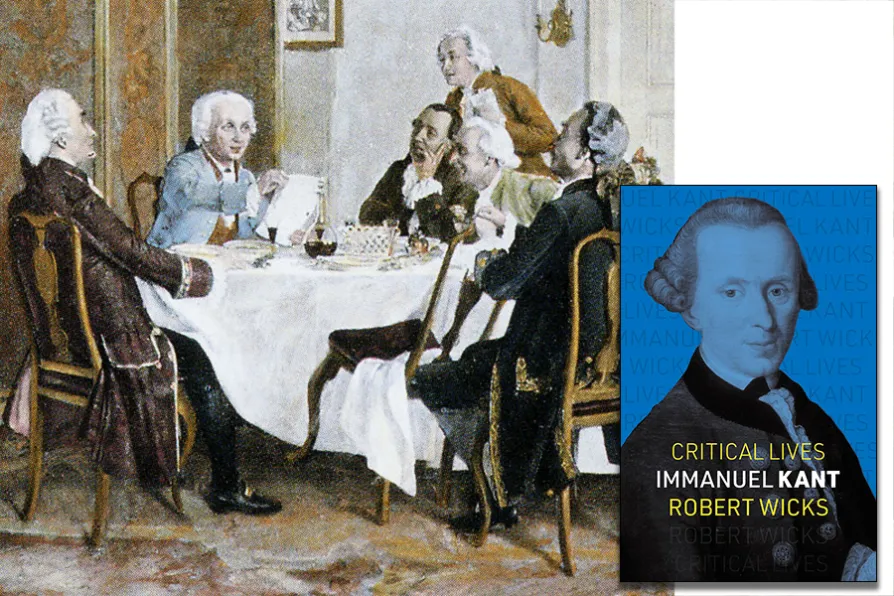 A CONVIVIAL MAN: Emil Doerstling (1859–1940), Kant and Friends at Table [Pic: Public Domain]

DAVID RABY welcomes a biography that emphasises how Fidel’s unique characteristics became hallmarks of the ongoing Cuban revolutionary process
IAN SINCLAIR recommends a readable, if partisan, account of the astonishing campaign of New York's new mayor
MATTHEW HAWKINS witnesses a contemporary ballet that represents human life as subjected to artificial intelligence
by Marwa Paikan





Immanuel Kant Robert Wicks, Reaction Books, £12.99
Robert Wicks’s short book in the Critical Lives series sets out to elucidate the life and work of a man considered by many as the greatest of modern philosophers. From the outset Wicks faces two problems in engaging the general reader.
Kant’s long life (1724-1804), although spent during the most turbulent years in Europe culminating in the French Revolution, was, personally, markedly uneventful, spent in his home town of Konigsberg, lecturing at the university.
His work, however, involving the examination of the pre-eminent concerns of the Enlightenment’s “Age of Reason,” and climaxing in his ground-breaking Critique of Pure Reason in 1781, was so innovatory that he termed it a “Copernican revolution.”
Just as Copernicus had fundamentally changed how humanity perceived and behaved in the 16th century by revealing that our globe was not the God-created centre of the universe but only one of a number of planets circling the sun, Kant argued that instead of experiencing impressions passively, we play an active role in creating those impressions.
A perfunctory reader may respond: “So what?,” noting that Karl Marx observed that “Philosophers have only interpreted the world in various ways; the point, however, is to change it.”
At this point, before either giving up or persevering with the chapters that describe in detail the historical, social and personal context of Kant’s daily life, and as a preliminary to the task of engaging with the complexity of his theoretical argument, I strongly recommend turning to the book’s Epilogue, “Kant’s Legacy.” There he makes a convincing case for his major influence on our contemporary worldview. According to Wicks, here is a philosopher who has indeed helped to change the world.
Back to the creative forces that shaped this staid although ambitious man. Wicks stresses the influence of Kant’s Pietist homelife and education, a kind of revival and reform movement within Prussian society’s Lutheranism. Although Kant remained a believer in God throughout his life, he rejected the formal structures and dogmas of religion.
Both philosophers of the early Enlightenment, like Descartes and Leibnitz, and his immediate contemporaries, especially Rousseau and Hume, along with Newton, modern science and mathematics, all played formative roles in the evolution of the creative mind of a man “who conceived of himself as a player in the intellectual big leagues.”
His early works, prior to the Critique of Pure Reason, reflect his confident ambition. For example, inspired by the work of Isaac Newton, he “developed a grand theory of the universe’s origins beyond what Newton was able to accomplish… still recognised as a plausible explanation of how stellar and planetary bodies originated.”
His main works and claim to international fame are the three Critiques: of Pure Reason, examining the bounds of human knowledge; of Practical Reason, on morality and ethics; and of The Power of Judgement, on aesthetics and beauty. These were designed to determine “carefully and precisely the limits of human reason, which is a project of self-knowledge.”
We must recognise that certain basic metaphysical questions, such as whether the world has a beginning or whether our judgements are free, are meaningless in as far as they are unanswerable, offering “truths” either way. These, Kant terms the antinomies of pure reason.
Kant’s ultimate aim is to explain how the mind works and to distinguish between our sensibilities and our intellectual faculties.
Wicks explains Kant’s “mind-boggling” theory of human reality in his characteristic, simple terms: “We open our eyes in the morning and extending before us each day is a spatio-temporal theatre, the appearance of which — in its three-dimensionality and movement in time — arises from the activity of our own minds. We create that appearance.”
Robert Wicks impressively conveys the main tenets of Kant’s work as explicably as any short account could be expected to.
In our present day, beset by multiple man-made and natural crises, it can appear an indulgence to spend time in contemplating the efforts of Immanuel Kant to understand our world and our place in it. But, as Wicks demonstrates in the final sections of his book, until we understand where and who we are, we can never hope to change it.

Similar stories
MARTIN HALL welcomes a plea for greater compassion between believer and non-believer via the framework of philosophical enquiry
GORDON PARSONS is intrigued by a biography of the Marxist intellectual and author, made from the point of view of his son
JOHN GREEN’s palate is tickled by useful information leavened by amusing and unusual anecdotes, incidental gossip and scare stories
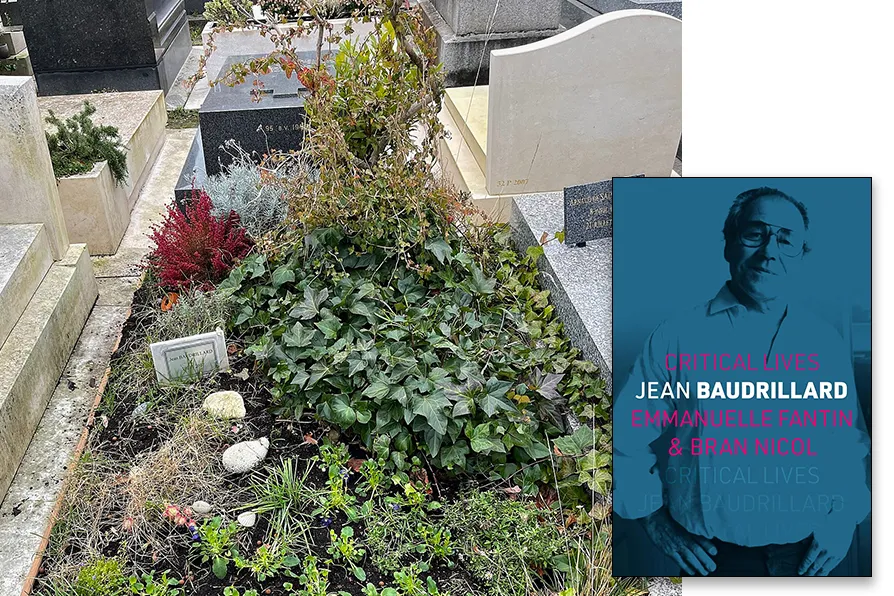
ALAN McGUIRE welcomes a biography of the French semiologist and philosopher