
ROB WARZYNIAK wades knee deep through a pile of ‘dead canaries’ of Trumpist policies which exacerbated the horrors of US capitalism domestically


Venezuela: a retreat is not a surrender
Concessions to Washington by the post-Maduro leadership in Caracas are designed to preserve the core of the Bolivarian Revolution not betray it, argue Roger D Harris, Francisco Dominguez and Mara Paez Victor. How the solidarity movement responds is critical
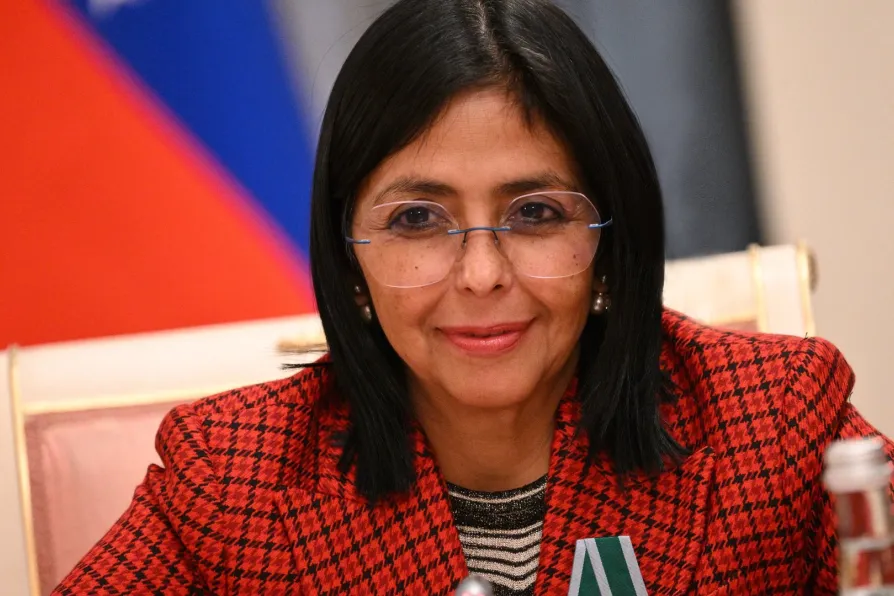
 Acting president Delcy Rodriguez [Pic: government.ru/Creative Commons]
Without evidence or Nato consultations Berlin’s answer to the Leipzig incident is a rupture of relations. SEVIM DAGDELEN examines why
FRANCISCO DOMINGUEZ introduces the background to a conference on defending Latin America’s sovereignty
The glacier collapse in Nepal is yet another warning that a warming planet is making Himalayan disasters more frequent and destructive – but the countries facing the greatest risks are often those least responsible, says LI YANG
Nick Blair is set to benefit from a hugely lucrative contract to ‘virtually’ train the British army for its next war. Like father, like son, writes SOLOMON HUGHES
Even when tragedy strikes, Western media cannot resist the opportunity to turn it into a sordid propaganda opportunity, as the Nepal-China border tragedy shows, writes CARLOS MARTINEZ
Trade unions should be at the heart of the anti-racist push for reparations for the historic legacy and continuing impact of slavery, writes ROGER McKENZIE





“NOTHING is easier than to be idealistic on behalf of others.” Karl Marx, 1858.
The US military kidnapped the lawful Venezuelan President Nicolas Maduro and his wife and National Assembly deputy Cilia Flores on January 3, 2026, resulting in over 100 fatalities of civilians as well as Cuban and Venezuelan guards.
This surprise attack flagrantly violated international law but in expectation that the US could act with impunity. Even the left-leaning governments of Brazil and Colombia offered only mild rebukes. Then Venezuelan Foreign Minister Yvan Gil said: “We found ourselves alone.” That is the context of subsequent developments.
The attack was the climax of a quarter of a century of US and allied (particularly Canadian and British) machinations against Venezuela: asphyxiating sanctions, stolen assets, diplomatic isolation, cyber attacks, assassination attempts, mercenary invasions, and establishing a fake parallel government. For the two months preceding the invasion, the US navy blockaded oil shipments. Even so, the empire’s goal of regime change was not achieved.
The revolution’s resilience compelled the US to escalate
Washington failed to destroy Chavismo, founded by Hugo Chavez and carried forward by his successor Nicolas Maduro. Venezuela did not collapse into chaos after the abductions. The US-backed far-right opposition did not seize power, but found itself more marginalised.
Vice-President Delcy Rodriguez was sworn in constitutionally as acting president. The top command held firm, backed by the National Assembly and supreme court. Likewise, the civic-military union and the communes and grassroots Chavista institutions supported the government.
Relying on military superiority, Washington made a mafia-style “offer you can’t refuse.” US Secretary of State Marco Rubio called Rodriguez to deliver an ultimatum to collaborate or face national destruction and the murder of her and other leaders. Variations of this scenario are corroborated by both the corporate press and Chavista sources.
Trump threatened: “There is more where that came from.” With US forces deployed off its coast, a military confrontation would have meant annihilation. Rodriguez made a tactical retreat in the face of overwhelming force.
Venezuela did not surrender
The Chavista state institutions and the powerful grassroots revolutionary organisations remain intact. Yet, US imperialism, pointing a gun at the government’s head, can force unpalatable decisions, such as the deportation of the former minister of industry Alex Saab to the United States.
Former Chavez official Sergio Rodriguez Gelfenstein observes: “What is at stake is the survival of the state and the republic, which if lost, would make the discussion on any other topic banal.” Former Venezuelan foreign minister Jorge Arreaza said, “everything is now negotiated,” with Washington in daily give-and-take sessions.
Legislative reform had long been on Maduro’s agenda. However, revisions to laws governing the exploitation of hydrocarbons and hard minerals involved offering generous conditions to foreign investors.
Another planned initiative, the new amnesty law, promotes reconciliation and denies extremists pretexts for violence. The law excludes “anyone who has committed war crimes, human rights violations, homicide, drug trafficking, or treason.”
The government is negotiating with the moderate opposition, as Maduro did.
Rodriguez has counselled prudence and patience. The core Chavista leadership, the military, the United Socialist Party of Venezuela (PSUV), and community formations have remained united.
Long-sought gains achieved
The US now in practice recognises the Venezuelan government as legitimate. The Bolivarian project has forced its greatest adversary into a reversal.
Since 2019, the US blocked transactions with Venezuelan banks. US restrictions cut Venezuela off from the global financial system. Oil sales to the US have now resumed, with some revenue returning to the domestic economy. The US-dominated International Monetary Fund (IMF) is again engaged with Venezuela. Rodriguez has stated that Venezuela is not seeking IMF loans, but access to its own frozen funds.
Although sanctions largely remain in place, special licenses and a temporary easing of economic restrictions for earthquake relief have provided some breathing space, although the broader structure of US economic warfare is intact. Nonetheless, this is preferable to the total oil blockade imposed before the January 3 assault.
Rodriguez has demanded that Venezuela be freed from all sanctions. She has even appealed to King Charles III for the return of 31 tons of Venezuelan gold held by the Bank of England.
Changed political landscape
Judging compromises by an idealised Chavez-era standard is mistaken. The balance of forces confronting today’s Venezuelan leadership is more unfavourable.
Some international commentators invoke Chavez to discredit the current leadership. Ignoring the changed context, infantile leftists claim that Chavez never compromised and that “one does not negotiate with the enemy,” forgetting the advice of Fidel Castro during the 2002 coup: “Don’t immolate yourself, Hugo.”
Chavez governed during a commodities boom that provided resources for benefits unavailable under sanctions today. The geopolitical context has shifted significantly since Chavez’s time, especially with the present “Donroe Doctrine.” Not since Maduro’s victory in July 2024 has a left-leaning candidate won in Latin America. The last seven presidential elections have been won by the right. Until this reactionary trajectory is reversed, further retreats are likely.
The impact of the illegal unilateral coercive measures have eroded public support for the government. Years of comprehensive sanctions – despite the 2021-2025 economic recovery following an 75 per cent GDP contraction – have left Venezuela vulnerable. Currently the Venezuelan economy is operating at 30 per cent of its pre-sanctions level.
The Rodriguez government is buying time to salvage the economy, although the June 24 earthquakes caused physical damage estimated at over $37 billion (£27bn), over a third of Venezuela’s gross domestic product. Most Venezuelans want domestic peace and a return to prosperity, not a confrontation with the US empire.
“Unity is the most important thing – without it, nothing is possible; with it, everything is possible.”
Those were the words of Fidel Castro as he was organising the Cuban Revolution in 1956. Most dangerous for the sister Bolivarian Revolution is the suggestion that the current leadership has betrayed the cause and that a truly leftist “third way” can replace them. There have always been competing factions within the Bolivarian movement. But political choices must ultimately be resolved within Venezuela itself, not by outsiders.
These “third way” analyses, equating and rejecting both Caracas and Washington, typically fail to address what Venezuelans could realistically do at this historical juncture – long on what’s wrong but short on viable alternatives.
It was not so long ago that the likes of far-right Maria Corina Machado highlighted “cracks and fissures within the Chavista ranks.” She anticipated “the beginning of a social explosion” against the elected Venezuelan government. Now some solidarity activists are repeating this.
Left disunity in Bolivia should be a lesson of what could happen in Venezuela. The Chavista leadership is painfully aware of this, hence their vigorous effort to establish the broadest united front against US colonisation. Rather than being traitors to the cause, the Rodriguezes and Interior Minister Diosdado Cabello represent the most militant Chavistas – fighters from the very inception of the revolution.
What solidarity requires
Constructive criticism and solidarity activism need not be counterposed. Dissident opinions are appropriate when contextualised and advance common goals – not as individualistic venting.
Some among the left have appointed themselves as guardians of the faith, judging negatively from afar the very difficult and risky tactical retreat undertaken by the Bolivarian leadership, even though it prevented a suicidal military confrontation with US imperialism.
The international left’s disappointment regarding Venezuela’s retreats is understandable. But the Global South is not about to fulfil the revolutionary aspirations of those living in the belly of the beast. That is the task for people in the imperial core.
As a Venezuelan activist friend said: “You gringos tell us how to make our revolution when our problem is you have failed to make yours.”
Venezuelans will determine their path without foreign interference, either right or left. Solidarity necessitates efforts to accompany and uplift, not dictate to the Venezuelans. Internationalists in the US, Canada, and Britain need to place the primary focus on our own imperialists. All other contradictions are secondary.
The solidarity movement must unite the broadest alliance to defend national sovereignty and the right to self-determination. It must strongly oppose the farcical New York trial of Nicolas Maduro and Cilia Flores, demand the lifting of all sanctions, and call for the return of stolen assets.
The old slogan, El pueblo unido jamas sera vencido. (A united people will never be defeated.) is truer than ever,
Roger D Harris is a founder of the Venezuela Solidarity Network in North America. Francisco Dominguez is the national secretary of the Venezuela Solidarity Campaign in the UK. María Paez Victor is the founder Louis Riel Bolivarian Circle in Canada.

Similar stories
On its revolutionary founder’s 100th birthday, Cuba remains the revolution that ‘does not give up’ and socialism humanity’s only hope of avoiding the abyss
On January 29, US President Donald Trump declared Cuba an ‘unusual and extraordinary threat’ to US national security and tightened the blockade against the island nation MANOLO DE LOS SANTOS reports
The US attack on Venezuela raises grave threats to Cuba and the region, writes NATASHA HICKMAN of Cuba Solidarity Campaign
International solidarity can ensure that Trump and his machine cannot prevail without a level of political and economic cost that he will not want to pay, argues CLAUDIA WEBBE