
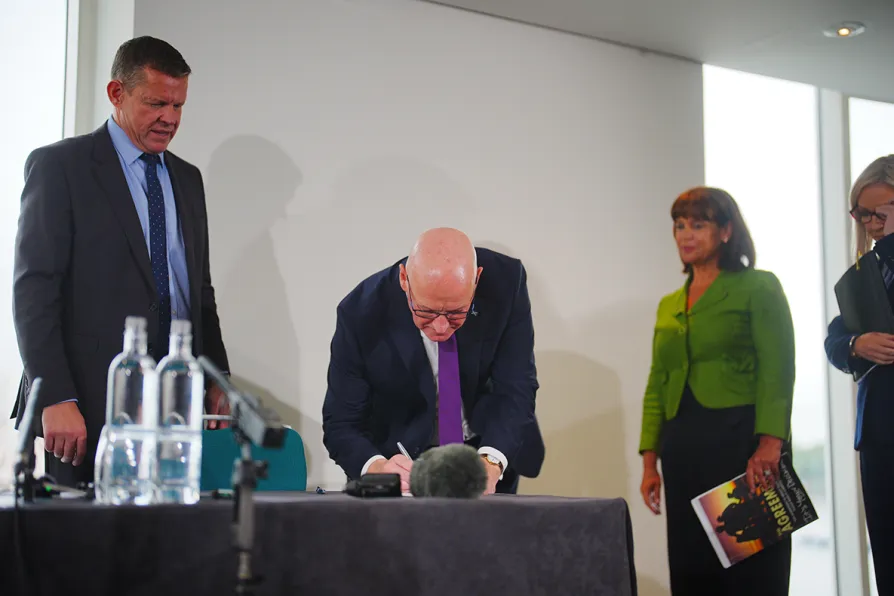
The UK Prime Minister may have the regal touch in northern England, but he’s been wrong-footed on the constitutional challenges posed by the Celtic Alliance of first ministers from Scotland, Wales and Northern Ireland, argues KENNY MacASKILL

From blockade to asphyxiation: the US war on Cuba enters its most brutal phase
On January 29, US President Donald Trump declared Cuba an ‘unusual and extraordinary threat’ to US national security and tightened the blockade against the island nation MANOLO DE LOS SANTOS reports
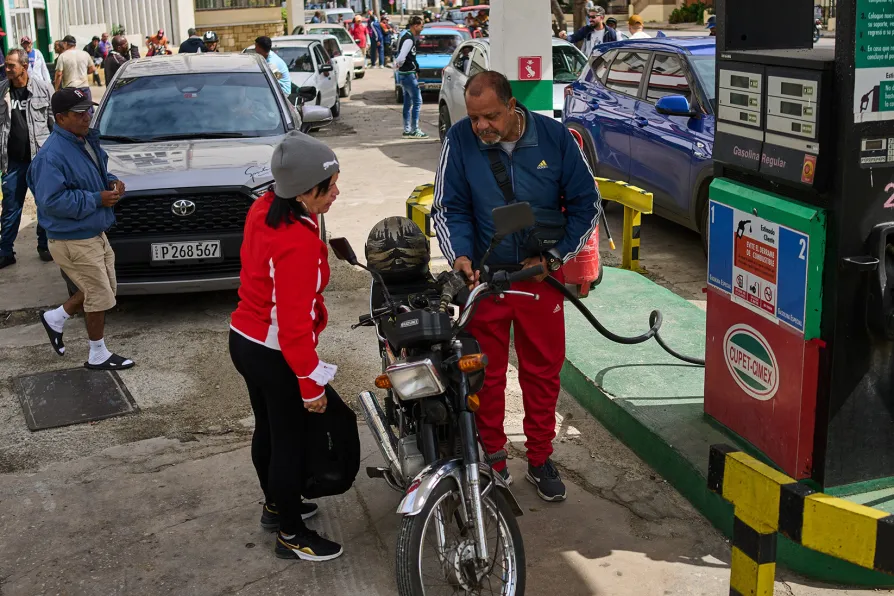
 A driver refuels a motorcycle as other drivers wait in a long line at a petrol station in Havana, Cuba, Friday, January 30 2026
NEIRLAY ANDRADE, a member of the Communist Party of Venezuela’s political committee, outlines her party’s position on the crisis facing the country
A look at Taylor Wimpey’s accounts shows why Labour’s market-led housing strategy won’t deliver more, cheaper homes, as promised, says SOLOMON HUGHES
DAVID HORSLEY remembers the remarkable life and death of US black revolutionary George Jackson, whose politically passionate prison letters were published as Soledad Brother
Cuban trade union federation CTC leader OSNAY MIGUEL COLINA speaks to Ben Chacko about life and work under a crippling US siege
A part of the British empire’s network of slavery, today the Caribbean island of Nevis faces a new form of exploitation in the form of crypto-colonialism, CLAUDIA WEBBE writes
Challenges from the unscrupulous misuse of AI to steal actors’ voice and physical likenesses is being met with a firm union response, writes LYNDA ROOKE





IN THE stillness of a Havana night, the only sounds are the hum of a generator in a distant hospital and the murmur of a family gathered in candlelight. For them, “US national security” is not an abstract concept debated on US cable news; it is the tangible reality of a 20-hour blackout, the smell of spoiled food, and the fear for a child’s refrigerated medicine. This is the face of a policy that the United States government calls a response to an “extraordinary threat.” The true threat, however, is not military. It is the 67-year defiance of a small island nation that has refused to relinquish its sovereignty.
On January 29 2026, the Trump administration transformed a long-standing campaign of pressure into a blunt instrument of suffocation. With an executive order, it weaponised the US tariff system against any nation, including countries like Mexico, that dares to sell oil to Cuba. This is no longer about isolating or containing the Cuban people from the rest of the hemisphere; it is a deliberate strategy of total economic asphyxiation, a move unseen in its aggression since the cold war.
Cuba’s electrical grid, water pumps, public transport, hospitals and schools run on imported fuel. By coercing third countries, the US aims not merely to sanction but to disrupt a nation’s very metabolism. The Cuban government’s statement cut to the core: this is “blackmail, threats, and direct coercion” designed to prevent fuel from entering the country. The result is collective punishment, a violation of international law that uses hunger, darkness and disease as political weapons to break the will of a people.
To call this a “foreign policy” is to undersell its nature. It is an evolving, multilateral instrument of war, relentlessly pursued by 10 consecutive US presidencies with a single goal: the destruction of Cuba’s socialist project.
• Eisenhower (1960) initiated the aggression with the first blockade after Cuba nationalised US-owned refineries.
• Kennedy (1961-62) escalated with the failed Bay of Pigs invasion, made the blockade total, and greenlit Operation Mongoose, a secret programme of sabotage and attempted assassination of Cuban leaders, including over 630 attempts against Fidel Castro.
• Clinton (1992-96) delivered what was hoped to be a “knockout blow” after the Soviet Union’s fall, passing the Torricelli and Helms-Burton Acts. These laws extended the US blockade extraterritorially, punishing foreign companies for trading with Cuba and asserting US authority over global commerce.
• Trump (2017-2026), after a fragile thaw under Obama, not only reversed course but plunged deeper into cruelty. He added Cuba back to the “State Sponsors of Terrorism” list, a move widely condemned as political fiction, and enacted 243 new sanctions. His most recent act, the 2026 executive order, seeks to seal the island’s fate by starving it of energy.
The strategy has always been naked in its intent. A declassified 1960 State Department memo by Lester D Mallory advocated creating “hunger, desperation and overthrow of government” by denying “money and supplies.” The human cost is the point, not a side effect.
This engineered crisis has measurable, horrific consequences. By the 1990s, the tightened blockade caused a 40 per cent drop in caloric intake and a 48 per cent surge in tuberculosis deaths. Today, it blocks the purchase of medical ventilators, spare parts for water purification, and, crucially, the fuel to power them.
This suffering is framed as a necessary sacrifice by members of the Cuban-American mafia that serve in the US Congress. US Representative Maria Elvira Salazar of Florida, recently articulated the chilling calculus: “It’s devastating to think about a mother’s hunger, a child who needs immediate help… But that is precisely the brutal dilemma we face…: to alleviate short-term suffering or to free Cuba forever.”
This promised “freedom” is a return to the pre-1959 past, when US corporations controlled 80 per cent of Cuba’s public utilities and 70 per cent of all arable land. It is the “freedom” to exploit, purchased with the calculated suffering of an entire generation.
Trump’s escalation is the cornerstone of his administration’s “Donroe Doctrine,” a 21st century revival of the 1823 Monroe Doctrine that declares the whole of Latin America and the Caribbean to be US property. Following the illegal attack of January 3 2026, on Venezuela, Trump stated plainly: “American dominance in the western hemisphere will never be questioned again.” Under this doctrine, any nation that chooses an independent path, especially one organising its economy for human need, like Cuba’s world-renowned healthcare system, is deemed a “national emergency”.
For the US people, it is critical to see this not as a distant issue but as part of a continuous logic. The same administration that invokes “national emergencies” to strangle Cuba’s economy uses “emergencies” to unleash Ice raids in US cities and kill its own citizens like Renee Good and Alex Pretti. The same mindset that labels 11 million Cubans a collective threat for practising self-determination labels migrants and minorities as domestic threats. The logic of the blockade and the logic of the border are one and the same: the violent control of populations and resources, and the designation of entire groups of human beings as disposable.
The flickering candle in that Havana home, then, is more than a light against the darkness. It is a defiance of an imperial order. The struggle of the Cuban people to keep their lights on is a fundamental struggle for the right of all peoples to determine their destiny, free from the coercion of an empire that confuses dominance with security and mistakes cruelty for strength. As in the past, Cubans will collectively rise to the challenge in order to not only survive, but overcome the blockade.
Manolo De Los Santos is executive director of The People’s Forum and a researcher at Tricontinental: Institute for Social Research. His writing appears regularly in Monthly Review, Peoples Dispatch, CounterPunch, La Jornada, and other progressive media. He coedited, most recently, Viviremos: Venezuela vs. Hybrid War (LeftWord, 2020), Comrade of the Revolution: Selected Speeches of Fidel Castro (LeftWord, 2021), and Our Own Path to Socialism: Selected Speeches of Hugo Chávez (LeftWord, 2023).

Similar stories
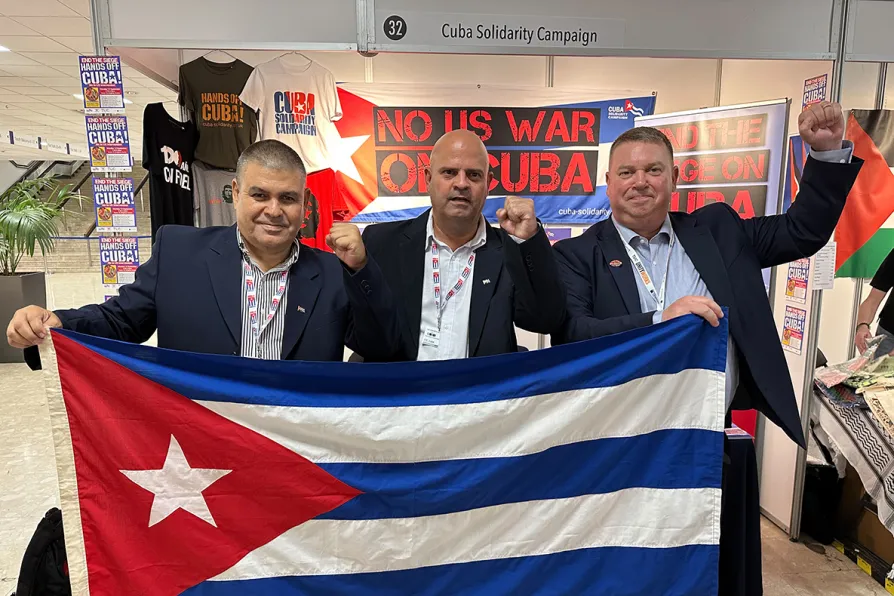
ALEX GORDON, general secretary of the Communist Party of Britain, calls on Britain’s trade unionists to redouble solidarity with the socialist island
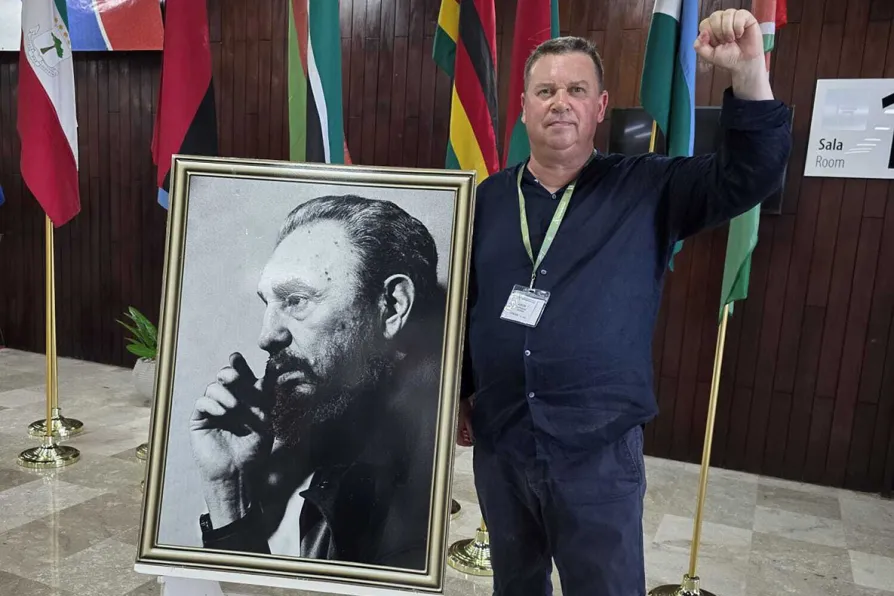
ALEX GORDON and LORRAINE DOUGLAS report from Havana, Cuba, where they represented the Communist Party of Britain at the 24th International Meeting of Communist and Workers’ Parties on August 7-8
CLAUDIA WEBBE says the US is tightening the noose to destroy Cuban socialism — the need for immediate, international solidarity is urgent
As the US intensifies its economic and political pressure it is now vitally important to demand the British government intervene to end US aggression, writes GEOFF BOTTOMS