
The US administration is endangering lives by reversing environmental protection laws, CHAUNCEY K ROBINSON argues

25 years after the Miami Five were jailed, we must campaign for Cuba’s freedom again
As the US intensifies its economic and political pressure it is now vitally important to demand the British government intervene to end US aggression, writes GEOFF BOTTOMS
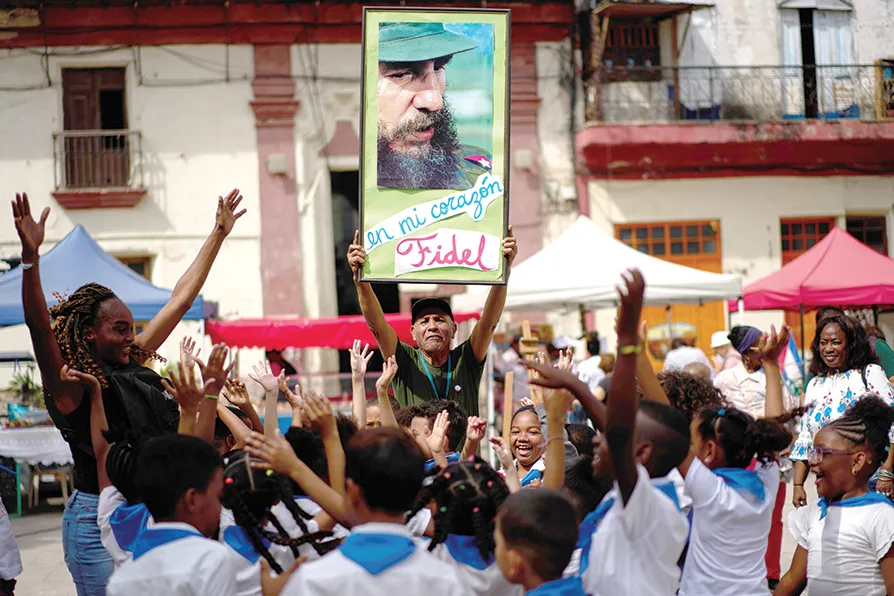
 HIGH SPIRITS: During a school activity in a park in Havana on March 4 2026 while a man holds up a photo of Fidel Castro with an ‘in my heart’ message
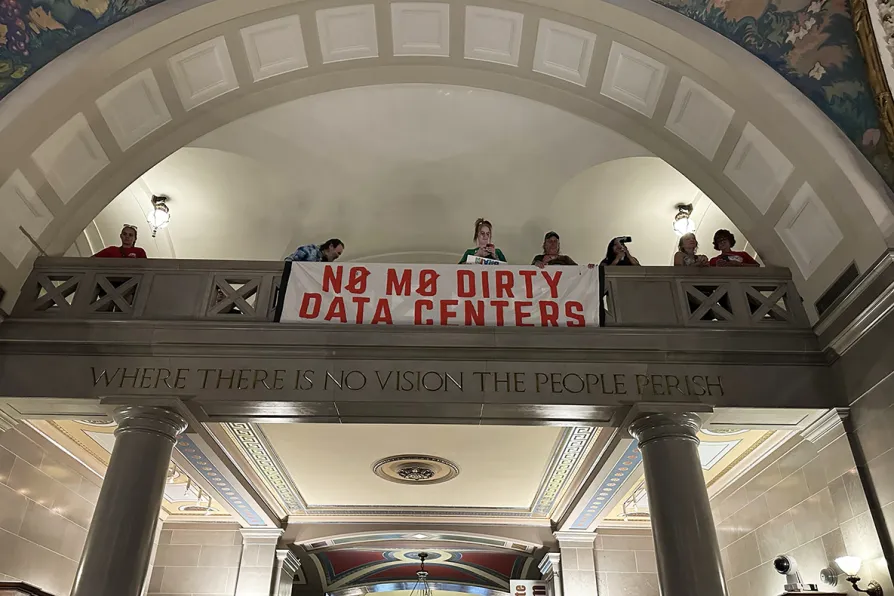
It’s time to stop retreating and go on the offensive to promote working-class interests, argues DOUG NICHOLLS
Marco Rubio wants to defeat socialism in Nicaragua, not restore ‘democracy,’ writes JOHN PERRY
Believe it or not, there was a time when the US government built beautiful homes for working‑class Americans to deal with a housing shortage, writes ERAN BEN-JOSEPH
DIANE ABBOTT provides an analysis of the reasons for EU and British voters’ dramatic swing to the right
Train drivers’ union Aslef general secretary DAVE CALFE speaks to Ben Chacko about his hopes that Burnham’s devolution agenda will include the importance of the railway





THIS year will mark the 25th anniversary of the unjust conviction and sentencing of five Cuban political prisoners in the United States.
Known as the Miami Five, they faced charges ranging from using a false identity to conspiracy to commit espionage, and even murder, for which they were given sentences ranging from 15 years to double life.
In reality Gerardo Hernandez, Ramon Labanino, Antonio Guerrero, Fernando Gonzalez and Rene Gonzalez had come from Cuba to infiltrate right-wing Cuban exile groups based in Miami, who had been responsible for terrorist attacks against Cuba.
For more than 40 years, these groups based in Miami had killed almost 3,500 people and injured over 2,000 others with the complicity of the CIA and US government, which had repeatedly failed to act against the perpetrators of such crimes.
These included chemical attacks on crops, biological attacks on livestock and the general population, the blowing up of a Cuban airliner in 1976, killing 78 people, and a bombing campaign against Cuban tourist hotels in the 1990s, killing an Italian tourist.
To save lives, Cuba sent these five men to Miami to infiltrate and monitor the groups. At the request of the US government, this information was passed to the FBI in 1998. But instead of arresting the terrorists, the US government arrested the five anti-terrorists on September 12 1998 in Miami, where they were illegally held in solitary confinement for 17 months.
The trial began in November 2000 in a hostile Miami, where the Cuban-American mafia, intent on destroying the Cuban Revolution, wield enormous political influence, making a fair trial impossible.
A change of venue was denied five times by the judge, defence evidence was suppressed and witnesses were intimidated by the local press. Prominent US officials testified that the Five had not accessed any classified documents, yet the jury reached a unanimous guilty verdict on all charges.
The Miami Five were convicted on June 8 2001 and sentenced between December 13 and December 27 that same year. The sentences for Guerrero, Labanino, and Fernando Gonzalez were reduced on appeal in October and December 2009.
On October 7 2011, Rene Gonzalez became the first of the Five to be released on parole from prison after serving his full term. In February 2014 Fernando Gonzalez also completed his sentence and returned home while in December 2014 the final three prisoners were released early as part of a prisoner exchange following an international campaign and talks between Cuba and the US.
Fast forward to the present day and the threat of terrorist and mercenary aggression remains. On February 26 Cuba intercepted and thwarted a group of 10 armed anti-Cuban exiles on a Florida-registered speedboat in Cuban waters, who were trying to infiltrate the country from the US for terrorist purposes. After first opening fire, five of the exiles were fatally shot and five were wounded.
Earlier on February 13, South Florida Republican lawmakers, Maria Elvira Salazar, Mario Diaz-Balart and Carlos Gimenez, had written a letter to the Trump administration urging the US Department of Justice to indict former Cuban leader Raul Castro, citing decades-old reports indicating that he personally ordered the attack on the Brothers to the Rescue aircraft 30 years ago, killing three US citizens and one permanent resident.
The aircraft belonging to the terrorist group was shot down after continually entering Cuba’s air space and had been warned to leave.
Following these calls, Florida’s attorney-general James Uthmeier, announced on March 5 2026 that a state-level criminal investigation into the incident would be reopened, while reports from March 9 indicate that the top federal prosecutor in Miami, Jason Reding Quinones, is currently considering criminal investigations against Cuban government officials.
Cuba today lies at the heart of a perfect storm as it faces an acute existential crisis with the escalation of the US economic, financial and commercial blockade whose origins lie in the Mallory Memorandum of April 6 1960. This aimed to overthrow the revolution by cutting funding and supplies to Cuba, causing hunger, desperation and poverty, and basically starving the people into submission.
Following the absurd redesignation of Cuba as a State Sponsor of Terrorism by President Donald Trump within hours of his inauguration early last year, the screw has been tightened even more by the signing of an executive order on January 29 this year that has declared Cuba to be an “unusual and extraordinary threat” to the national security of the United States, while the real threat that Cuba poses is that of an example, proving that another more just, peaceful, sustainable and equitable world is possible.
As a consequence sanctions have been threatened against any country that supplies oil to the island in an attempt to push Cuba into a deep humanitarian crisis and prepare the way for military intervention. Fidel Antonio Castro Smirnov, the grandson of Fidel Castro, has described the recent escalation as “economic terrorism in its highest form.”
This is in the wake of the recent illegal attack by the US against the national sovereignty of Venezuela, the major supplier of oil to Cuba, and which is in line with the recently revamped Monroe doctrine of 1823, reasserting US hegemony in Latin America, which it considers its “backyard.”
And now Exxon Mobil and Havana Docks are currently testing the limits of Title III of the Helms-Burton Act of 1996, activated by the first Trump administration in 2019, seeking compensation through the US Supreme Court against foreign entities “trafficking” in US-owned assets, that were nationalised by the Cuban state in 1960. If successful this would lead to further claims and deter future foreign investment.
Cuba was already experiencing an acute energy crisis as a result of 243 additional sanctions introduced during Trump’s first term and this further escalation means that worsening fuel shortages are causing regular prolonged blackouts, leaving hospitals, schools and workplaces without power, transportation of food and medicines severely limited, and food rotting in fridges and freezers.
Meanwhile Cuban President Miguel Diaz-Canel has said that his government is in talks with the Trump administration to find solutions to the two countries’ differences, while measures will be introduced to “facilitate a space” for the participation of Cubans abroad in the social and economic development of the country.
In response to the crisis the Cuba Solidarity Campaign has launched a Call for Peace and Sovereignty, rejecting threats against Cuba and Latin America. It has also called on its supporters to email their MPs asking them to sign early day motion (EDM2739) which has been tabled in Parliament demanding that the British government opposes the escalation of Trump’s war on Cuba. Then there is the ongoing Cuba Vive Medical Aid Appeal, which has raised more than £280,000 and sent six containers of medical aid worth over £1.3 million, with more on the way carrying food such as rice and lentils.
Meanwhile the five heroes of the Republic of Cuba continue to defend their country and its revolution in their various different and vital roles.
Gerardo Hernandez Nordelo, is the national co-ordinator of Cuba’s Committees for the Defence of the Revolution, Fernando Gonzalez is the president of the Cuban Institute of Friendship with the Peoples, while Ramon Labanino is vice-president of the National Association of Economists and Accountants of Cuba. Antonio Guerrero is the president of the National Union of Architects and Construction Engineers of Cuba and Rene Gonzalez is vice-president of the Jose Marti Cultural Society.
The international coalition of solidarity that coalesced around the campaign for their release now needs to be built in defence of Cuba and its people in the wake of this latest act of US imperialist aggression against a sovereign nation. Cuba has thrown wide open its arms to the world in acts of selfless solidarity that have exported doctors not bombs. It is now time for the world to open its arms to Cuba. There can be no finer way to honour Fidel Castro’s legacy in this centenary year of his birth.
Geoff Bottoms is a member of the Cuba Solidarity Campaign and was involved in the campaign to Free the Five. Sign CSC’s Call for Peace and Sovereignty at bit.ly/CSCPEACE; Support CSC’s Cuba Vive Medical Appeal at bit.ly/49MLBQs; ask your MP to sign EDM2739 at bit.ly/EDM2739.

Similar stories
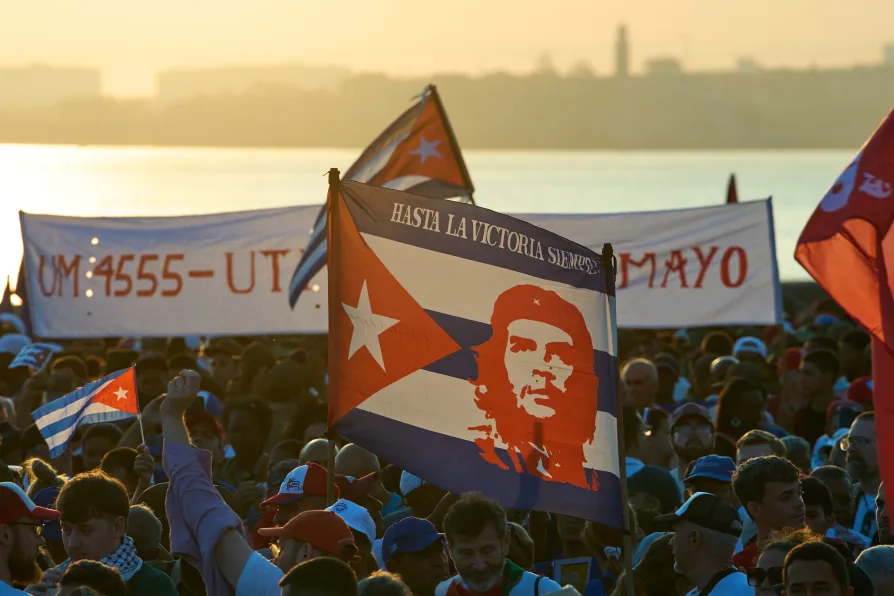
On the centenary of Fidel Castro’s birth, Communist Party international secretary KEVAN NELSON salutes the ongoing example of a revolutionary people facing a brutal US siege
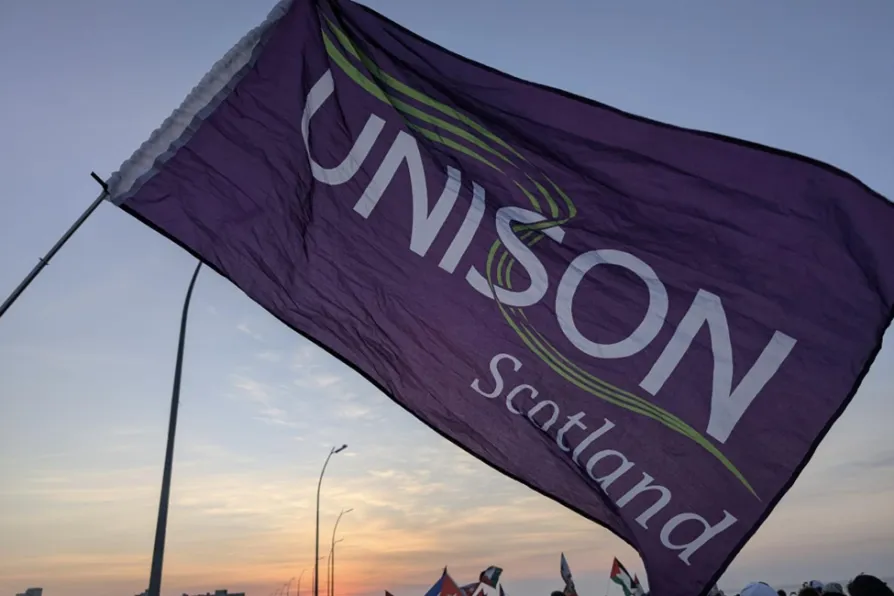
Trade unionists are mobilising to support Cuban workers and public services, amid escalating US pressure on the socialist island. RONAN OGILVY explains
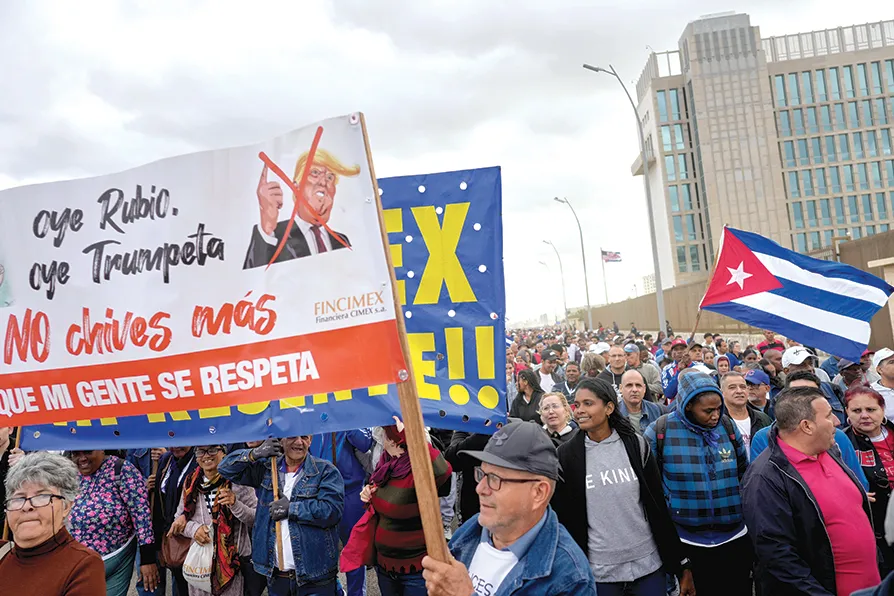
The US attack on Venezuela raises grave threats to Cuba and the region, writes NATASHA HICKMAN of Cuba Solidarity Campaign
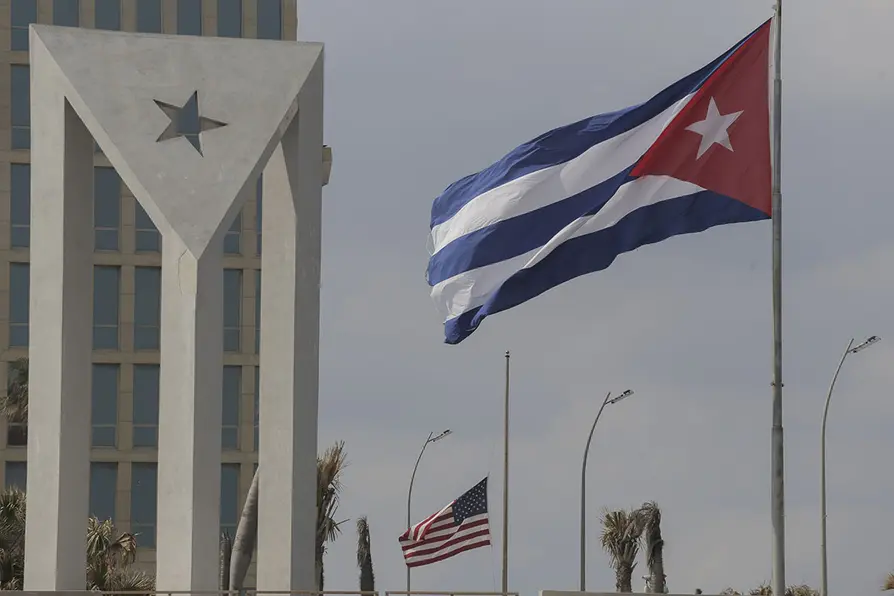
Where normally only the US and its ally Israel vote to strangle Cuba economically, there have been special efforts to slander and isolate the besieged socialist island nation year — so we must redouble our solidarity, writes TARIQ ANDERSON