
PETER MASON applauds the revival, 39 years later with the same team and cast, of Manfred Karge’s version of Brecht’s 100-year-old play, Mann Ist Mann

Roy Oxlade: Britain’s brilliant tearaway
MIRANDA RICHMOND relishes the gloriously liberated art of Roy Oxlade, and traces his method back to the thinking of David Bomberg, his acknowledged teacher
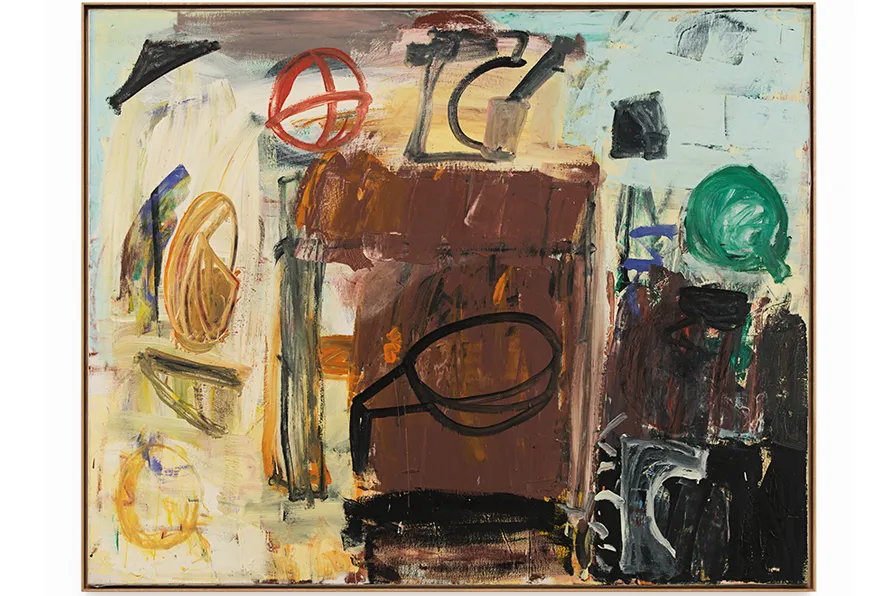
 AMBASSADORIAL IMAGE: Roy Oxlade, Metaphysical Objects after Holbein, c.1991 [Pic: © Estate of Roy Oxlade]
New releases from Biita Houdei, The Mary Wallopers, and The Tubs
New releases from Biita Houdei, The Mary Wallopers, and The Tubs
MAYER WAKEFIELD applauds a fearless attempt to bring to the stage the 1984 toxic gas disaster in Bhopal, India
ALEX HALL applauds the account of a dogged, traumatic and punishing campaign for justice that has lasted from 1998 to the present day
NICK WRIGHT laments the political bias of an epic attempt to tell the history of the liberation of France from the Nazis, that excludes both the decisive contribution of the Soviet Red Army, and of the French communist party itself





Roy Oxlade
Alison Jacques Gallery, London
★★★★☆
INITIALLY, to the casual visitor, Roy Oxlade’s paintings may appear messy, formless and indecipherable. They might be excused for thinking he had no training at all in the art of painting. The shapes appear random, the brushwork artless and the colour schemes unappealing.
But given some time with the paintings, spacial relationships begin to reveal themselves, and a scale, which is suggestive of interior spaces.
Without knowing the work at all, and without reading the title, one is confronted, for example, by a rectangular canvas displaying a large rust-coloured oblong in the centre with a banjo-like linear form, a cream area to the left with a black lopsided triangle towards the corner, some blackish forms bottom right. Graphic shapes in crude paint lines — an ochre oval, a green circle and a black square banjo-like linear form dance in an arc cross the canvas, like the objects tossed from the hand of a juggler. All this, with a pale blue tile-like area top right create a cluttered space which could represent perhaps, a kitchen with objects such as a stove, pans, a colander.
Next to it another painting is filled with light sweeping structures of cream and white paint. On the left a large black cone shape crossed by loose cream lines. A child’s outline of a dog, a shape somewhat like a kettle and another small structure hanging in the middle distance in rough yellow outlines, all loosely painted and overpainted or sometimes scraped off.
Clearly these are not abstract paintings in the sense of being non-representational. The scribbly and random colour area, apparently created over a period of time, amount to a carefully constructed surface which is deeply spacial and also gloriously liberated; and on reading the titles one has a clue to his method and approach.
Image
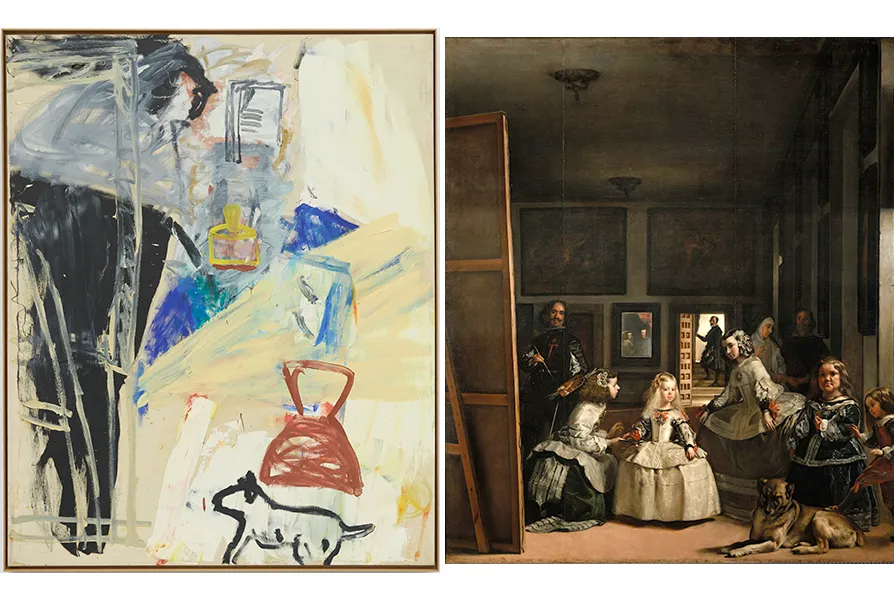
Given a certain background knowledge of Western art history, one can work out that the teasing title: Infanta With Black Easel should be read as a series of shapes and cyphers, references to Velasquez’s painting of 1656, Las Meninas, from which Oxlade made a series of studies. Metaphysical Objects After Holbein refers to Holbein’s The Ambassadors.
Oxlade wrote extensively about, and analysed the writings of David Bomberg, whose influential classes he attended for two years, and whose ideas profoundly influenced and formed a basis for his own approach. What Bomberg himself would have made of his student’s development and interpretation, is interesting to speculate.
Oxlade writes that from after the first world war, when Bomberg turned his back on geometric abstraction, it became increasingly clear to Bomberg that “the self-destructive impulses latent in materialistic and sophisticated societies could be avoided only by reappraising man’s relationship with nature.”
Also, that “the draughtsman must at all costs avoid conventional pre-established configurations and utilize instead a primitive sign language which is formed as it is drawn. It is a language used about things; it draws attention to, emphasizes, punctuates, pulls and pushes in a will to form.” (Art and Instinct, Selected writings of Roy Oxlade, Ziggurat Books, 2010)
Oxlade has taken seriously, and followed to its conclusion, Bomberg’s statements that the conventional orthodoxy of academic drawing, and particularly the analytical method practiced at the Slade school at the time of Bomberg’s classes (and still today widely held up as the measure of good drawing) is actively harmful to the development of the student. It destroys “the gift of form” (one of Bomberg’s phrases), without which we lose the “capacity to make qualitative judgements about the forms and spaces where we construct our lives. The exercise of aesthetic choices [is to] be the measure of a free society.”
Apart from the transcriptions from Velasquez and Holbein paintings described above, most of the subject matter in the exhibition depicts ordinary domestic objects around the house or studio, and the interior spaces, with paintings of his wife, Rosie Wylie, as well as figures or nudes.
Image
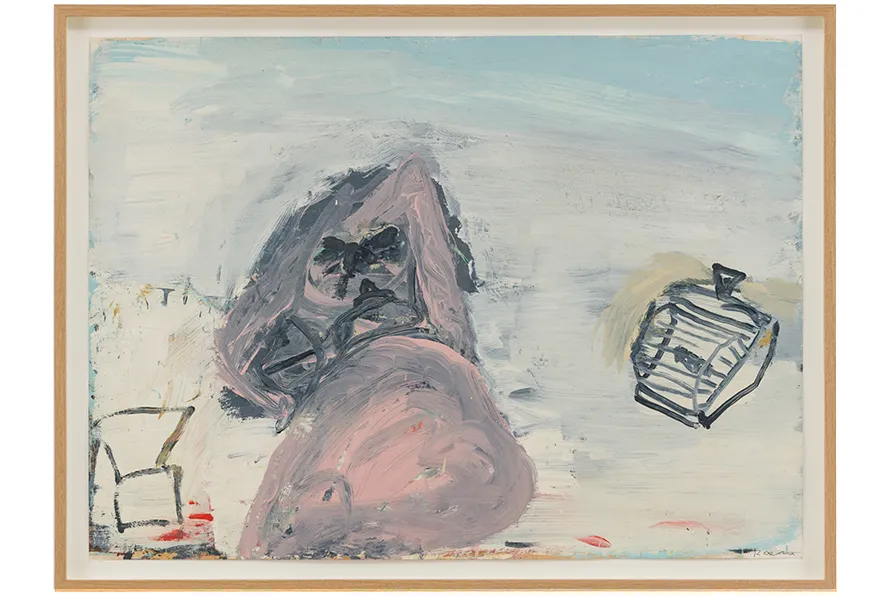
Two paintings from the 1980s: Reclining Nude and Rose In A Chair With Hands Behind Head are a bit more painterly, the colours more lush, suggestive of landscape. Slightly later, Green Leg 2001 is delightfully spare and direct; a simple table top with an interlocking chain of outlines — glasses, a jug, decanter, cutlery.
I think that Oxlade, in these paintings, has achieved something very difficult: to combine the genuine directness of a child with the sophistication of an adult. But I wonder whether the work is, ultimately, profound and moving, or whether is it rather quirky, inventive and joyful.
In his interpretation of Bomberg’s teaching, Oxlade has grappled with the question of how to show the essence of a thing freed from visual appearance. Is there such a thing as the “feel” of a form? And how does the feeling relate to the visual?
Obviously the visual appearance of an object can be reproduced in any number of ways, and today perfectly successfully by non-human intelligence, so what remains for the human is to find a way of expressing the bodily experience of “being in the world.” This is arguably what Bomberg meant by his famous expression “the spirit in the mass” — “mass” referring to that which triggers the response in us known as “being moved” or “being touched by.”
Other artists who have seriously responded to Bomberg’s teaching have taken a different approach from Oxlade. A painstaking study of appearances that connects one part of a form to the next through the senses, and in the gradual development of a whole — an approach that was seemingly rejected by Bomberg in his writings (though not in his practice) — can be a way to uncover hidden and potentially meaningful and moving structures.
Having said that, this exhibition successfully throws open the continuing enquiry about how we experience the world, and the nature of vision. Oxlade’s profound engagement with these questions through both painting and writing make the work important, prescient and a vital contribution.
Runs until May 30. Admission free. For more information see: alisonjacques.com.

Similar stories
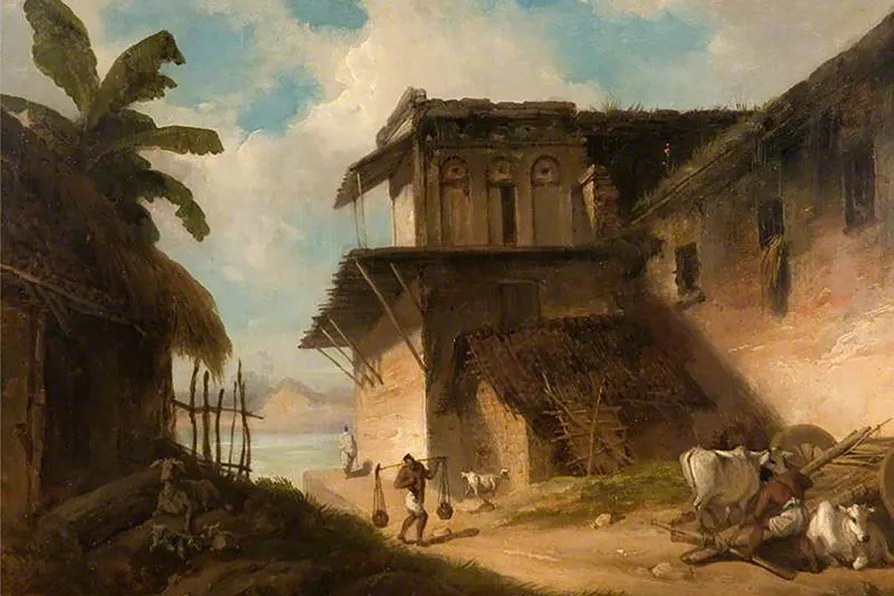
APURBA CHATTERJEE explains how British artists in India used the “picturesque” to reshape colonial landscapes and celebrate imperial power
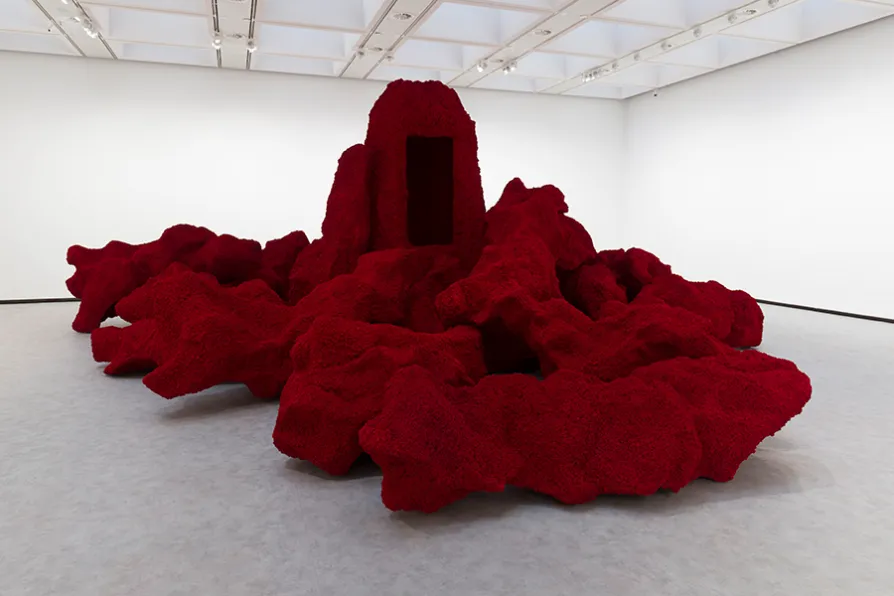
SIMON DUFF is thrilled by a visceral, no-holds-barred exploration of the expressive powers of raw material
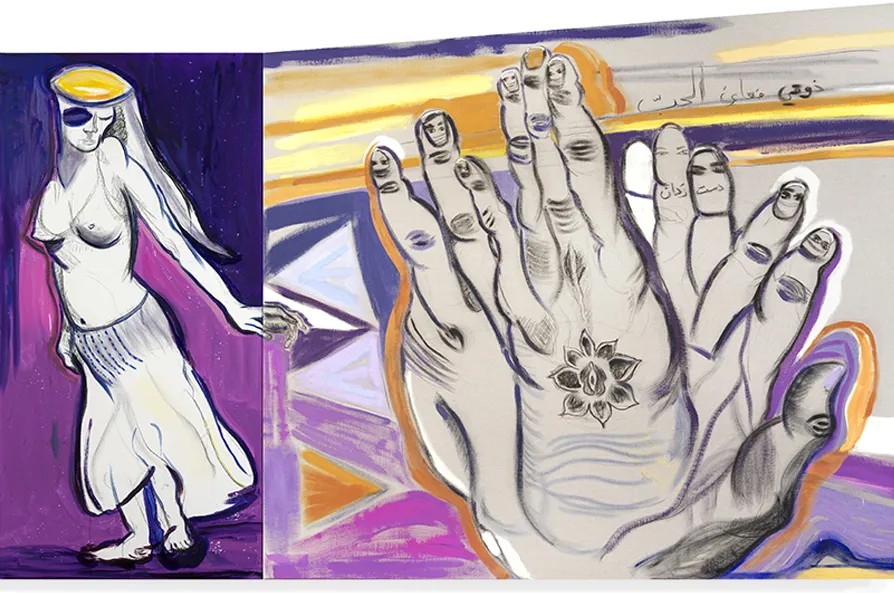
SIMON PARSONS applauds an artist who rescues and rehumanises stories of women, the victims of violence, from a feminist perspective
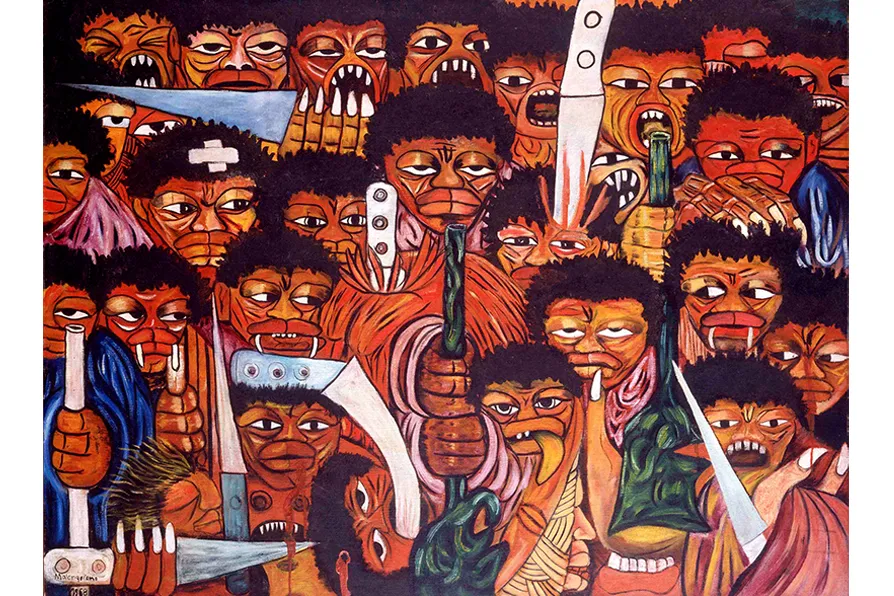
JOHN GREEN welcomes a remarkable study of Mozambique’s most renowned contemporary artist