
APURBA CHATTERJEE explains how British artists in India used the “picturesque” to reshape colonial landscapes and celebrate imperial power


‘Music remains an intrinsic part of us during migration’
SIMON PARSONS applauds an artist who rescues and rehumanises stories of women, the victims of violence, from a feminist perspective
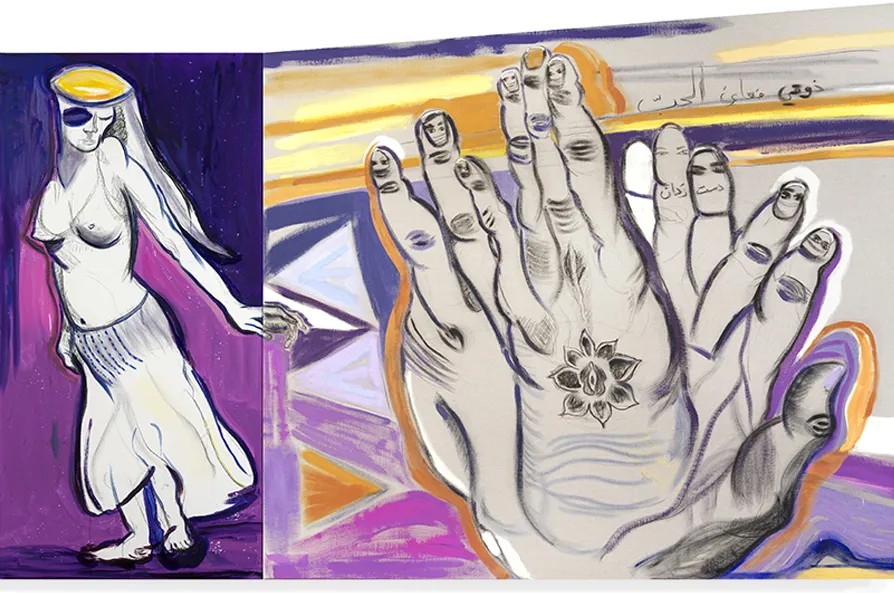
 29 Mounira Al Solh, Flying, Clapping, Grooving, Tasting love, Triptych, 2025, detail [Pic: Courtesy of Arnolfini Gallery]
PAUL DONOVAN welcomes a revival of Reginald Rose’s classic play that reminds us of the fundamental need for trials with juries
SIMON PARSONS applauds an exceptional performance of Wesker’s little-known play, by the same actor for whom it was written 45 years ago
ANDY HEDGECOCK and MARIA DUARTE review Late Fame, The Death of Robin Hood, Leviticus, and Gail Daughtry and the Celebrity Sex Pass
ANGUS REID recommends a uniquely accomplished documentary collage that contemplates our relation to the natural world
GORDON PARSONS enjoys Kant’s ‘mind-boggling’ theory of human reality: that we create the reality we experience





A Land As Big As Her Skin
Arnolfini Gallery, Bristol
⭑⭑⭑⭑⭑
BORN in 1978 in civil war-torn Lebanon, Mounira Al Solh’s eclectic work has been dominated by her response to destruction, displacement and the abuse of power, and how life can go in such conditions. Neither oppressive nor tragic, her art, full of exuberant colour and vitality and utilising traditions and materials from the Middle East and the Netherlands, is a way of expressing her feelings, and a form of therapy.
Dividing her time between Holland and Lebanon, she has grown in stature as an international visual artist where her paintings, sculptures, videos and textiles fill and flow between the spaces they occupy, and refuse to be pigeonholed. Winner of several international artistic awards, she is seen as having “significantly contributed to art that resonates with our times” (Artes Mundi, 2023).
Many of her works repurpose the old, such as her use of ancient myths, to reflect on contemporary themes. “I wanted to delve into something old, something that connects to what’s happening now,” she says.
Epic stories of female victims told by men are reinvented with a feminist perspective focusing on the personal and where the women are no longer objectified. Legendary women are given an interior life. Violated queens, founders of ancient cities, become individuals in their own private spaces, the political becomes the personal and myths are domesticated.
For Al Solh “an artwork can change people’s perspectives when it is not, perhaps, directly didactic.” Her poetic escapism is an act of defiance that looks for hope and survival in the carnage of a war, in places where migration, trauma and inequality have become the norm.
“A Land As Big As Her Skin” is a collection of earlier work such as her Lebanese Pavilion at the 2024 Venice Biennale with additions for her 2025 exhibition at The Bonnefanten Museum in Maastricht.
Set over three floors, the carefully curated exhibition at the Arnolfini reveals Al Solh’s typical attention to detail in staging her work, so that it is as much performance as exhibition. Layout, lighting and music have all been carefully chosen with one large wall even being repainted with coffee, a traditional Lebanese curative.
The various themed rooms are set out to be explored.
Image
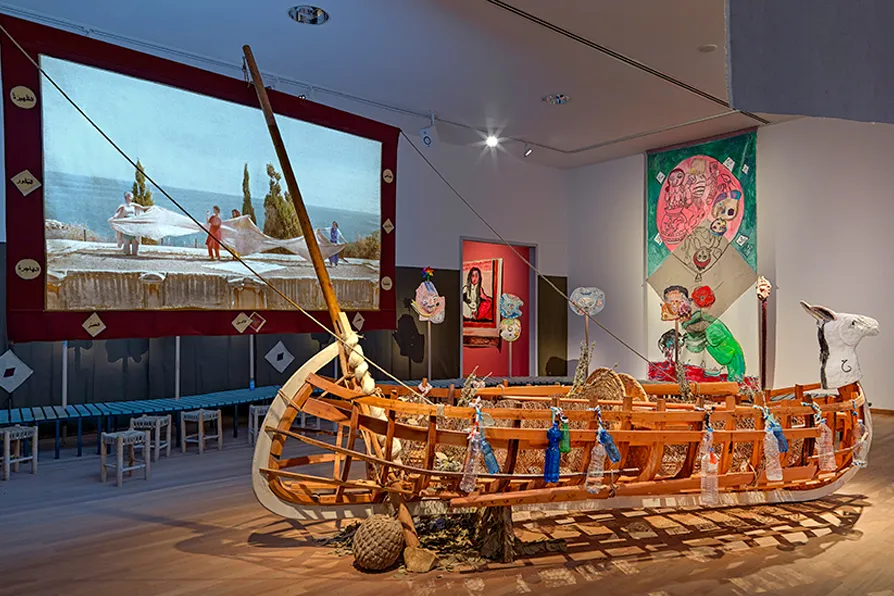
Her reworking of Europa’s abduction by Zeus in the form of a bull dominates the first room, A Dance With Her Myth. A skeletal boat to carry the princess across the sea and a film projected on the sail retelling the myth from a feminist perspective is surrounded by primitive masks symbolising the conservative forces overlooking events. Bold reds, purples and greens dominate the colour palette while the pictures on papyrus round the wall, storyboarding the film, all represent aspects of her cultural and historic heritage. Paintings of Zeus tied to Europa’s back or borne aloft in a vase with an Atlas-like depiction of the Phoenician princess also revisit and subvert the myth with obvious humour.
The story is returned to and updated in the last room, Europa’s Bedroom, where Al Solh’s playfulness is clearly evident in a domestic scene of the god’s household once he has the princess back home. Inverting traditional depictions, an incomplete statue of Zeus is hard at work ironing while the more human figure of Europa reclines on a bed, smoking a hookah pipe.
The feminisation of epic male narratives continues in “Elissa’s Room” where the queen (later known as Dido) who fled from Phoenicia (now Lebanon) and founded Carthage is the subject. Al Solh’s down-to-earth response to her supposedly committing suicide at the loss of her lover — “What sort of nonsense is that!” — is explored with an elongated tomb decked with traditional items and framed by two lighthouses representing those in Beirut.
A bold stylised painting of Elissa, proud of her sexuality, overlooks the tomb while an image of the women she brought with her stand on guard, warrior-like on the tops of similar lighthouses.
Al Solh’s keen interest in music and its “impact on the soul,” is at the heart of some of the other rooms with her celebrated, three-dimensional triptych — Flying, Clapping, Grooving, Tasting Love, Drieluik — being a representation of clapping as fundamental to Arabic music. A vivid depiction of solitary dancers lost in movement and a hand of many fingers is again streaked with strong colours such as the royal purple originally from Murex shells and vital to Phoenician trade.
Other works also reflect on the importance of music to Al Solh and her memory of a popular song that was frequently played on the radio between news of the war and bomb alerts. From Beirut To Saida, Ya My Eyes is a long canvas of people swayed by the music and thoughts of love, while missiles fill the air above. For her: “Music remains an intrinsic part of us during migration.”
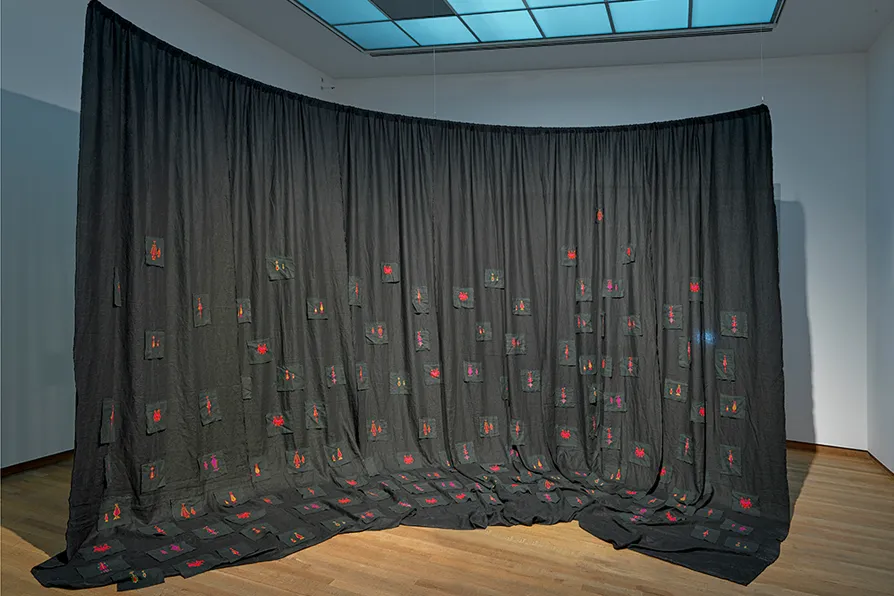
Al Solh’s interest in collaborative work is also evident in her more recent Red Cyprus Tree, created with the assistance of Palestinian refugees. Various women from the ravaged towns of Gaza established a group to preserve Palestinian embroidery techniques. These skills are illustrated in numerous red embroidered patches showing a tree symbolising life and grief. The images representing different towns and villages in Palestine are dotted over a vast black curtain as a symbol of hope in a devastated land.
Image
Although the exhibition’s subjects are traditionally seen as the victims of violence, Al Solh injects life and energy into her subjects retelling their stories from a fresh, vital perspective and, in so doing, rehumanises those too often objectified in mythical accounts and factual analyses of war.
This exhibition will hopefully introduce a wider audience to Al Solh’s dynamic and colourful work, that shines a light in the darkest of places. In the library and workroom at the end of the exploration there is also a chance to see some of the artist’s influences and to create images for ourselves, subverting other myths, to hang alongside Al Solh’s.
Runs until May 24, admission free. For more information see: arnolfini.org.uk

Similar stories
APURBA CHATTERJEE explains how British artists in India used the “picturesque” to reshape colonial landscapes and celebrate imperial power
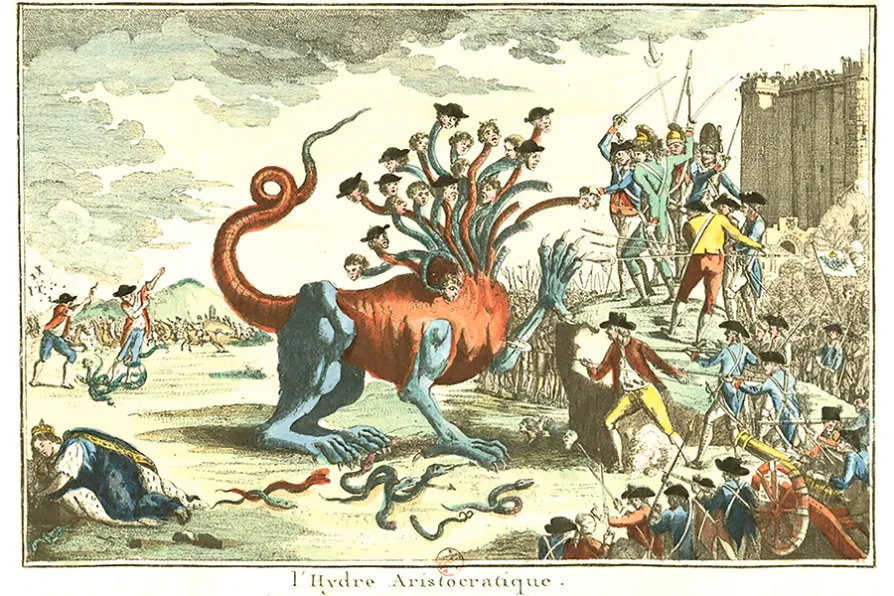
Before Greek myths reached the multiplex, they were weapons of political satire. CALLUM SMITH explores the evidence
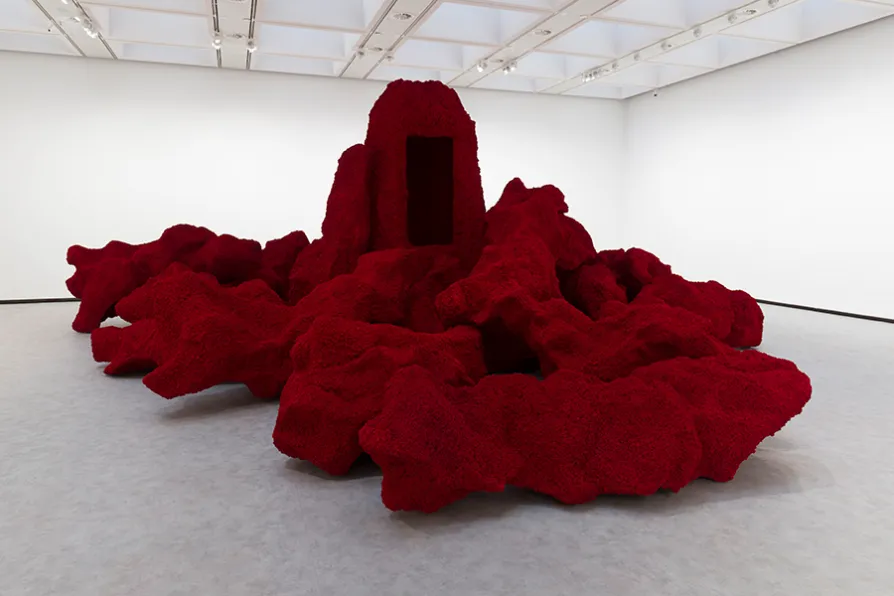
SIMON DUFF is thrilled by a visceral, no-holds-barred exploration of the expressive powers of raw material
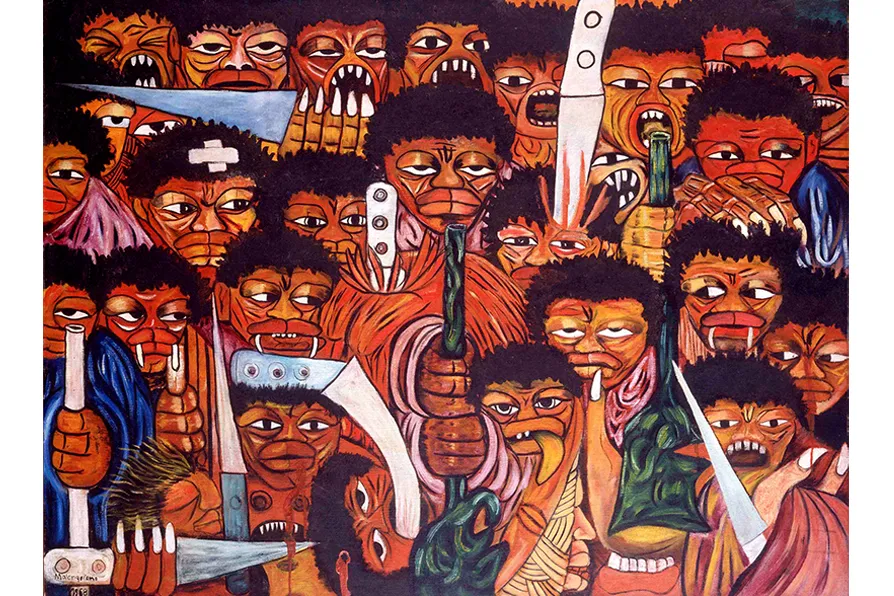
JOHN GREEN welcomes a remarkable study of Mozambique’s most renowned contemporary artist