ANDY HEDGECOCK and MARIA DUARTE review Late Fame, The Death of Robin Hood, Leviticus, and Gail Daughtry and the Celebrity Sex Pass


 Latest editorial

The Good Life, Cicero-style
MARTIN HALL examines the way the Roman orator took on different schools of philosophy
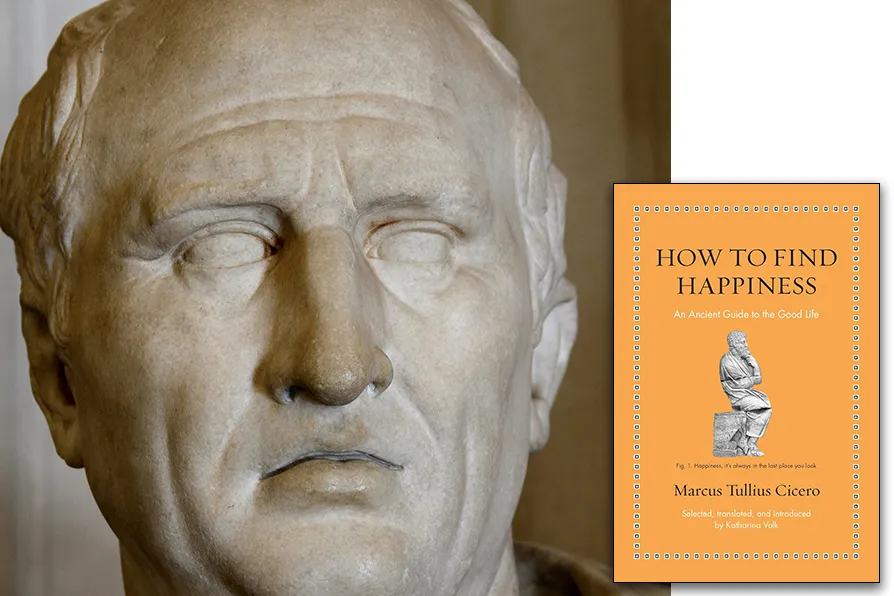 Roman statesman, lawyer, scholar, philosopher, orator, and writer Marcus Tullius Cicero [Pic: José Luiz/CC]

GORDON PARSONS enjoys Kant’s ‘mind-boggling’ theory of human reality: that we create the reality we experience
DAVID RABY welcomes a biography that emphasises how Fidel’s unique characteristics became hallmarks of the ongoing Cuban revolutionary process
IAN SINCLAIR recommends a readable, if partisan, account of the astonishing campaign of New York's new mayor
MATTHEW HAWKINS witnesses a contemporary ballet that represents human life as subjected to artificial intelligence
by Marwa Paikan





How to Find Happiness: An Ancient Guide to the Good Life
by Marcus Tullius Cicero, translated by Katharina Volk, Princeton University Press, £14.99
A NEW translation of Cicero presents some interesting questions for the philosophically inclined contemporary reader. What does he have to tell us about ethical questions today? Is he an interesting stop on the road from Aristotle to modern virtue ethics and moral philosophy after Anscombe and McIntyre?
But more of that shortly. Firstly, the basics: what we have here is a new translation of four of the five books of On the Greatest Good and Evil (45 BC), which is Cicero’s taking on of three of the principal philosophical schools of his day: Epicureanism, Stoicism and the Old Academy of Antiochus. The latter book is what is missing, based on the somewhat quixotic argument that no-one has heard of it today, which we might want to suggest is an example of the logical fallacy known as begging the question.
Cicero’s method is consistent and follows a particular dialogic structure: someone presents an argument in favour, then Cicero critiques it without setting up a countervailing argument in full. This stems from Cicero’s adherence to the Sceptical Academy and the return to the Socratic method that had happened a couple of centuries earlier. Normally, a Sceptic would argue both sides (a technique known as in utramque partem disputare) but here Cicero gives the “pro” role to others.
So, what’s it about, should it not be obvious from the title? There are two related concepts: eudaimonia in the Greek (“happiness,” “flourishing” or “blessedness” and used in adjectival form for one of Aristotle’s two major books on ethics) and the summum bonum in the Latin (the greatest good).
Of course, these topics had been central to philosophy since Aristotle. What was different in Cicero’s time was the dominance of two such opposing schools, neither of which was aligned with the Aristotelian tradition: Epicureans argued that pleasure (which is not the same thing as eudaimonia) is the summum bonum; whereas Stoics posited that virtue and moral goodness was the way to that state.
In the first book, the proposer of the Epicurean position is Lucius Manlius Torquatus, who has all the enthusiasm of youth, proselytising passionately. What we learn is that pleasure might actually be viewed in its negative form by Epicureans: as freedom from pain. This means that sometimes pleasure must be foregone to prevent pain down the road, and secure greater pleasure in the future. Epicureanism is therefore not identical to hedonism.
Cicero then attempts to demolish his young friend’s argument. He opines that calling “pleasure” “freedom from pain” goes against how we commonly use the term. He alludes to the concept’s disreputable position in Roman society. Finally, he talks about the importance of virtue and goodness, neatly taking us to the third and fourth books.
Cicero’s interlocutor in this one could not be more different, as translator Katharina Volk makes clear in the introduction. It is Cato the Younger: an arch-conservative politician, presented in the dialogue as difficult and pedantic. We learn that Stoicism is more complex, with a more technical vocabulary. Cato presents us moving from a state of natural interest in our wellbeing to a realisation that – by way of example – health, strength and a good reputation are not goods in themselves; rather, the pursuit of them in full knowledge of their importance is. Good here then relates to intention, more of which once we’ve noted Cicero’s response.
Cicero’s argument is a version of the emperor with no clothes. He accuses the school of a lack of originality: “Nothing to see here” is the argument, effectively. He states that the only novelty is that the Stoics have changed the terms, using the phrase, “preferred indifferents” to refer to the objects being pursued, with the only real good being intentionality. He also criticises their focus on the mind over the body.
Regarding intention: the Stoics prioritise the subject’s state of mind, whereas Elizabeth Anscombe’s famous argument in Intention (1957) is teleological; it privileges what happens in the world. Stoicism, while generally considered a form of practical realism, does have idealist tendencies, which, if nothing else, makes it quite au courant in 2026. Where it differs is in its insistence that there is an objective world that requires us to act in certain ways.
So, does the student of virtue ethics and moral philosophy need to read this book? Probably not. But it is an interesting exposition of both a technique and a period and will be of interest both to specialists and to lay people.

Similar stories
MARTIN HALL welcomes a plea for greater compassion between believer and non-believer via the framework of philosophical enquiry
BEN CHACKO unpicks the significance of the discovery, in 2015, of ancient texts about Confucius. Was he simply a teacher, or a philosopher, statesman and saint?

ALEX HALL is amused at the way the UFOs appear exactly where commercial interests, conspiracies, militarism and right-wing media overlap

MARTIN HALL welcomes a study of Britain’s relationship with the EU that sheds light on the way euroscepticism moved from the margins to the centre