WILL STONE samples the 20th anniversary atmosphere of this eclectic end-of-season indie festival


 Latest editorial
Patti Smith, Laurie Anderson and Beverly Glenn-Copeland
WILL STONE wallows in a triple helping of classic US protest music
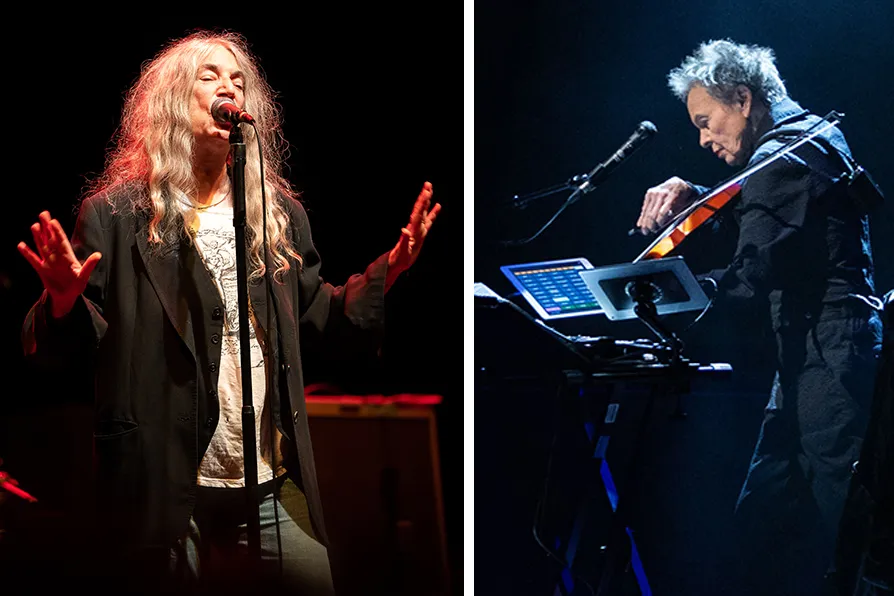 LEGENDS: (L) Patti Smith; (R) Laurie Anderson [Pics: Tom Dumont / Courtesy of Brighton Festival]

Comics are not just superheroes and spandex – it can be public art, telling public stories, suggests HARRIET EARLE
The bard serenades the Diggers of Wigan and their festive followers
ALEXEI SAYLE speaks to Angus Reid about a lifetime of protest, how to hone political art – and what to do now
ANDY HEDGECOCK, JAMES WALSH, LEO BOIX and MARIA DUARTE review Just An Illusion, Everybody Digs Bill Evans, Blue Film, Oasis: Don’t Look Back in Anger, and Runner
MARIA DUARTE recommends a nerve-wracking reconstruction of the 72 hours before the Normandy landings





BRIGHTON Festival’s 60th anniversary edition has pulled out all the stops to stage some of the biggest names in music. Three legendary artists in particular have roots in protest music and who all perform exclusive sets for the landmark occasion.
Patti Smith headlines a two-night residency that sees the legendary US singer-songwriter, poet and author perform with her quartet before hosting a special “evening of words and music” in a more intimate setting.
“This one’s for all the children of Palestine, Lebanon and Iran,” Patti tells the crowd as she launches into Peaceable Kingdom. She co-wrote the song with bandmate Tony Shanahan in 2003 as a tribute to Rachel Corrie, the 23-year-old US activist crushed to death by an Israeli bulldozer while protecting Palestinian homes.
Patti’s voice is as powerful and resonant as ever at the age of 79, belting out Ghost Dance, Break It Up and Because The Night with gusto, while she frequently finds ways to re-contextualise her music to present-day crises as only a punk poet can.
She dedicates Wing, often described as a hymn of mourning, to the three women drowned at sea off Brighton beach.
And her timeless protest song People Have The Power finds stark new meaning in the context of a warmongering US president and the draconian criminalisation of protest at home. This classic sees Patti joined on stage by her daughter Jesse Paris Smith, on keys, and son Jackson Smith, on guitar, for a moving and celebratory encore.
From the godmother of punk to the godmother of the New York avant-garde scene, Laurie Anderson, a former guest director of Brighton festival, performs her latest show The Republic Of Love.
The project, about the relationship between government and love, written for a Vienna-based festival themed around the rise of fascism in Europe, sees Laurie continuing to reinvent the gig.
Part spoken word, part experimental music, part visual art presentation, Laurie’s multimedia, immersive performance lecture invites us to question whether governments and love have anything to do with each other.
As if to exemplify their differences, she begins by projecting a list of words banned on federal websites by the Trump administration. These largely relate to diversity and inclusion and include words like anti-racism, equality, marginalised, under-represented and climate change, and even black, women, queer and minority.
In this context, she often frames love as a revolutionary counter-force to state power while the set, which reinterprets some of her best-known songs like Big Science and Language Is A Virus, acts as a celebration of freedom.
Modern technology is also utilised, often in humorous ways, such as when she reimagines the pastoral Swedish upbringing of her grandfather Axel Anderson through the use of AI, and a wonderful dream sequence about a conversation with a smoking Sigmund Freud.
She later shares her three core rules for living, developed with her late husband Lou Reed: don’t be afraid of anyone, get a really good bullshit detector, and be really tender.
And in honour of Lou Reed, who loved tai chi, she guides the entire audience in a mini tai chi lesson in place of an encore. The project’s conclusion then is a meditative call for community.
On a par to the talents of Patti Smith and Laurie Anderson, but only recently recognised, is Beverly Glenn-Copeland. Finding fame in his 70s after 30 years of relative obscurity, the black trans elder, now aged 82 and recently diagnosed with dementia, has rich musical influences inspired by everything from spirituals and gospel music, folk, ambient electronics, classical, jazz, Afro-futurism and his own Buddhist practice.
He is joined on stage by keyboardist and live musical director Alex Samaras, who fills in for his wife and long-time collaborator Elizabeth Glenn-Copeland, as they showcase tracks from latest album Laughter In Summer.
A singular singer-songwriter with a unique, soaring tremulous voice, Glenn Copeland’s music is deeply spiritual and can inspire tears of sorrow and joy in equal measure.
There’s the bitter-sweet Ever New and the life-embracing Let Us Dance, where Samaras, whose interaction with Glenn-Copeland is both tender and playful, initiates the collective voice of the audience in a touching call and response.
Joined by the queer-led F*Choir towards the end of his set, Glenn-Copeland finishes with the powerful Stand Anthem — a resolute call to environmental and social action.
This year’s festival is the first in 16 years to ditch the guest director system and be curated in-house under Brighton Dome’s new chief executive Lucy Davies.
The approach has been highly successful, with the festival’s first-ever original in-house theatre production, starring actor Arinze Kene in the one-man show Kohlhaas, proving to be a triumph.
Brighton Festival runs until May 25. For more info visit brightonfestival.org
