The greatest threat to democracy may no longer come from political parties but from unelected tech oligarchs like Peter Thiel and his powerful Silicon Valley network, argues JOHN GREEN


 Latest editorial
Into a post-Starmer era: Labour’s power struggle has begun
The collapse of Streeting’s leadership challenge and an opening for Burnham’s potential path back to Parliament have accelerated the battle over what – if anything – Labour still stands for, writes ANDREW MURRAY
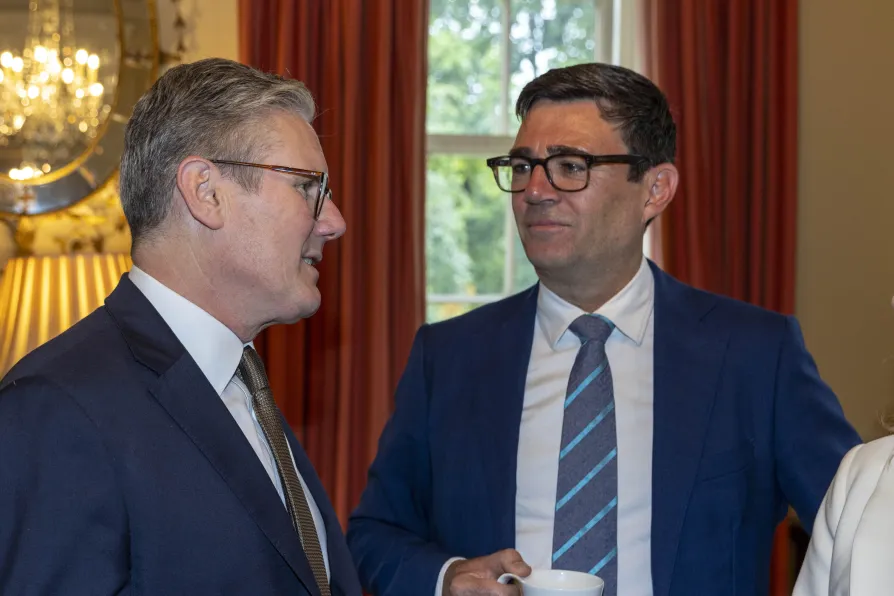 Prime Minister Keir Starmer (left) and Mayor of Greater Manchester Andy Burnham, during a meeting with English regional mayors, at No 10 Downing Street in Westminster, central London, July 9, 2024
Today’s interconnected conflicts are enriching the arms industry while pushing the entire world towards permanent militarisation, argues ROGER McKENZIE
by Nana Backland, Merseyside Morning Star Readers & Supporters Group
The government’s Pip review looks like a carefully managed exercise in legitimising future cuts to disability support, argues Dr DYLAN MURPHY
The Tories introduced the 50% strike ballot threshold to make industrial action harder. MATT WRACK argues that a Labour government has no justification for leaving it on the statute book





AS THURSDAY broke, Wes Streeting was health secretary and poised to challenge Keir Starmer for the Labour leadership, Angela Rayner was under the cloud of her tax affairs and Andy Burnham was stuck in Manchester with no obvious way back to the House of Commons.
By evening, none of those things were still true. And the prospects for the government and Starmer’s misleadership of it were upturned.
First, Streeting. The Health Secretary has been anointed as the Blairite successor to Starmer for years. He is at least as right-wing as the Prime Minister, but more charismatic and a far better communicator.
Streeting is advancing the privatisation of the health service he superintends and is a career-long advocate for Israel, although he has been endeavouring to tiptoe away from the latter position — that and his long-standing intimacy with Peter Mandelson.
His apparently reckless conduct over the last week has been driven by the knowledge that his window for succeeding Starmer is narrow.
That is down to an omission by Labour’s right wing. It has floated the idea that, when Labour is in government, any vacancy for the leadership should be filled by the members of the Parliamentary Labour Party alone — returning to the system which prevailed before 1981.
However, they never managed to secure Labour conference endorsement for this plan. Had they done so, Streeting would have been a shoo-in. But the final decision is still in the hands of the membership.
There, as polling this week confirms, Streeting would run second to any candidate to his left. That would not be someone from the socialist left, since it is almost impossible for such a candidate to get the support of required 20 per cent of Labour MPs, mostly hand-picked by Morgan McSweeney, to go further.
Still, Streeting would lose if the members get involved. So his only hope was to bounce Starmer from office on the back of the catastrophic results of last week’s elections, while Burnham was still out of the Commons and Rayner grappling with stamp duty.
He thus went far enough in undermining Starmer to make his own continuation in the Cabinet impossible, but still failed either to force him to quit, or to secure the backing of the 81 MPs needed to provoke an immediate contest.
Given the right-wing composition of the PLP, why did he not reach the magic number? In large part because the experienced factionalists of the Labour right believed they would end up in a worse place than they are now with the wretched Starmer.
Remember, for these people, keeping Labour out of the hands of even the softest left is their political alpha and omega. They are not in politics to do good, they are there to do in socialists.
Veteran Labour right organiser Luke Akehurst MP made their concerns plain: “The risk of initiating this process is the outcome isn’t Wes Streeting becoming PM. It’s a candidate from the left of the party and six years of hard work will be destroyed.”
Thus Streeting’s sharp turn on Thursday towards ingratiating himself with Andy Burnham, advocating for the return to Parliament of the one candidate who he could not remotely hope to defeat in a leadership contest. He had boxed himself in.
Right on cue, one of the leading acolytes of the McSweeney faction, the architects of Labour’s present predicament, made a present of his constituency to Burnham.
Josh Simons, forced out of government because when director of Labour Together he ordered the snooping on and smearing of journalists probing his faction’s misdeeds, announced he was quitting his Makerfield seat, in Burnham’s Greater Manchester bailiwick.
There are any number of good reasons for Simons to leave politics for ever, but the one he chose was to make room for Mr Mayor. His motives must be questionable, and no way is it a great look for Burnham in the opinion of many.
That clears the first hurdle to the mayor’s ambition to become the next prime minister.
The second — being allowed to stand by Labour’s national executive — also appears to have been surmounted.
Starmer no longer has the political authority to block him from standing, as he did in Gorton and Denton earlier this year.
So it is all up to the voters of the former mining communities in Makerfield. Simons’s majority was only 5,000 in 2024 and Reform UK won every single ward in the constituency in last week’s elections, polling around 20 per cent more than Labour.
Burnham is far more popular than his party, for sure. Perhaps the voters of Makerfield will feel flattered to be choosing the next prime minister, or perhaps they will resent being taken for granted as pawns in a larger game.
Maybe they will prove to be so disgusted with Labour in government that even Burnham cannot overcome the hostility. We will find out.
If Makerfield goes off script, Labour is back where it started, contemplating a Rayner-Streeting showdown, since the voters of that constituency can block Burnham’s advance but it is beyond anyone’s power to bring Starmer back from the dead.
The next assumption is that as soon as Burnham is returned to Parliament, he will demand the leadership from Starmer and walk unopposed into No 10. That is questionable.
The deluded premier may dig in and try to force a contest in which, as the incumbent, he would automatically be on the ballot paper. Rather more likely he will have to throw in the towel, since he is drained of all authority and grip on government.
And even if Streeting has made his peace with Burnham, another overt rightwinger like Home Secretary Shabana Mahmood or Foreign Secretary Yvette Cooper may argue the toss. So there would be an election, further prolonging the government’s effective paralysis, incidentally.
At that point, if not earlier, it would be time to ask — what does Andy Burnham actually stand for? His record as a Labour MP and a minister was conventionally right wing.
He stood unsuccessfully for the Labour leadership in 2010 and 2015. In the second contest he loudly announced he would take no trade union funding for his campaign, which he launched from a City institution.
Burnham has been described as being “on a journey” for so long he might as well be Marco Polo or Odysseus. The destination is still moot.
He is, by common consent, an amiable and relatable man, and he has been a good mayor of Manchester, although the city’s skyline, increasingly choked with high-rise apartment and office blocks, suggest property developers have not found him especially challenging.
Also, he is popular, even if only because he has been at arms-length from the weekly calamities of Labour in government. Many on the left genuinely see him as the only politician who could see off the existential threat of Nigel Farage in 2029.
Burnham has a publicly stated commitment to proportional representation which would provide another serious barrier to a far-right ascendancy. However, it must be rated improbable that he would be able to get such a change through this parliament in time, despite it being Labour Party policy.
He has vaulted ahead of Angie Rayner as the soft-left alternative to the status quo, with Ed Miliband no more than a lurking rumour.
Rayner, cleared by the tax authorities and increasingly bold in her criticisms of the leader she served as deputy for five years, has made it clear that she would back Burnham were he available and would only stand to block a Streeting ascendancy which is not now happening.
Some of the socialist left is considering running a candidate at least to get their arguments for a substantive change of course heard amid the clamour. As noted, a left candidate could not get on the ballot paper but could raise the policy debate, particularly if they started early.
Several names are mentioned — Richard Burgon, Ian Lavery and Bell Ribeiro-Addy among them.
Anyway, it is Burnham’s moment. McSweeney is gone, Mandelson disgraced, the right split and Starmer sinking into the obscurity from which Labour Together should never have retrieved him for their own dishonest factional purposes.
But is the party of genocide support, of militarism, of Treasury rules and welfare cuts, of pandering to Trump, Israel and the City salvageable?
Tim Stanley of the Telegraph put the case against very pithily amid the chaos this week: “Labour cannot fix us because it cannot fix itself, because it is a hangover of a 20th-century party that no longer enjoys a class basis or a mobilising philosophy.”
That is the challenge in a nutshell. We know that Starmer wasn’t up to it, and that Streeting would have been still worse.
Over to Makerfield for a red wall opinion on the most pressing question of our time — has Labour a future?
