
PETER MASON applauds the revival, 39 years later with the same team and cast, of Manfred Karge’s version of Brecht’s 100-year-old play, Mann Ist Mann

How social media eclipsed the news
The world of fake news, where people don’t believe what they are fed, will lead to a demand for authenticity, suggests PAUL DONOVAN
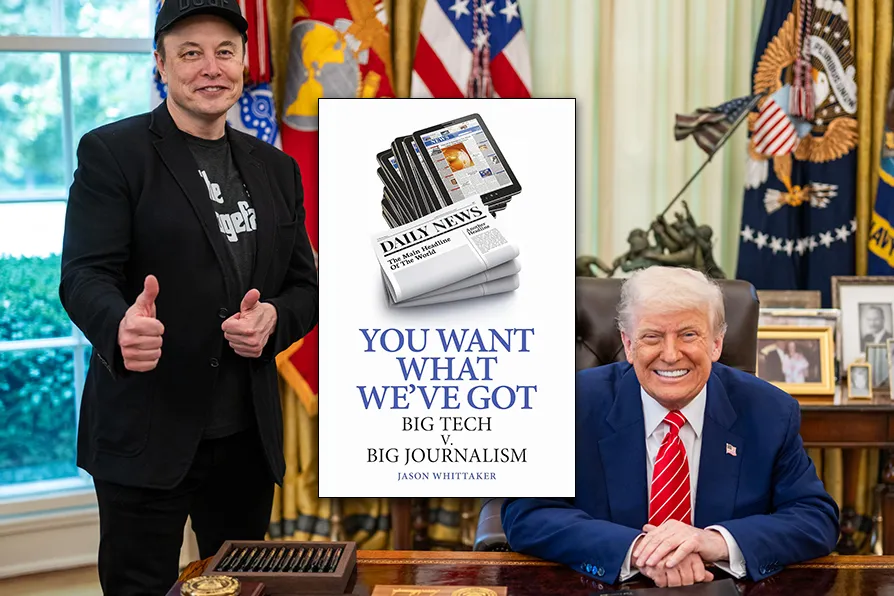
 UNSCRUPULOUS INDIVIDUALS: Donald Trump holds a press conference with departing DOGE adviser Elon Musk, May 30, 2025 [Pic: Daniel Torok/CC]

New releases from Biita Houdei, The Mary Wallopers, and The Tubs
New releases from Biita Houdei, The Mary Wallopers, and The Tubs
MAYER WAKEFIELD applauds a fearless attempt to bring to the stage the 1984 toxic gas disaster in Bhopal, India
ALEX HALL applauds the account of a dogged, traumatic and punishing campaign for justice that has lasted from 1998 to the present day
NICK WRIGHT laments the political bias of an epic attempt to tell the history of the liberation of France from the Nazis, that excludes both the decisive contribution of the Soviet Red Army, and of the French communist party itself





You want what we’ve got — Big Tech v Big Journalism
Jason Whittaker, Reaction Books, £16.99
JASON WHITTAKER has produced a comprehensive and intriguing examination of the media world over recent decades.
He plots how legacy (traditional) media has gone from a position of dominance and power in the early 1990s — with high advertising revenues bringing in big profits — to one of fading influence today.
Whittaker outlines how the growth of Big Tech companies, with the technology but not the editorial content, led to the eclipse of much of the legacy media, and so the scene is set with Big Tech companies rolling forward, swallowing up the content and ads revenue in a brave new world of disinformation.
Whittaker highlights the period after September 11 as being crucial for legacy media, when it effectively lost credibility and so the trust of people. The time of the dodgy dossier and failure to find weapons of mass destruction in Iraq are described as the time when media failed to hold government to account and so became its propaganda wing. This, of course, opened the door to claims of fake news.
Whittaker profoundly reflects that: “Legacy media had poured fuel over the pyre of public trust and credibility. All it required now was an unscrupulous individual with a talent for social media to light the match.”
Enter Donald Trump/Elon Musk.
He then goes onto unravel the free for all that developed. Where legacy media had concepts like balance and objectivity, as well as gatekeepers, the new media saw content as anything that attracts clicks. This would be determined by algorithms, thereby manipulating people’s choices and opinions.
By 2016, 50 per cent of US adults turned to social media, rather than legacy for news.
The evolution of the likes of Meta, Google, Twitter (later X) and Microsoft all come in for scrutiny.
The final stages of the book enter the debate on AI. Interestingly, Whittaker views the technology as a possible aid to journalism if used and controlled properly. The need for gatekeepers is emphasised.
What is most interesting about this book is that it points the way to a future for journalism. The world of fake news, where increasingly people don’t believe what they are fed, will lead to a demand for authenticity. If the media can regain trust, in some way, then it can provide that authentic voice. So, there is some hope for the future.
Criticism of this book would centre on its density. It is not an easy read, getting particularly bogged down in some sections, such as the one on AI.
While the thesis is a fascinating one, some of the execution could have done with a lighter touch. All the same, this is an interesting read, that raises many profound questions as to where the world of media and information goes from here.
