The 25th anniversary meeting of the Shanghai Co-operation Organisation in the Kyrgyz capital may offer a glimmer of hope that international relations do not need to be defined by endless confrontation, writes KENNY COYLE


 Latest editorial

The art of law
ANSELM ELDERGILL examines the relationship between law and the humanities
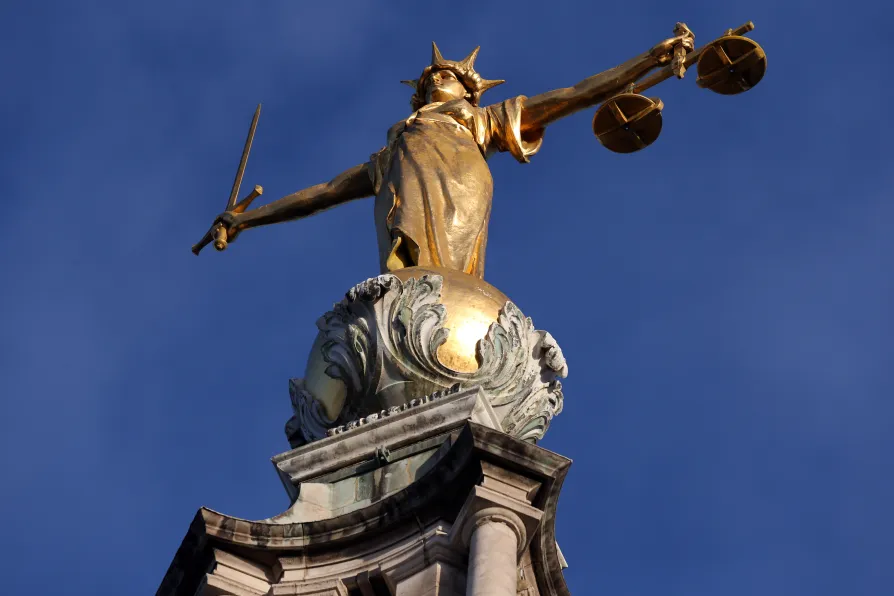 FW Pomeroy's Statue of Justice stands atop the Central Criminal Court building, Old Bailey, London

The artist, who has just died, is embedded in the subconscious of the Palestinian people
The five young men killed in the A66 crash were responsible for a devastating tragedy — but the crash should force us to ask difficult questions about wider society, argues RENATA MEDEIROS MIRRA
The unwillingness of the British political elite to acknowledge that we are on the edge of a direct conflict with Russia leaves the peace movement with an urgent and onerous task
Committee for the Defence of the Iranian People’s Rights general secretary GAWAIN LITTLE discusses the impact of the US-Israeli war on the Iranian people and economy
Capitalism has extracted itself from crisis before, argues PRABHAT PATNAIK – but through methods no longer available. So it is turning to authoritarianism, militarism and neocolonialism





TONY BENN once said of this month’s famous Hay Festival of Literature & Arts that “In my mind it’s replaced Christmas.”
Although not commonly described as such, the law is ― like literature and the arts ― one of the humanities, and many of our legal system’s failings arise from its failure to realise this and to ground itself in the humanistic tradition.
The best lawyers are usually those who did not study law as an undergraduate, but took another career first or came to it after studying the humanities or social sciences. They have a more rounded appreciation of human nature and society and what is of value. Their attention is not narrowly focused on the letter of the law and technicalities, to the exclusion of justice and our duty of common humanity.
Literature and the arts describe and express human feeling and behaviour. They are compass points in a disturbed world. A number of literary works address directly the effects of injustice on individuals or ask us to consider the adequacy and fairness of our legal system.
Harper Lee’s To Kill A Mockingbird and William Faulkner’s Intruder in the Dust, in which three outsiders ― two children and an elderly woman ― seek justice for a black man accused of killing a white man are powerful indictments of legally sanctioned racial injustice and mob rule.
Truman Capote’s non-fiction novel In Cold Blood tells the story of the capture, trial and execution of a pair of drifters. They killed in cold blood, are prosecuted and tried in cold blood, and then are killed by the state in cold blood. All three novels were influential in changing social attitudes and triggering legal reforms.
Kafka’s The Trial begins with the arrest of Josef K on his 30th birthday by two agents from an unidentified agency for an unspecified crime. The crime is never made explicit and he never asks. He is summoned to appear in court and is executed. The explanation lies in Kafka’s remark that “only our concept of time makes it possible for us to speak of the Day of Judgment by that name; in reality it is a summary court in perpetual session.”
Josef K has been arrested not because of his actions, but because of who he is. He is punished for his depravity, not by an earthly court but by a justice system that assesses souls under the eternal law.
The novel therefore examines justice and injustice in everyday life and whether outside the courts people receive justice. Most of us have known an egotistical bully at work who advanced and was rewarded in spite, or because, of it and also deserving colleagues whose merits went unrecognised.
The Trial also requires us, before judging others, to confront our own legal and social crimes that have escaped notice or punishment. It is, after all, not injustice we all fear, but justice.
The “social crimes” it depicts ― the mistreatment or misuse of others within the law for personal gain ― lead us to ask what brand of justice our laws are designed to promote.
Why is it that our laws prohibit and punish minor misdemeanours as “criminal” conduct but permit egregious “social crimes,” deeming them lawful, even commendable? Why is the theft of £5 by a poor person a crime whereas the trousering of billions of pounds by a company that exploits its market dominance and pays its employees minimum wages, or outsources the work to subsistence labour abroad, not?
The Trial contains a famous parable called Before the Law, which a priest tells Josef K as a way of explaining his situation. Before the law sits a gatekeeper. To this gatekeeper comes a man from the country who asks to gain entry to the law, but the gatekeeper says that he cannot grant him entry at the moment. The man from the country had not expected such difficulties, believing that the law should always be accessible for everyone. He waits for admittance.
When, after many years, he is dying, he asks the gatekeeper: “Everyone strives after the law, so how is that in these many years no one except me has requested entry?” The gatekeeper replies: “No-one else could ever be admitted here, since this gate was made only for you. I am now going to shut it.”
The gate has a spiritual aspect, as a gate to heaven, but the parable also has a secular meaning. The gatekeeper’s authority and indifference suggest a bureaucratic legal system that is arbitrary, impersonal and unyielding. The gatekeeper is both a protector of the law and an obstacle to it, capable of perpetuating injustice through arbitrary exclusion.
Charles Dickens’s Victorian novel Bleak House excoriated the convoluted court procedures of the Court of Chancery, which evolved to become part of our High Court. The cancer of excessive legal formalism persists and is the primary reason for the appalling delays in our jury trial and civil justice systems.
Leveson’s misguided, bureaucratic proposals to pare back the jury system will only add to the problem. This huge target was in front of him. He fired, missed and injured an innocent bystander.
Drama is a performing art that combines writing, speaking and body language. The theatre is therefore naturally suited to portraying the law and courtroom scenes, and themes of justice and morality.
A fine recent example is Robert Bolt’s A Man for All Seasons, in which Thomas More stresses the fundamental importance of the rule of law: “This country’s planted thick with laws from coast to coast— man’s laws, not God’s — and, if you cut them down ― and you’re just the man to do it ― d’you really think you could stand upright in the winds that would blow then?”
The law and literature intersect when the law seeks to ban books.
DH Lawrence’s Lady Chatterley’s Lover is an example of a work of literature being banned, and its publication led to Penguin Books being tried under the Obscene Publications Act in 1960.
The Eton-educated prosecutor, Mervyn Griffith-Jones, asked the jurors whether it was “a book that you would even wish your wife or your servants to read?”
Unsurprisingly, he lost and the Permissive Society was launched. The case is a good example of how literature can be a catalyst for legal change.
Nothing beats first-hand experience. However, most people have no wish to suffer or share the experiences of poverty, disease or mental illness, or to eat the legal aid lawyer’s diet of post-mortems, prison life, police stations and acute psychiatric units.
We can at least draw on the insights of great writers to gain a better understanding of our fellow human beings. Read, but not too much law, would be my advice to young lawyers.
Anselm Eldergill was until recently a judge in the Court of Protection. He is a solicitor and an honorary professor at Queen’s University Belfast.
