
The US administration is endangering lives by reversing environmental protection laws, CHAUNCEY K ROBINSON argues

China turns the tables: the slow collapse of US sanctions power
Beijing’s latest response to Washington’s economic coercion suggests major powers are no longer willing to play by Western rules, says CARLOS MARTINEZ
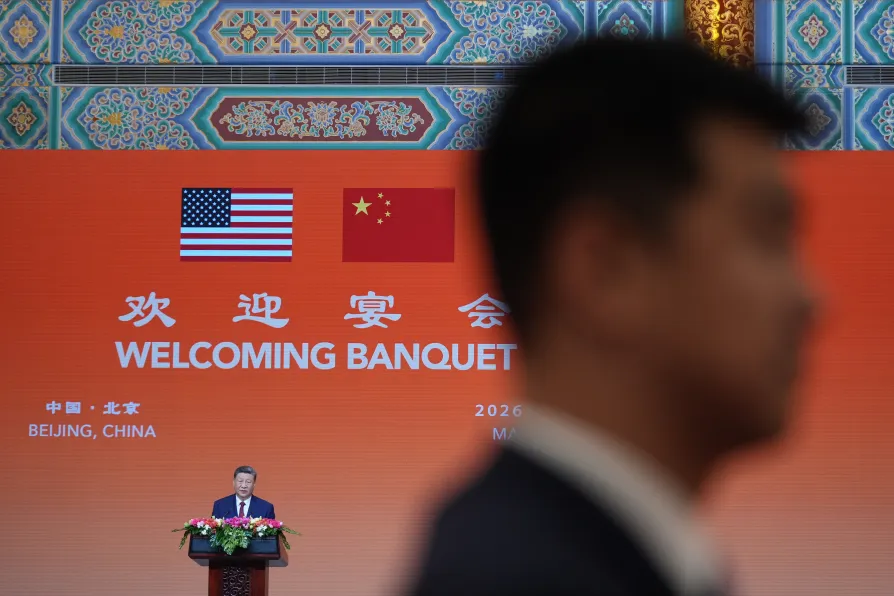
 Chinese President Xi Jinping speaks during a state dinner with President Donald Trump at the Great Hall of the People on May 14, 2026, in Beijing

It’s time to stop retreating and go on the offensive to promote working-class interests, argues DOUG NICHOLLS
Marco Rubio wants to defeat socialism in Nicaragua, not restore ‘democracy,’ writes JOHN PERRY
Believe it or not, there was a time when the US government built beautiful homes for working‑class Americans to deal with a housing shortage, writes ERAN BEN-JOSEPH
DIANE ABBOTT provides an analysis of the reasons for EU and British voters’ dramatic swing to the right
Train drivers’ union Aslef general secretary DAVE CALFE speaks to Ben Chacko about his hopes that Burnham’s devolution agenda will include the importance of the railway





IN EARLY May, the US sanctioned five Chinese oil refineries — four of them small independent operations known as “teapot” refineries — for allegedly purchasing Iranian petroleum in violation of Washington’s unilateral sanctions on Iran.
All five were added to the US Treasury Department’s Specially Designated Nationals (SDN) list, which bars them from accessing the US financial system and penalises any company that does business with them.
China’s Ministry of Commerce conducted an in-depth assessment of this action and concluded that it “constitutes improper extraterritorial application” of US law. It then ordered all Chinese companies, banks and other entities not to recognise, enforce or comply with the sanctions.
This was the first application of China’s 2021 Rules on Counteracting Unjustified Extraterritorial Application of Foreign Legislation and Other Measures, commonly known as the Blocking Rules.
The practical implications are considerable: any bank or supplier that stops doing business with the five sanctioned firms in order to comply with US demands can now be sued for damages in Chinese courts.
As Xu Tianchen, a senior economist at the Economist Intelligence Unit, put it: “If the US sanctions these banks, it will invite harsh Chinese retaliation. If it doesn’t, it means the SDN list is unenforceable.” Washington is caught in a trap of its own making.
This move doesn’t come out of nowhere. Last year, when the US announced a global ban on Huawei’s Ascend chip series — declaring that utilising these processors anywhere in the world violates US export controls — China’s Ministry of Commerce warned that any organisation enforcing the ban would face legal consequences under the Anti-Foreign Sanctions Law, also passed in 2021.
Beijing is constructing, piece by piece, a legal architecture specifically designed to neutralise Washington’s use of sanctions as a weapon of coercion.
Sanctions as a tool of empire
Sanctions have long been one of the primary instruments of the West’s economic coercion. The basic logic is to cause sufficient economic harm to a target population that it either rises up against its government or forces that government into submission — “making the economy scream,” as Henry Kissinger proposed in relation to destabilising Chile’s Popular Unity government.
Cuba has lived under a comprehensive US blockade for over six decades. Venezuela, Iran, Syria, Zimbabwe, Nicaragua, Eritrea, Iraq, the DPRK — the list of countries subjected to this form of collective punishment is long, and the human cost is enormous.
What sanctions also do — and this is crucial to understanding their use against China — is function as a tool of economic warfare, designed not merely to punish but to impede the development of competitor economies.
When the US sanctioned China’s semiconductor industry, blacklisted Huawei, and banned the use of advanced chips in Chinese AI development, the motivation had very little to do with promoting human rights and a great deal to do with slowing China’s emergence as a technology superpower.
London in Washington’s wake
Britain has been a willing accomplice in this long-running campaign. Britain imposed co-ordinated sanctions over alleged human rights abuses in Xinjiang alongside the US, Canada and the EU in 2021.
More significantly, Britain banned Huawei from its 5G networks in 2020 — a decision taken under intense pressure from Washington, despite Huawei equipment being already deeply embedded in British telecommunications infrastructure and despite a substantial body of technical opinion suggesting the ban was based on political rather than security grounds.
The cost to British consumers and to the country’s digital infrastructure has been considerable; the benefit to British interests, non-existent.
This is a pattern. Washington announces sanctions or restrictions; London dutifully follows; the sovereignty of both the target country and of Britain’s own commercial sector is subordinated to the requirements of the Project for a New American Century.
What has changed now is that the targets — most notably China, Russia and Iran — are in a position to actively and effectively resist these measures.
The limits of coercion
Sanctions are ceasing to function as an effective instrument of coercion, particularly against large, strong, cohesive states that fiercely guard their independence.
Russia, subjected to one of the most sweeping sanctions packages in history, has not collapsed; its economy has adapted, its trade has reoriented towards the global South, and it has demonstrated a quite remarkable degree of self-sufficiency.
Iran, as the ongoing war makes clear, has not been brought to its knees by decades of sanctions; it has developed an economy resilient enough to withstand enormous pressure and a military capability formidable enough to inflict serious damage on the most powerful military machine in the world.
China is in an especially strong position. It is the world’s second-largest economy in nominal GDP terms, a manufacturing powerhouse, and a global leader in precisely those technologies — AI, renewable energy, nanotechnology, robotics, advanced manufacturing, supercomputing, space exploration and more — that US sanctions were designed to deny it.
The attempt to prevent China from developing its own chip industry has, as predicted, had exactly the opposite effect: it has accelerated a “whole-nation” drive towards technological self-sufficiency. Huawei’s chips now deliver performance approaching that of Nvidia’s best products.
What China’s Blocking Rules represent is the institutionalisation of this resistance — the construction of a legal counter-architecture that makes US extraterritorial jurisdiction costly to enforce, and gives third parties a concrete reason to resist US pressure.
This has an important impact beyond the borders of the People’s Republic, as it signals that Beijing will not be bound by the US’s illegal, unilateral secondary sanctions.
The era in which Washington could simply decree who the world could and could not trade with, and expect compliance, is ending.
Carlos Martinez is author of The East is Still Red - Chinese Socialism in the 21st Century (Praxis Press).
