A California union’s decision to host a meeting about US policy towards Cuba has prompted a congressional probe and renewed attacks on international solidarity, writes CAMERON HARRISON



Why should we pay for Trump’s wars?
A new wave of austerity is being prepared, and it’s workers who will be expected to pay for it, warns MICHAEL BURKE
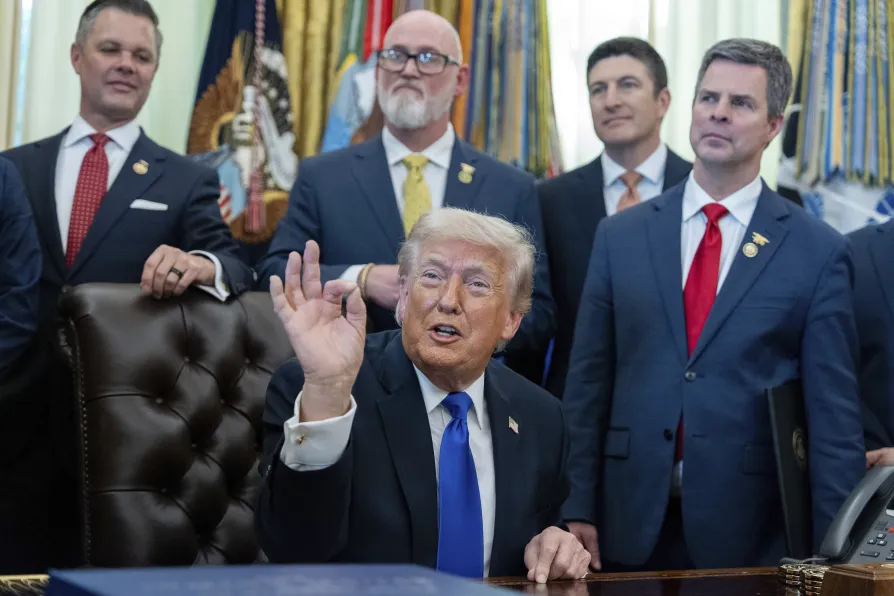
 President Donald Trump speaks in the Oval Office of the White House, April 30, 2026, in Washington
The Baltic state is set to reverse its constitutional prohibition on nuclear weapons and foreign bases as part of accelerated Nato war preparations, warns TOM UNTERRAINER
Long-term underfunding and state neglect, while simultaneously probation services have been undermined, have intensified the prison crises, argues SOLOMON HUGHES
Holyrood incompetence has cost jobs and put the future of Clydeside’s Ferguson Marine shipyard into jeopardy. Its future should have been assured, argues KENNY MACASKILL
With the agitated debate now raging in the media about the early release schemes, Prison Officers Association general secretary STEVE GILLAN gives the view of those who work in the sector
The hounding of the late Jason Arday is an all too familiar experience for many black people. ROGER McKENZIE calls for collective action to combat what can feel like personal isolation





THE leaders of the Nato countries do not expect the current US war rampage to be short-lived. Whatever they might say, they are planning for prolonged war.
That is the content of the plans for sharply increased military spending. They are equally clear that the funding will have to come from existing budgets, chiefly welfare, public services and public-sector pay.
The leading politicians in the Nato countries have already raised their banner, “Warfare, not welfare.” It follows that everyone in the labour movement has a direct interest in opposing both the war drive as well as the intensified austerity that would be needed to pay for it.
The classic “shirkers versus workers” argument must be opposed.
The purpose of cuts to the social safety net are to force workers to accept ever-lower-paid jobs, which is designed to have an effect on all pay.
But there is also the interim period, now where the majority of the populations of the Nato countries is being asked to make “sacrifices” because of the wars that have already begun.
We can see this clearly in the effects of the Iran war. When asked about the impact on the price of gas in the US, Donald Trump repeatedly dismisses it as a small or short-lived price to pay.
Of course, this is because it is not his backers, the oil majors, the big banks, the big tech companies who are paying the price.
The US stock market reporting season shows they are making profits hand over fist. BP has joined them.
No, it is US workers, who mostly drive to work, and other producers who are paying the prices. Naturally, higher prices for key essentials also hurt the Republican Party going into the US midterm elections.
But we have often seen leading politicians sacrifice their party-political fortunes in service of the interests of the ruling class. Keir Starmer’s policies (and their impact on Labour’s standing) are merely a recent domestic example of that.
The price paid by workers and the poor globally for the Iran war is going to be a high one, and much greater than has already been inflicted. Higher oil prices translate directly into higher prices of all foods that must be transported.
At the same time, there is both a scarcity of fertilisers (where liquefied natural gas, LNG, is a key input) and significantly higher prices, which will impact all types of agricultural output and food well into next year’s harvests and beyond.
The IMF already says that “in Africa, food insecurity looms large.”
Steel producers in India and car markers in Japan have already cut production and laid off workers. Of course, Iran itself is in crisis, but that has quickly spread throughout the region. Iraq has had to shut down oilfields because it cannot ship through the Strait of Hormuz, thanks to the US blockade.
Extraordinarily, the UAE, one of the richest countries in the world, has asked the US for an emergency currency swap arrangement because it has run out of US dollars because its oil production is severely disrupted.
It is in oil-poor Asia that the widest disruption will be felt, especially in its less developed areas. US representatives are increasingly explicit that their aim is to break Iran’s oil exports to China, even if that has negative consequences for the entire Asian continent. This has led to increasing US tensions with supposed allies like South Korea.
In Britain, and many of the other Nato countries, there is a degree of dangerous complacency about the consequences of their own actions. The first measurable effect we have had is on inflation.
March consumer prices rose 3.3 per cent from a year ago, accelerating from 3 per cent in February. On the face of it, this is mildly concerning but little more than that.
However, dig a little deeper and the picture becomes more worrying. Consumer price inflation rose 0.7 per cent in the month and petrol prices at the pump rose 9 per cent, with diesel up 12.5 per cent. Overall transport costs are now 4.7 per cent higher than a year ago, which will feed through into the costs of nearly all other goods.
Producer input prices show the cost of crude oil rising by 58.8 per cent. If the burst of global inflation coming out of lockdown is any guide, producers will not absorb these extra costs themselves for long. These are pipeline prices rises, which will make themselves felt at a later date.
In virtually all cases, workers and the poor will be hit hardest by renewed price rises. Unless there is strong resistance, falling living standards will become a prolonged feature of our lives.
To head off unified resistance to war and austerity, their advocates are forced to conjure up a series of phantasms. Just as Hamas was hiding in hospitals, so the US claimed it was facing an imminent threat from Iran, and Venezuelan fishing boats were trafficking narcotics to Florida.
But perhaps the most fantastical of all, and the main European justification for hugely increased military spending is the alleged threat of a Russian invasion of western Europe.
This supposed fear is somewhat belied by the now regular threats to Russia issued by Finland and the Baltic states. Russia and Nato are now close to a stalemate in Ukraine, and soon the war will have lasted longer than World War I.
The idea that Russia is about to sweep through western Europe (despite a population and armed forces that are a large multiple of Russia’s) is pure fiction.
Yet the purpose of this propaganda will be to lead to slashing useful public spending to pay for the war drive. Nato and European political leaders are explicit on this. In Britain, an increase of military spending from 2.3 per cent of GDP to just 2.5 per cent in April next year implies a rise in military spending of £6 billion.
Trump’s demand is that is rises to 5 per cent of GDP, a rise of over £80 billion based on current output. This would be to double military spending when Britain is already the sixth-largest military power in the world.
This is at a time when the economy is weak and set to deteriorate because of the war. Government borrowing is already high enough that ministers are focused on lowering it, so raising borrowing for the war drive is ruled out. Increased military spending can only come from deepening austerity.
This explains both the relentless hectoring of the war party, and why the labour movement has every interest in opposing it.
