NICK WRIGHT laments the one-sided telling of French history in an otherwise entertaining spectacle


 Latest editorial
An awful lot more needs to be said
STEVEN ANDREW praises a beautifully written and enjoyable read
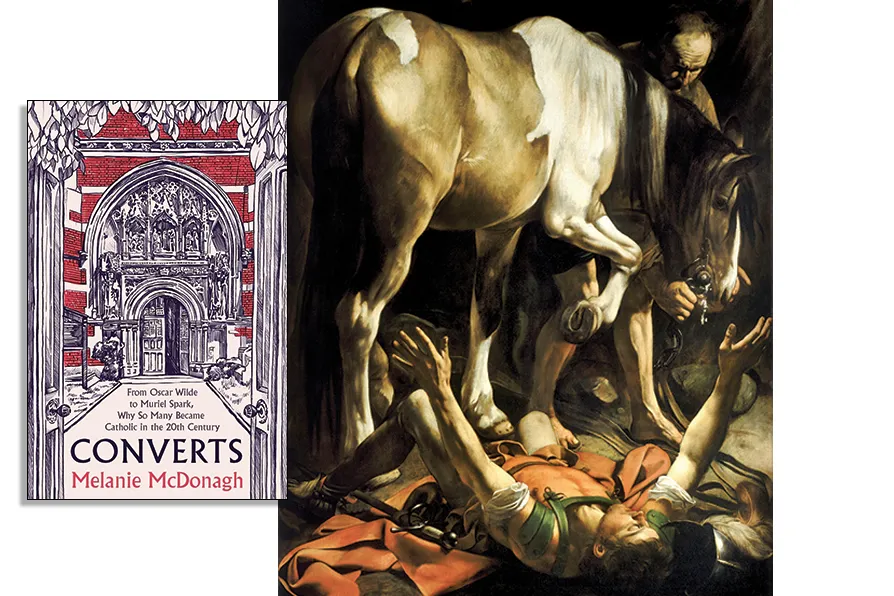 SETTING A PRECEDENT: Conversion on the Way to Damascus (St Paul), 1601, by Caravaggio / Public domain
MARK TURNER relishes the warm, melancholy of jazz drummer-turned composer Sam Green
RITA DI SANTO assesses the winners of the most politically charged festival to date
KATARZYNA KOSMALA introduces a retrospective by one of the most significant figures in contemporary US photography
MAYER WAKEFIELD is entertained but let down by an audacious production that, sadly, doesn't ring true





Converts: From Oscar Wilde to Muriel Spark, Why So Many Became Catholic in the 20th Century
by Melanie McDonagh
Yale University Press £25.00
ONE of the most common assumptions within the social science is that the more that societies grow, develop and industrialise the less religious and the more secular they will be. And in the initial decades of, say, the western industrialised nations there was a fair amount of evidence to support this as an overall thesis.
However, in recent years it would be fair to say that this transition to non-belief is not as universal or unilinear as was once thought.
Critics, have, for example, noted that while decline in organised religion may be evident this is not synonymous with a move away from spirituality which continues to solicit mass interest and take many a different form.
Similarly, in the case of world religions, the most obvious being Islam, belief remains absolutely central to the lives and experiences of millions, probably to a greater extent than it did a few decades ago.
Converts is a recent text that adds to this school of thought, documenting as it does a period in British history from the start of the 20th century to the late 1950s that saw a number of high-profile conversions to Catholicism as well as around 500,000 others about who we still know very little.
As regards the former a fair number were drawn from the arts and intelligentsia, were predominantly from a middle- or upper-class background and were generally English.
A fairly narrow demographic but all the more surprising given the strong association of Catholicism in this period with people from a working-class and often Irish background.
Motives for conversion were so varied. Muriel Spark cited a key gain being insight into the human condition, something which enabled her to become a better novelist.
Eric Gill was influenced by the art forms of Catholicism and by the notions of guilds so central to distributist thought. War-time poet Siegfried Sassoon was undoubtedly driven by the trauma of his military experiences.
It is good that the author does not romanticise the results of conversion either. Both GK Chesterton and his associate Hillaire Belloc were life-long and unrepentant anti-semites.
Evelyn Waugh had a series of affairs, although his comment that he would have been an ever worse individual had he not been a Catholic might well contain more than a grain of truth.
I particularly enjoyed the chapter about Vincent McNabb and McDonagh’s notes about whether he became a modern-day St Francis of Assisi or just a posing charlatan is a debate that still continues.
Politically, it was an incredibly diverse milieu, attracting both the left and right, although to what extent conversion to Catholicism played a role in this is hard to know.
Taken as series of pen portraits, Converts is a beautifully written and enjoyable read. However, in terms of exploring why such conversions took place in this period, an awful lot more needs to be said.
Nodding reference is made to the earlier and quite seminal influence of individuals such as Cardinal Newman, the Oxford Movement and Anglo Catholicism but there’s little else in terms of context.
Related to this, it’s a shame that the book doesn’t really ever mention the increased interest in converting to Catholicism that was happening in other countries at the same time, not least because it involved figures such as the legendary Dorothy Day and, more controversially, French philosopher, resistance fighter and a communist author Roger Garaudy who reconverted to Catholicism in the 1970s.
