NICK WRIGHT laments the one-sided telling of French history in an otherwise entertaining spectacle


 Latest editorial
Fatal attraction
The allies of the US, like our own country, end up dominated and cowed, concludes ALEX HALL
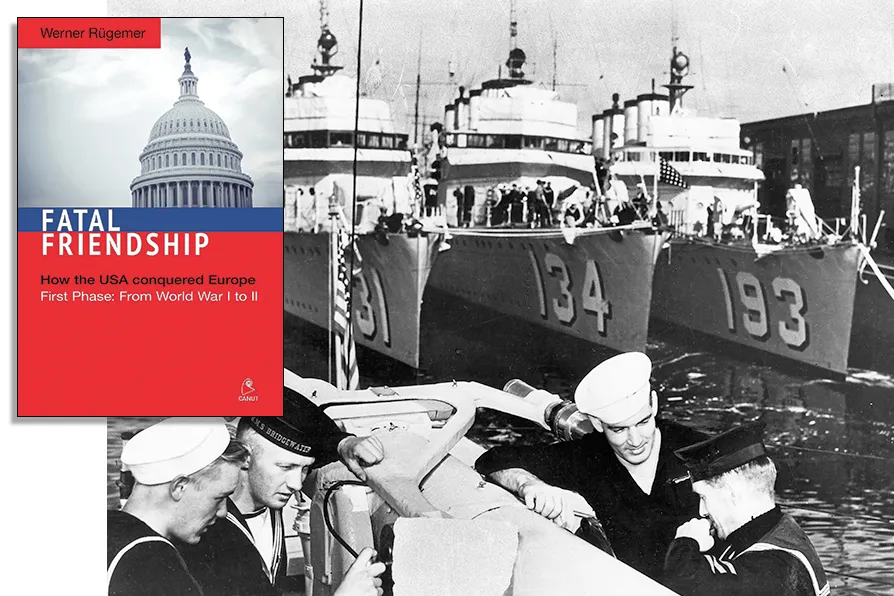 RAW DEAL: Over-age destroyers turned over to Britain in September 1940 in exchange for naval and air bases. The total Lend-Lease cost to UK was £2.2 billion (equivalent to £45.74 billion in 2025) / Pic: National Archives and Records Administration/CC
MARK TURNER relishes the warm, melancholy of jazz drummer-turned composer Sam Green
RITA DI SANTO assesses the winners of the most politically charged festival to date
KATARZYNA KOSMALA introduces a retrospective by one of the most significant figures in contemporary US photography
MAYER WAKEFIELD is entertained but let down by an audacious production that, sadly, doesn't ring true





Fatal Friendship: How the USA Conquered Europe. First Phase:
From World War I to II
by Werner Rugemer
Canut Press International £14.99
IN THE aftermath of a US president threatening to destroy a civilisation overnight, Werner Rugemer’s Fatal Friendship reminds us that while the crude outbursts and impunity of Donald Trump sound novel, the actual policy, and material reality, of today’s US empire is in fact long standing and horribly familiar.
The title is drawn from Heny Kissinger’s oft-quoted 1968 quip that “It may be dangerous to be America’s enemy, but to be America’s friend is fatal.” The implication throughout the book is that while some nations might resist the US, those that roll over are exploited all the same, and often more.
Rugemer’s previous work focuses on corporate power in capitalist states. Fatal Friendship is very reminiscent of William Blum’s America’s Deadliest Export, or any of Noam Chomsky’s historial works.
Some of the surprising facts evoke those revealed in Howard Zinn’s Peoples History of the United States. These authors were exercised initially by the US war in Vietnam. Rugemer takes a similar tack with respect to the US in Europe.
The US is almost the epitome of capitalism. The state came into existence through the settler-colonial process of genocide, and benefitted from commercial slavery. Expansion is part of the internal dynamics of capitalist acquisition, such that Woodrow Wilson insisted that the new nation must batter down the doors of nations reluctant to give access to their markets. Expansion and control were central drivers.
Both WWI and II were massive opportunities for US capitalism to seize larger pieces of the pie. US firms would sell energy, arms, and supplies to both sides. The protagonists of the war, weakened, were less able to resist US conditions. After WWI the US supported the League of Nations, but didn’t join it themselves, not wanting to be bound like other states to its provisions.
After WWII, the US joined the United Nations, but still created a parallel system of treaties and satrapies. The rest of the world got the UN. But the US also had their own “rules based order.”
Both the US and European elites were initially very receptive to fascism in Europe. US
capitalists supported politically and economically Franco, Mussolini and Hitler. The latter was trumpeted as the hammer that could destroy the nascent Soviet Union, itself an existential threat the capitalist world order by example and by intervention.
There are significant parallels between WWII policy towards the Soviet Union and modern US intervention in the Ukraine since 1990, including that preventing energy from Russia reaching European customers.
US firms supplied Germany throughout WWII through branches in Germany or in neutral states like Spain. The Bank of International Settlements remained a conduit for Wall Street until 1945. US firms downplayed the facts of the holocaust that they knew.
Lend-Lease gave most Allies credit arrangements, the Soviet Union (eventually a strategic ally) a notable exception for credit terms.
Allied bombing in Germany focused on civilian areas, and avoided factories and industrial areas, some of which were either ripe for take over or already US investments. The Hiroshima and Nagasaki bombings, further targeted civilian rather than military targets.
In both wars is a maelstrom of capitalist endeavours involving significant state actors, themselves in a revolving door between public office, industry, and the banks.
The forerunner to the CIA had one of its main aims the securing of profits for US companies, and find people to continue the anti-communist struggle.
Rugemer’s work is a synthesis of multiple sources with a roller-coaster narrative of facts and episodes.
The allies of the US, like our own country, end up dominated and cowed. “Enemies” might actually fare better in the long run. And crucially, what we presently see from the US is essentially the same entity with the same overarching policies.
The mask changes; but the fist never does.
