
Tony Benn’s constituents chose him by an overwhelming majority — but because he had inherited a peerage, parliamentary rules declared their choice invalid, writes MAT COWARD


Why do we need the armed forces?
There is no justification for spending colossal amounts of money on so-called defence — sacrificing our education, health and transport while they’re at it, says BERT SCHOUWENBURG
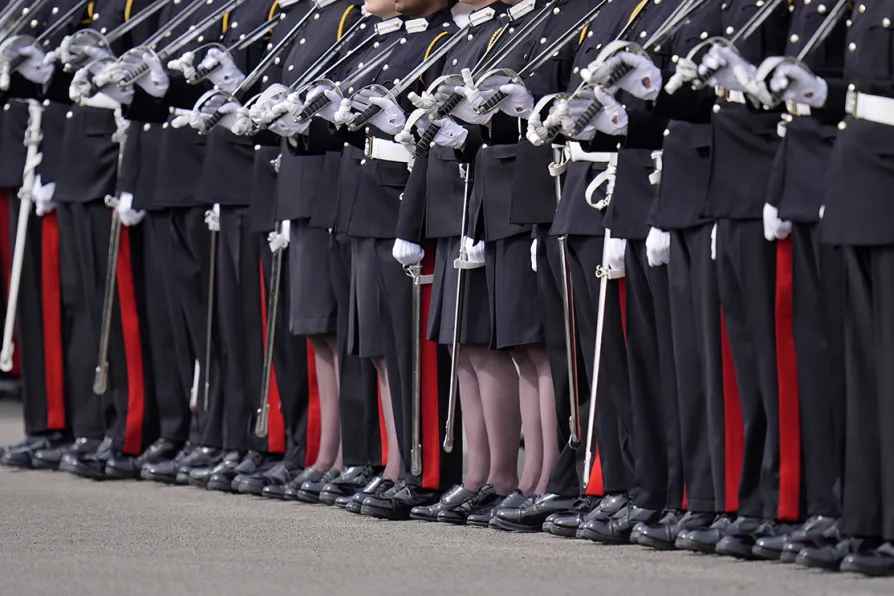
 Officer cadets line up during the Sovereign's Parade at the Royal Military Academy Sandhurst in Camberley, Surrey, April 10, 2026

The real welfare dependency is at the top of our society, says ALAN SIMPSON
Two months of student unrest have forced out India’s education minister and rattled the BJP regime. Could this be the beginning of the end for Modi, asks Communist Party of India (Marxist) general secretary MA BABY
Councillor SAM WHEELER says there’s a tangible shift in mood on the left in the city whose mayor has recently become PM — but there’s no room for complacency
Communist Party leaders Alex Gordon and Lorraine Douglas deliver vital medicines in trip to besieged socialist island
TUC Cymru is playing a leading role in tackling far-right ideas in the workplace, says LAURA DOEL





NEARLY 16 years ago, on June 8 2010 to be precise, in his column for the Guardian newspaper, Simon Jenkins advocated for the complete abolition of the UK’s armed forces. Not just some of it, but all of it: army, navy, air force, overseas bases, the lot. For those who may be unfamiliar with him, Jenkins is not a left-wing agitator but is in fact the former editor of both the now-defunct Evening Standard and The Times, neither of which could be remotely described as radical publications.
The principal reasons for his position were twofold, the first being that the amount of money spent on “defence” was unjustifiable and the second that it was completely unnecessary anyway. Jenkins was particularly critical of Conservative politicians David Cameron and George Osborne who, he said, were young men scared of old generals.
He was equally critical of the New Labour hierarchy and of their defence secretary, one George Robertson, who “bought new destroyers to defeat U-boats, new aircraft carriers to save the British empire and Trident submarines with nuclear warheads so Tony Blair could show off at conferences.” Now Lord Robertson, he has clearly learned nothing in the intervening years judging by his pronouncements on sacrificing welfare spending to pay for more guns and missiles.
In 2024-25, the UK government spent £66 billion on defence, which is 2.3 per cent of national income and more than the £63.7bn for the entire schools funding budget for 2025/26. The amount of money wasted on military procurement is the stuff of legend: aircraft carriers that break down before they have even left port, Ajax armoured cars that make their inhabitants sick and drones that can’t cope with bad weather are just three examples of Ministry of Defence failures.
The two new carriers alone cost over £6bn and have already racked up £1bn in maintenance costs. Undeterred by this catalogue of incompetence, the MoD wants another £28bn over the next four years to put the armed forces into “war-fighting readiness.” After the US, the UK has more military bases around the world than anyone else with 145 sites in 42 different countries.
In Cyprus alone, there are 17 British facilities, the largest of which is Akrotiri RAF base, used for surveillance flights over Gaza to assist Israeli genocide. In the Central American state of Belize, the army has extensive jungle training centres, though what use they are in the defence of the realm is a matter of pure conjecture. There are over 800 military personnel stationed on the Malvinas/Falkland Islands and hundreds of others stationed in multiple locations across Asia, Africa and Europe.
Back in the UK, colossal amounts of taxpayers’ money is wasted on the so-called nuclear deterrent that is in fact owned and controlled by the US. According to CND, the lifetime replacement cost for Trident nuclear submarines will reach at least £205bn when construction, supporting forces, running costs and decommissioning are factored in. As a Nato member, the UK is already committed to spending 2 per cent of GDP on defence each year and Prime Minister Keir Starmer announced last June that this will rise to 5 per cent of GDP for “national security” from 2035, without even consulting Parliament.
The reasons given by politicians to justify the obscene amounts of money spent on weapons of war do not stand up to scrutiny. As Jenkins said in his article, Britain was safer than at any time since the Norman Conquest and is under no threat from anybody. Nato, he said, “is an alliance in search of a purpose.”
The end of the cold war eliminated the supposed threat of the Soviet Union and should have heralded a peace dividend that obviated the need to spend vast sums on weapons of war. Instead, Western imperialism has run riot, launching unprovoked attacks on Iraq, Afghanistan, Yugoslavia, Libya and now Iran and Lebanon. Russia, having been provoked into attacking Ukraine, is once again portrayed as being the enemy and hundreds of thousands of working-class people have been killed and maimed in a futile conflict that is being cynically protracted by successive UK governments and the Von de Leyen regime in the EU.
Simon Jenkins’s article is as relevant today as it was when he wrote it. Britain is under no threat of invasion and there is no justification for spending eye-watering amounts of taxpayers’ money on overseas military bases or on the so-called nuclear deterrent.
A far better use of Britain’s resources would be to scrap the armed forces and engage in diplomatic, cultural and commercial exchanges with other countries to facilitate mutually respectful dialogue with a view to resolving outstanding issues within the framework of international law.
Such an approach would, of course, not find favour with the arms industry who are making vast profits out of the West’s never-ending wars, nor with ridiculous warmongering politicians like Starmer and Defence Secretary John Healey who like nothing better than posing in military uniforms on tanks or warships. All the more reason then for doing it.
