
Tony Benn’s constituents chose him by an overwhelming majority — but because he had inherited a peerage, parliamentary rules declared their choice invalid, writes MAT COWARD


The Easter Rising and the British left
GEOFFREY BELL looks at the curiously unsupportive stance of British progressives of the Easter Rising
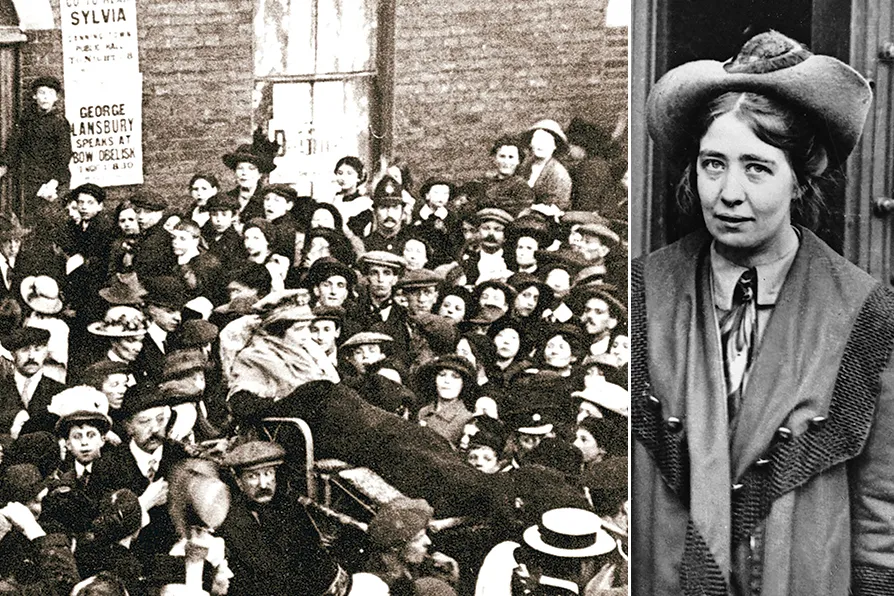
 Sylvia Pankhurst on hunger strike carried by supporters in Old Ford Street, Bow, London in June 1914; Pankhurst in October 1911 / Pics: Public domain
The real welfare dependency is at the top of our society, says ALAN SIMPSON
Two months of student unrest have forced out India’s education minister and rattled the BJP regime. Could this be the beginning of the end for Modi, asks Communist Party of India (Marxist) general secretary MA BABY
Councillor SAM WHEELER says there’s a tangible shift in mood on the left in the city whose mayor has recently become PM — but there’s no room for complacency
Communist Party leaders Alex Gordon and Lorraine Douglas deliver vital medicines in trip to besieged socialist island
TUC Cymru is playing a leading role in tackling far-right ideas in the workplace, says LAURA DOEL





JUST before James Connolly was executed by the British for his part in the 1916 Easter Rising, he asked his daughter, Nora, if she had seen how the socialist press reacted to the Rising. He predicted: “They will never understand why I am here. They forget I am an Irishman.”
Connolly’s pessimism proved correct. Many on the left in Britain were not only critical of the Rising but seemed dumbfounded by Connolly’s participation.
The Scottish left-wing Forward (a socialist newspaper published in Scotland from 1906 to 1959) for which Connolly had often written called it “madness, badness or both.”
Labour Leader of the Independent Labour Party (ILP), the then mass-supported self-proclaimed socialist party, said it would “condemn as strongly as any those who were responsible for the revolt.”
As for the Labour Party, one of its leaders, JH Thomas, insisted: “There was no Labour leader in this country who did not deplore the recent rebellion in Ireland.”
The most surprising response came from the Socialist, the newspaper of the Socialist Labour Party, based mainly in Scotland, of which Connolly had been its first national secretary. It made no comment on the Rising or Connolly’s leadership of it for a couple of years.
Of course, this was when Britain was fighting in WWI, and enlistment supported by the Labour Party and TUC. They were always likely to react critically to this declaration of another war in Ireland against Britain.
Moreover, many of those on the British left who refused to endorse Britain’s enrolment in WWI did so on pacifist grounds, which meant they were hardly likely to endorse armed insurrection in Ireland.
One such pacifist was George Lansbury, editor of the mass circulation Herald, which commented: “No lover of peace can do anything but deplore the outbreak in Dublin.” His political confusion was also apparent when he described the Rising as “fighting between men of the same nation.”
There were exceptions. The British Socialist Party (BSP), which was to provide the nucleus of the Communist Party when it was formed, said that while the Rising was “foolish” and “doomed,” also said it “understood this effort of the Irish people to throw off the alien yoke.” It added, “that when England is abroad fighting for smaller nations … the Irish nation should be as a free as the Belgian people or the Serbs.”
The most determined and well-argued defence came from suffragette and socialist Sylvia Pankhurst and her newspaper, The Woman’s Dreadnought.
Writing in the immediate aftermath of the Rising, Pankhurst argued that “justice can make but one reply to the Irish Rebellion and that is the demand that Ireland should be allowed to rule itself.”
Although she went on to describe the Rising as “reckless,” she added that the “desperate venture was undoubtedly animated by high ideal.” She concluded: “We understand why rebellion breaks out in Ireland and we shared the sorrow of those who are weeping today for the Rebels whom the Government has shot.”
The following edition of The Woman’s Dreadnought dug deeper. This was through an on-the-spot report by Patricia Lynch, a young Irishwoman then working for Pankhurst who went to Dublin after the Rising. She interviewed mostly working-class women in Dublin, while placing the Rising in a political, economic and social context that most of the British left ignored.
Lynch wrote: “Poets and dreamers do not make revolution. There must be popular unrest behind even the … smallest revolt. In Dublin, it is impossible for men and women to live like human beings. The conditions under which they live are more deadly than the trenches, out of every six children born, one dies. Can we wonder that high-spirited men and women seeing their wrongs so ignored have allied their discontent to political reformers?”
The most rounded defence came from afar: from Russia and Lenin. He criticised left critics of the Rising, saying that “whoever calls such a rebellion a ‘putsch’ is either a hardened reactionary or a doctrinaire, hopelessly incapable of envisaging a social revolution as a living phenomenon.”
He insisted: “To imagine that social revolution is conceivable without revolts by small nations … is to repudiate social revolution.”
So, it was possible to understand the involvement of Connolly and the Citizen Army in the Rising in socialist terms. Indeed, Connolly’s own writing envisaged such a participation.
At the start of WWI, he had written that “should the working class, rather than slaughter each other, should proceed to erect barricades all over Europe … we should be perfectly justified in following such a glorious example.”
That example did not arrive, at least until Russia in 1917, but Connolly hoped Ireland could set the precedent: that was beyond the imagination or political consciousness of too many of the British left.
Geoffrey Bell’s books include Hesitant Comrades: The Irish Revolution the British Labour Movement (Pluto, 2016).
