
PETER MASON applauds the revival, 39 years later with the same team and cast, of Manfred Karge’s version of Brecht’s 100-year-old play, Mann Ist Mann

The co-operative path of resistance
SYLVIA HIKINS welcomes a survey of successful contemporary worker co-operatives and economy-based co-operative systems
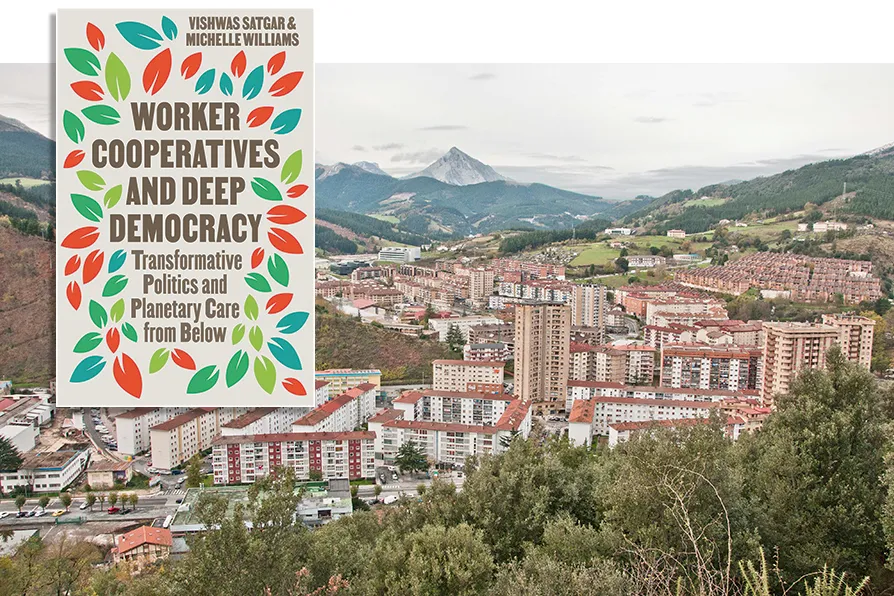
 TO EACH ACCORDING TO THEIR NEEDS: San Andres neighbourhood of Mondragon with the Anboto mountain visible in the background ' Pic: Marisol Murua/CC

New releases from Biita Houdei, The Mary Wallopers, and The Tubs
New releases from Biita Houdei, The Mary Wallopers, and The Tubs
MAYER WAKEFIELD applauds a fearless attempt to bring to the stage the 1984 toxic gas disaster in Bhopal, India
ALEX HALL applauds the account of a dogged, traumatic and punishing campaign for justice that has lasted from 1998 to the present day
NICK WRIGHT laments the political bias of an epic attempt to tell the history of the liberation of France from the Nazis, that excludes both the decisive contribution of the Soviet Red Army, and of the French communist party itself





Worker Co-operatives & Deep Democracy
Vishwas Satgar & Michelle Williams
Pluto Press £19.99
ON THE front cover of this book, the subheading — Transformative Politics and Planetary Care from Below — indicates contents that not only expose the growing planetary crisis but reveals progress some communities are making by developing solidarity-based economics and political alternatives.
Trading has always been part of human society, but not in the form of international capitalism that now dominates. Many people live and work in despair in a system that puts profit and profiteering first rather than promoting care-based alternatives. Many billionaires have disproportionate economic power, stay disassociated from the socio-ecological world, and display anti-social decision making without taking responsibility for their actions.
Based on over a decade of research across 15 countries, Vishwas Satgar and Michelle Williams visited 146 co-operatives, conducted 368 interviews, witnessing first hand schemes that are trying to create a transformed world.
We must remind ourselves that the word politics originates from the Ancient Greek “politikos” meaning of, for, or relating to citizens as well as the state.
Right now, while the rich built themselves luxurious residences, an increasing number of ordinary people are having to live with the reality of floods, landslides, chemical pollution, storm damage, and droughts. This is why transformative politics and planetary care must generate from below. For example, in a mountainous area of Kerala where landslides killed over 400 people, residents are now rebuilding lives and society with a system based on genuine democratic solidarity.
We cannot continue along a path where nations pass laws that can harm both citizens and environments in order to make more money for private companies: a system where billionaires get richer while others struggle to put food on the table.
The co-operatives described in this book take many forms, like grocery stores in the United States owned by members who procure goods only from other co-operatives with similar values such as small-scale farmers in countries as far away as Venezuela and South Africa, who connect deeply with the local environment, share profits equally, and are living proof of the way economies can give priority to social wellbeing as well as planetary care.
Described in deep detail is Mondragon in Spain, State-Civil Society in Kerala, and the Solidarity Economy Forum in Brazil.
Highly readable, this book reveals how, while living in an age where the absurd has become normal, we can learn from contemporary examples of successful worker co-operatives together with economy-based co-operative systems. Every chapter convincingly demonstrates in contrasting ways, the need for action and how it will originate from ordinary folk, workers not millionaires.
It is time for transformational change. Time to rise up and rebel in a co-operative fashion. Satgar and Williams demonstrate how this can be achieved. Go for it. Give the Earth a chance.

Similar stories

ALEX HALL recommends a searing panorama of our global predicament

SYLVIA HIKINS welcomes a an in-depth study of environmental activism that shows how governments work against citizens who put community before profit

ALEX HALL is fascinated by a lucid and historically convincing account of how rent has dominated capitalist economies from feudalism to modernity

SYLVIA HIKINS relishes Jeanette Winterson’s brilliant hijack of 1001 Nights to push aside the boundaries set by others